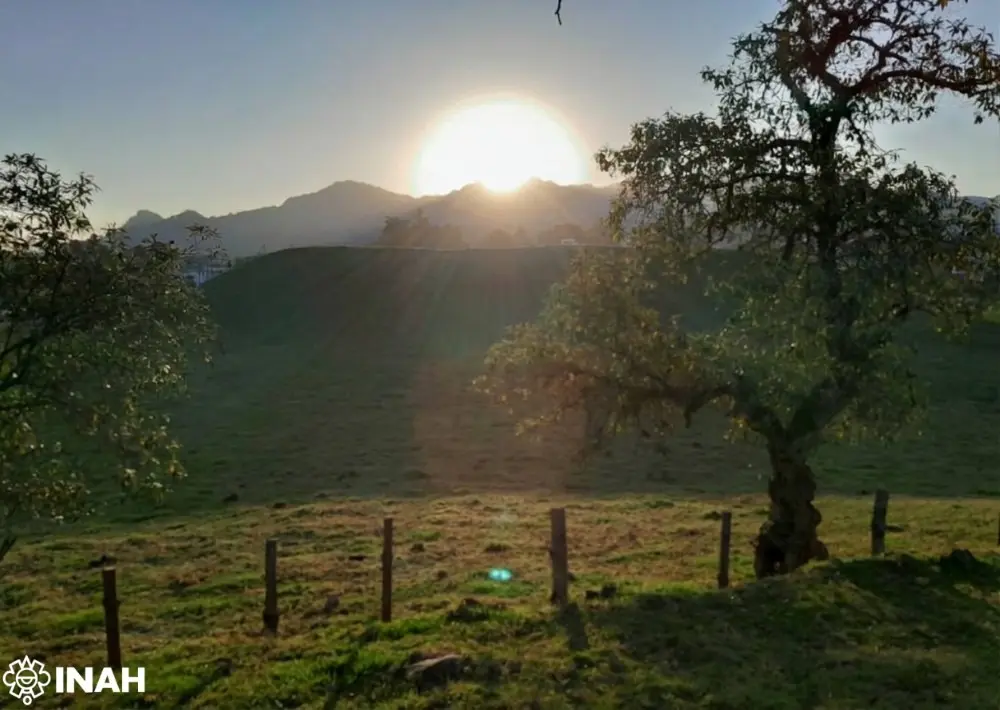
Researchers at Mexico’s National Institute of Anthropology and History (INAH) have announced the remarkable discovery of a 2,500-year-old architectural structure that functioned as an ancient solar observatory. Uncovered at the pre-Hispanic archaeological site of Teteles de Ávila Castillo in the lush Sierra Norte de Puebla, the find sheds new light on the sophisticated astronomical and architectural achievements of early Mesoamerican societies.
The structure has been under meticulous excavation by INAH teams since 2015. According to Alberto Diez Barroso Repizo, the director of the Teteles archaeological project, the site flourished during the Middle Preclassic period, roughly spanning from 900 BC to 600 BC. However, the settlement eventually experienced a significant decline around AD 100, a shift that researchers believe may have been driven by the territorial and political expansion of the nearby and much larger Mesoamerican metropolis of Cantona.
Despite its eventual decline, Teteles de Ávila Castillo played an important regional role during its peak. Diez pointed to the discovery of precious green obsidian beads at the site as a compelling indication of its integration into broader Mesoamerican trade routes. Because the green obsidian originated from a quarry controlled by the much larger city of Teotihuacan, the artifacts demonstrate that Teteles maintained long-distance economic and cultural connections across the region.
Sophisticated Astronomical Knowledge in Ancient Mesoamerica
The newly identified observatory reveals that the architects and inhabitants of Teteles possessed an advanced, highly specialized understanding of astronomy and calendar systems. According to an official statement released by INAH, the complex was deliberately engineered to track critical seasonal milestones, including the beginning of the Mesoamerican calendar in February and the vital harvest period in October.
One of the lead researchers on the project explained that the eastern base of the architectural complex essentially functions as a physical solar calendar. This design was achieved through precise spatial alignment: observations show that the trajectory of the sun aligns perfectly with the front of the structure during the onset of equinoxes and solstices. By integrating celestial tracking directly into their built environment, the ancient builders were able to regulate agricultural cycles, religious ceremonies, and community organization with remarkable precision.
Claudia Curiel de Icaza, Mexico’s Secretary of Culture, emphasized that the discovery significantly broadens the nation’s historical and cultural understanding of its pre-Hispanic heritage. The architecture of Teteles de Ávila Castillo provides tangible evidence of complex societies that developed profound astronomical knowledge and seamlessly wove that science into the daily and ceremonial organization of their public spaces, she noted.
Future Plans for Public Access and Preservation
Following years of careful excavation, conservation, and academic study, INAH is looking toward the future of the site. Diez confirmed that the institute has concrete plans to open the Teteles de Ávila Castillo archaeological site to the general public, allowing visitors to experience the ancient solar observatory firsthand. In addition to opening the site itself, organizers eventually plan to establish an on-site museum dedicated to showcasing the artifacts recovered during the decade-long excavation, including the trade goods, pottery, and ceremonial objects that tell the story of the people who inhabited the Sierra Norte de Puebla more than two millennia ago.