For years, real estate watchers in Clinton Hill and Fort Greene have looked on as historic brownstones and townhouses steadily crossed pricing thresholds that once seemed unimaginable. A decade ago, when local property values regularly began pushing past the $3 million mark, ambitious sellers started testing the upper limits of the market with extraordinary and exceptionally large properties. The results of these high-stakes gambles were often mixed, reflecting a luxury sector that was still finding its footing.
In 2015, a former union hall turned artist’s residence at 315 Vanderbilt Avenue sold for $7.2 million. While that figure established a new neighborhood record at the time, it fell far short of the property’s initial $8.5 million asking price. Similarly, a standalone mansion at 405 Clinton Avenue—originally built for a Brooklyn mayor—was listed for a staggering $9.85 million in 2014, only to fetch $6.5 million. When that same historic property changed hands again in 2023, the price dropped further to $5.69 million.
Perhaps no property better encapsulates the volatility and eventual triumph of the upper-bracket Clinton Hill market than the famous Pfizer mansion. Located at 280 Washington Avenue, the 10,000-square-foot architectural stunner sold for $7.2 million in 2015. Three years later, it returned to the market seeking $13 million before ultimately setting a neighborhood record of $9.05 million in 2021. Yet, even premier properties remain subject to market corrections; after returning to the market last year with a $10.3 million asking price, the Pfizer mansion ultimately sold for $7.8 million in May, according to public property records.
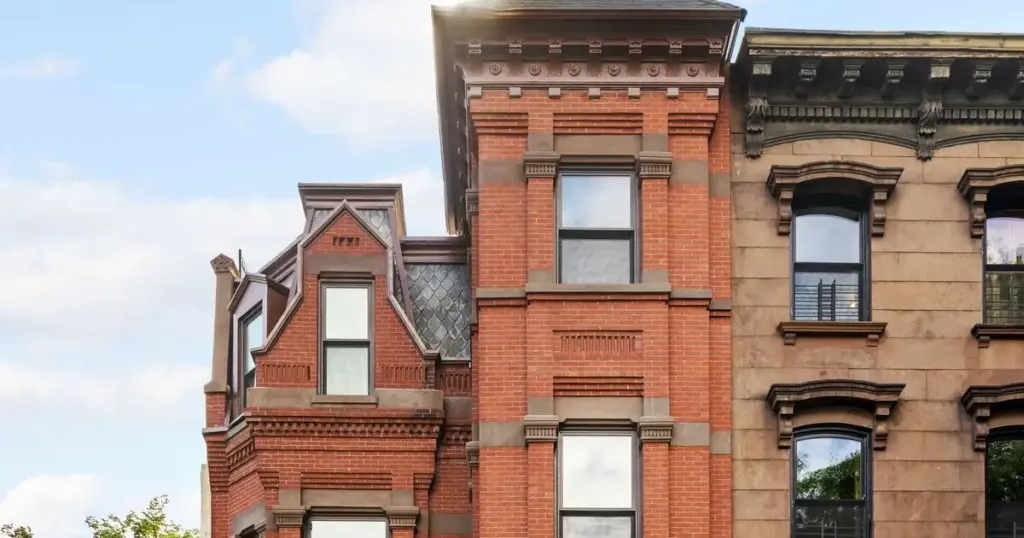
Despite occasional signs of a wobbly high-end market, recent transactions indicate that the upper echelon of Clinton Hill real estate is climbing steadily and establishing a new normal. The latest proof comes from 374 Washington Avenue, a 25-foot-wide townhouse that recently closed for $9.396 million in an off-market deal. According to the buyers’ brokers—Matthew Lesser, Matthew Lipsky, and Sophie Smadbeck of Leslie Garfield—the transaction officially sets a new price record for the neighborhood.
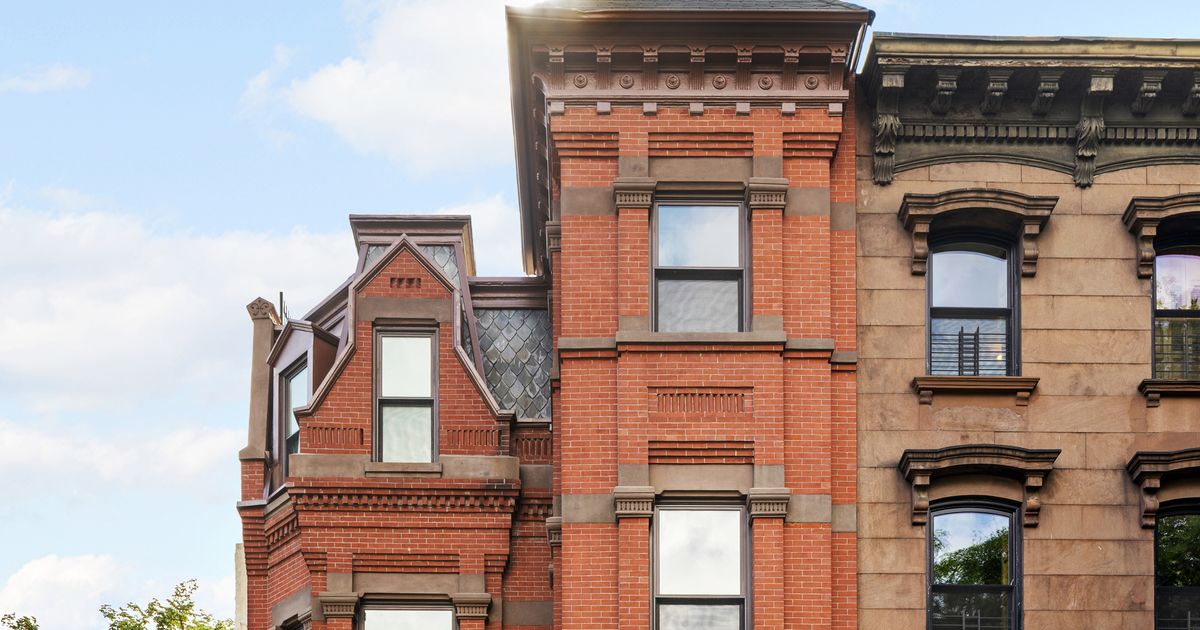
What accounted for the record-breaking price tag? Real estate professionals point to scale as a primary driver. The residence is not only remarkably wide at 25 feet, but it is also exceptionally deep, bringing its total interior footprint to just over 7,000 square feet. Beyond its impressive dimensions, the property possessed a rare attribute in the local luxury market: it was entirely turnkey.
According to Lipsky, most grand-scale mansions in Clinton Hill that have traded hands recently required substantial work, with high-end renovations often completed on only a portion of the enormous floor plans. By contrast, the Pfizer mansion’s most recent listing noted an uninstalled custom Boffi kitchen, highlighting the deferred project costs often associated with historic townhouses of this magnitude.
By comparison, 374 Washington Avenue has been completely reimagined since it last traded in 2014 for $3.75 million. While public records and past listings show the home was already in respectable condition a decade ago—featuring amenities like central air conditioning and a Viking stove—the recent overhaul is thoroughly high-end. Smadbeck notes that the transformation was carefully customized to the owners’ personal taste rather than executed as a generic developer spec house. That aesthetic vision ultimately proved to be broadly appealing, complementing the home’s soaring ceilings and historic architectural details rather than masking them.
The residence successfully balances historic charm with contemporary luxury. Original details such as working fireplaces and intricate pocket doors have been carefully preserved and paired with modern upgrades, including new white oak floors and zoned HVAC systems. Every one of the home’s five bedrooms features its own en-suite bathroom and a spacious walk-in closet. Culinary enthusiasts will find a standout feature in the kitchen, which boasts a custom Lacanche range, reflecting the fact that one of the sellers is a professional chef.
The home’s unusually large footprint also solved a common spatial dilemma inherent in historic Brooklyn townhouses. Typically, installing a sprawling, modern kitchen on the parlor floor—where formal entertaining spaces were traditionally located—results in compromised living and dining areas. At 374 Washington Avenue, however, the generous proportions allow for a generously sized living room, a proper dining room, and an expansive kitchen all on the same level, creating an ideal environment for large-scale entertaining. The property also features a private decked garden complete with an outdoor bar, extending the living space into the outdoors.

When the owners decided to list the property, Smadbeck already had a prospective buyer in mind. A persistent shortage of fully renovated townhouses in Clinton Hill and neighboring Fort Greene has created intense competition among high-end buyers, many of whom broker teams have spotted repeatedly at open houses across the area.
This strong demand and rising price ceiling are reflected in other recent transactions throughout the greater neighborhood, confirming that $9 million-plus sales are no longer isolated anomalies. Last year, 39 Portland Avenue, a Fort Greene townhouse that was mid-renovation at the time of sale, fetched $8.8 million to set a record for that specific neighborhood. Nearby, 70 South Elliot Place commanded an $8 million asking price and went into contract. A short walk away at 356 Clinton Avenue, a standalone Venetian Renaissance-style mansion has been listed with an asking price of $8.48 million.
Together, these sales paint a picture of a resilient and maturing luxury market in central Brooklyn. As buyers increasingly prioritize turnkey condition, expansive square footage, and thoughtful modern updates paired with historic architecture, exceptional properties continue to redefine the boundaries of neighborhood pricing.