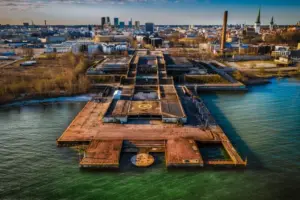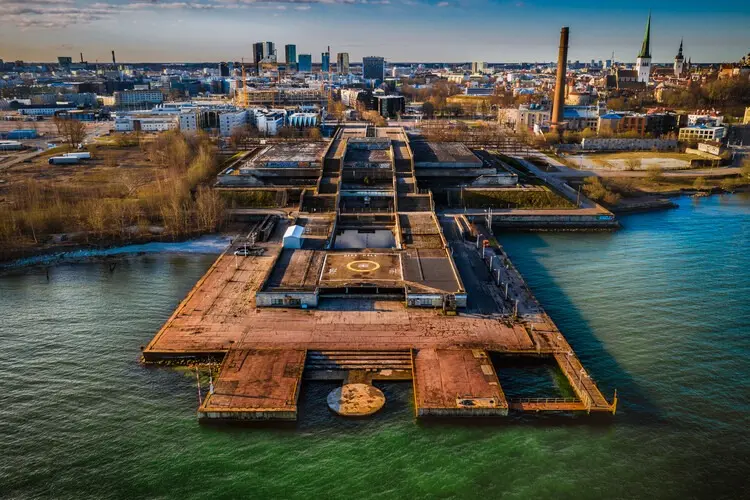
From the end of Mere Boulevard in Tallinn, Linnahall appears as a long, low mass of limestone and concrete laid carefully between the historic Old Town and the Baltic bay. Designed with deliberate restraint, the massive structure is kept intentionally beneath the line of the medieval city’s silhouette so that the ancient spires remain clearly visible from the water. Broad stairways climb its solid flanks, leading up to a sprawling roof paved as a public square, where locals and visitors alike can wander across its expansive horizontal plane. From this elevated vantage point, a sequence of terrace steps descends toward a small pier, a helicopter pad, and the open waters of the Gulf of Finland. Beneath that stark, brutalist surface lies a vast spatial network, including a cavernous amphitheater capable of seating 4,200 people, an expansive foyer spanning 6,000 square meters, an ice hall, various cafes, a bowling alley, and a historic recording studio.
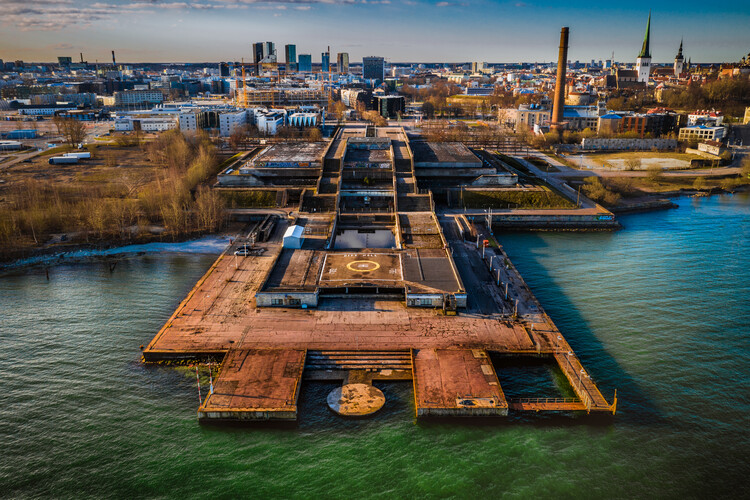
The monumental building officially opened in the summer of 1980 as the V. I. Lenin Palace of Culture and Sport, timed precisely for the sailing regatta of the Moscow Olympics. At the time, Tallinn was chosen to host the maritime events on behalf of the Soviet capital, which lacked a direct coastline. The construction of Linnahall was far from an isolated endeavor; it stood as one of more than 120 major civic and infrastructural projects planned under the city’s ambitious Olympic development program. Alongside the massive cultural palace, this sweeping urban overhaul included the creation of the yachting center in the Pirita district, the towering Tallinn TV Tower, the prominent Hotel Olümpia, and a brand-new airport terminal designed to welcome international visitors to the Estonian coast.
In the decades since its opening, Linnahall has transitioned from a celebrated symbol of international sport and cultural gathering into a fascinating architectural relic of a bygone era. Its unique hybrid typology—part civic monument, part public park, and part infrastructural bulkhead—continues to define the edge where the city meets the sea. As Tallinn’s urban fabric evolves and the surrounding shoreline shifts with new commercial and residential developments, Linnahall remains an enduring focal point for discussions about architectural preservation, brutalist heritage, and the future of post-Soviet public space. Architects, urban planners, and historians frequently return to its stepped rooflines and limestone walls to examine how large-scale public architecture can successfully integrate with both a historic cityscape and a dynamic marine environment, preserving the delicate visual dialogue between the medieval spires of the Old Town and the open expanse of the Gulf of Finland.