The findings, published in the scientific journal Nature Communications, provide a crucial roadmap for researchers attempting to develop more effective catalysts capable of transforming greenhouse gases like carbon dioxide into useful commercial products, most notably methanol. Beyond refining production pathways, the study also uncovered a surprising and unconventional way that hydrogen participates in these surface reactions. This unexpected behavior challenges long-held assumptions regarding how catalytic hydrogenation processes actually operate at the molecular level.
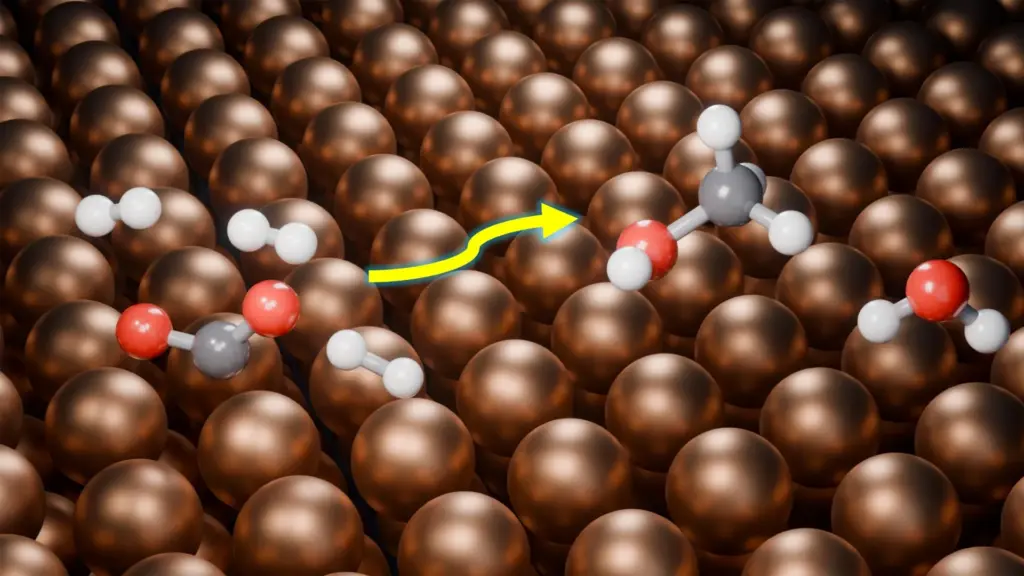
For years, one of the most promising yet technically challenging approaches to recycling atmospheric or industrial carbon dioxide has been hydrogenation. This method utilizes a solid catalyst to facilitate a chemical reaction between CO2 and hydrogen gas, ultimately synthesizing valuable industrial compounds such as methanol. However, this conversion process is notoriously complex, involving an enormous web of individual elementary reactions taking place simultaneously across the intricate surface of the catalyst.
Simulating every single possible reaction step using fundamental quantum mechanics requires an astronomical amount of computing power. Because of these computational limitations, researchers historically have had to rely on a heavily restricted selection of reactions, focusing only on those pathways believed to be the most critical or dominant. While this simplification makes the complex mathematics manageable, it introduces a significant blind spot, leaving hundreds or potentially thousands of chemically vital pathways completely out of the picture.
Anand Mohan Verma, the first author of the study who conducted the research as a CV Raman Postdoctoral Fellow at IISc and is now an Assistant Professor at the Motilal Nehru National Institute of Technology Allahabad (MNNIT Allahabad), highlighted the core anxiety that drove the project forward.
"We began with a worry familiar to anyone who does mechanistic modeling: How do you know that your reaction network has not omitted the one step that matters?" Verma said.
AI Reveals Thousands of Overlooked Chemical Reactions
To systematically overcome the severe limitations of traditional computational modeling, the research team adopted a hybrid methodology. They started by utilizing high-accuracy quantum mechanics simulations to construct a foundational database containing 152 well-understood chemical reactions. With this baseline established, they trained advanced machine learning models to rapidly estimate the energy barriers that additional, unmapped reactions would need to overcome to proceed.
Armed with these automated computational tools, the scientists systematically examined all possible reactions involving 105 distinct chemical species found present on the copper catalyst surface. They meticulously determined which molecular transformations could realistically take place within a single reaction step. This powerful automated approach dramatically expanded their original network from a mere 152 reactions up to an astonishing 9,389 potential reactions.
The difference in output between the small model and the massive new network was profound and immediate. When the researchers relied exclusively on their smaller, conventional network, their computational model produced drastically incorrect predictions. It incorrectly identified formic acid as the primary chemical product of the reaction rather than methanol. Furthermore, the limited model predicted a substantially lower rate of CO2 conversion than what has consistently been observed in physical laboratory experiments.
Ananth Govind Rajan, the corresponding author of the study and an Associate Professor in the Department of Chemical Engineering at IISc, elaborated on the stark contrast between the models.
"When we modeled the process using the 152 reactions considered initially, the network wrongly predicted formic acid, not methanol, as the major product, and underestimated how much CO2 gets converted," Rajan explained. "Only when we expanded the network to include thousands of additional, previously overlooked reactions did the predictions fall in line with what we and others see experimentally."
Expanded Model Predicts 40 Times More CO2 Conversion
When the scientists incorporated this vast new reaction network into a comprehensive kinetic model describing how quickly the individual chemical processes occur, the quantitative predictions shifted dramatically. The predicted amount of carbon dioxide conversion increased by approximately 40 times compared to the calculations produced by the original, simplified model.
Crucially, the newly expanded model also successfully identified methanol and carbon monoxide as the major reaction products, bringing its theoretical predictions into complete agreement with established experimental findings.
The validation of these computational predictions through rigorous physical experiments was carried out by an international and cross-institutional team of collaborators. This experimental work was led by G Valavarasu and Santhosh Kotni at Hindustan Petroleum Corporation Limited’s Green Research and Development Centre, alongside Amol Amrute and colleagues at the Agency for Science, Technology, and Research in Singapore. Additionally, Ambedkar Dukkipati, a Professor in the Department of Computer Science and Automation at IISc, provided essential contributions toward the development and refinement of the machine learning models.
A Surprising Hydrogen Pathway Challenges Conventional Chemistry
Beyond successfully aligning predictive models with physical experiments, the massive expansion of the reaction network exposed an unexpected and fundamentally counterintuitive mechanism involving hydrogen.
In several of the most critical reaction steps identified by the algorithm, hydrogen was found to transfer directly to intermediate chemical compounds as an intact molecular $H_2$ unit, rather than splitting apart into separate hydrogen atoms prior to binding, which has long been the foundational dogma of heterogeneous catalysis. Additional, rigorous quantum mechanics calculations were subsequently performed, confirming that this direct molecular transfer pathway can be exceptionally favorable when hydrogen is transferred to intermediate chemical species that contain oxygen.
This discovery directly challenges decades of established chemical assumptions regarding how hydrogen behaves during catalytic reduction processes, potentially providing researchers with invaluable new clues for the deliberate design of next-generation industrial catalysts.
Shivam Chaturvedi, a co-author and PhD student in the Department of Chemical Engineering at IISc, noted the significance of breaking with traditional textbook chemistry.
"The idea that hydrogen can transfer as an intact molecule, without first splitting into atoms, runs against what most of us were taught," Chaturvedi said. "This surfaced only because the network was large enough to allow for it, and the observation held up when we went back and computed those steps explicitly. This also suggests that catalysts that interact more strongly with $H_2$ could potentially enhance pathways leading to methanol."
The research team believes that this previously unrecognized mechanism could serve as a vital guiding principle for the future development of specialized catalysts. By engineering surfaces that interact more effectively with molecular hydrogen, scientists may be able to fine-tune and optimize the complex chemical pathways responsible for synthesizing methanol directly from captured carbon dioxide.
Furthermore, the broader computational framework developed during this study is expected to prove useful across a wide array of scientific disciplines well beyond carbon dioxide hydrogenation. By seamlessly integrating quantum mechanics simulations, machine learning algorithms, automated identification of reaction steps, and kinetic rate models, the methodology offers researchers a versatile tool for investigating other complex industrial processes.
Potential future applications for this technique include exploring alternative catalysts for carbon dioxide reduction, studying nitrogen reduction pathways for green ammonia production, and improving the efficiency of water splitting for hydrogen fuel generation. By systematically bringing to light the crucial chemical steps that simpler, traditional models inevitably miss, the new technique provides scientists with a significantly more complete picture of complex catalytic phenomena, ultimately unlocking fresh opportunities to improve the chemical and energy processes upon which modern industry relies.