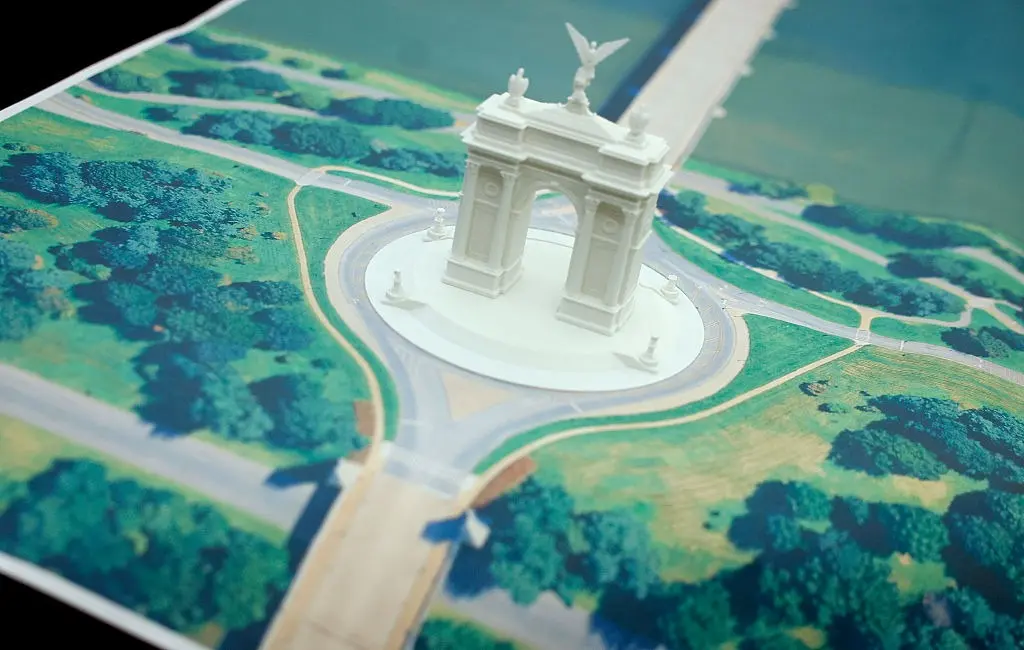
The American Institute of Architects (AIA) has formally censured federal preservation authorities over their decision to step back from one of the most contentious urban planning battles in the modern history of the nation’s capital. In a strongly worded letter dispatched on September 29, the professional organization denounced the Advisory Council on Historic Preservation (ACHP) for its effective resignation from the regulatory review process surrounding President Trump’s controversial triumphal arch project.
The direct target of the AIA’s criticism is a pivotal decision made by the ACHP on September 24. On that date, the federal agency responsible for safeguarding historic properties and sites across the United States elected to bypass Section 106 of the National Historic Preservation Act. By invoking this procedural bypass, the Council effectively concluded its formal involvement with the high-profile monument project. The proposed site for the massive 250-foot-tall structure is Memorial Circle, a heavily trafficked and symbolically sensitive location situated immediately adjacent to Arlington National Cemetery.
The Section 106 process stands as a cornerstone of federal historic preservation law. It serves as a vital mechanism compelling federal agencies to carefully evaluate the potential adverse effects of any projects they carry out, approve, or fund on historic properties, landscapes, and districts. Rather than adhering to this rigorous, established consultative framework, the ACHP opted to chart an alternative course. According to reports from The Architect’s Newspaper, the Council decided to circumvent the traditional Section 106 review entirely and instead communicate directly regarding the controversial development with U.S. Secretary of the Interior Doug Burgum, a prominent political ally of President Trump.
In its September 29 correspondence addressed to ACHP Director Jaime Loichinger, the AIA urged the Council to use its direct line of communication with Secretary Burgum to deliver an unequivocal message: the proposed triumphal arch project "must not proceed." Furthermore, the architects’ organization called upon the National Park Service to fundamentally "reconsider the location, scope, and design of the undertaking." The AIA letter highlights a sweeping array of serious concerns regarding the proposal, ranging from severe, irreversible adverse effects on neighboring historic properties to a profound lack of architectural and contextual harmony that the massive design would introduce into the carefully curated landscape of the Washington, D.C. monument core.
Central to the AIA’s argument is the unique spatial and symbolic character of the nation’s capital. The letter emphasizes that Washington’s celebrated collection of monuments, memorials, and public spaces was never conceived as a random assemblage of isolated objects. Instead, the capital functions as a cohesive, highly deliberate visual and ceremonial continuum. Introducing a permanent 250-foot architectural structure at the central hinge of this intricate landscape, the AIA contends, creates an unbridgeable visual and conceptual conflict. Such a monument, the letter notes, cannot harmoniously coexist with the area’s established historic sequence, intricate reciprocal views, profound civic meaning, and solemn national function.
The architectural organization also took direct aim at justifications put forward by the National Park Service. The Park Service had previously argued that exploring alternative locations or significant design modifications would fundamentally alter the project’s essential nature and prevent the achievement of its primary goals. The AIA letter characterizes this position as premature and misguided, encouraging the ACHP to press for a genuine, comprehensive analysis of alternative options. A thorough review could open the door to alternative solutions, such as proposing a significantly smaller-scale structure that is far less visually intrusive, or evaluating alternative designs that entirely avoid interfering with the area’s delicate sightlines, historic topography, and sacred surroundings.
The ambitious and polarizing arch project has remained a fixture of public discourse and national headlines since President Trump first floated the concept during a holiday gathering late last December. Despite mounting friction among civic groups, design professionals, and federal regulators, the Commission of Fine Arts officially approved the ambitious construction plan this past May. That approval moved forward despite strident, vocal objections raised by both military veterans and historic preservationists who viewed the monument as an inappropriate intrusion upon a landscape dedicated to the nation’s fallen service members.
The escalating dispute eventually spilled over from the realm of public debate and bureaucratic lobbying into the federal court system. Last month, military veterans and historic preservation advocates filed a formal lawsuit seeking to block the development. Shortly thereafter, plaintiffs secured a temporary restraining order designed to halt construction activities that had been aggressively scheduled to break ground in mid-September. As legal battles continue to unfold and professional organizations intensify their pressure on federal agencies, the future of the Memorial Circle triumphal arch remains deeply uncertain.