The accidental discovery of an ancient stone-and-wood fortification beneath a historic hospital in Paris may have finally put to rest a decades-long academic debate regarding the true birthplace of the French capital. For generations, historians, classicists, and archaeologists have argued over the exact geographic origins of the city, weighing textual accounts left behind by Roman conquerors against sparse and often contradictory physical evidence scattered across the modern Parisian landscape. Now, a 72-foot-long relic unearthed in the heart of the city has injected profound new physical proof into the discussion, shifting the scientific consensus and offering a tangible link to the turbulent era when the ancient world collided with the might of the Roman Empire.
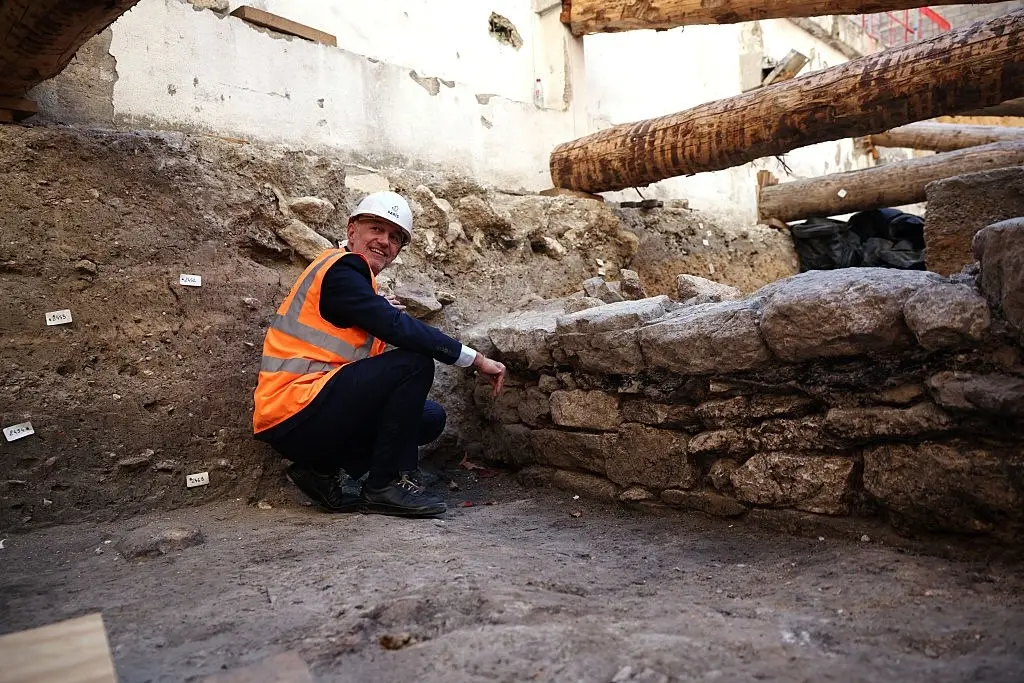
The remarkable find came to light during routine construction work at the Hôtel Dieu hospital, situated on the Île de la Citœur—the natural island in the middle of the River Seine that forms the historical and geographical beating heart of modern Paris. According to reports from the New York Times, construction teams and supervising archaeologists uncovered the massive structure, which is masterfully constructed from a combination of stone and heavy timber. Resting nearby was a distinctly Gallic spearhead, an artifact that immediately signaled to researchers that they had stumbled upon something dating back to the pre-Roman Iron Age. Subsequent scientific analysis, utilizing advanced carbon-dating techniques, has placed the construction and active use of the wall somewhere between 200 BCE and 10 BCE. This specific chronological window aligns precisely with the epoch of Roman expansion and the systematic conquest of Gaul by legions led by Julius Caesar.
To understand the immense weight of this archaeological discovery, one must look back to the historical narratives penned more than two millennia ago. In his surviving accounts detailing the Gallic Wars, Julius Caesar frequently wrote about a settlement known as Lutetia. This strategic location was established and inhabited by the Parisii, a prominent Gallic tribe whose name would eventually echo through the centuries to become the modern name of Paris. Caesar described Lutetia not as a sprawling metropolis, but as a fortified town strategically positioned on an island situated directly within the waters of the Seine. According to the Roman commander’s military chronicles, when his formidable troops approached the settlement in the first century BCE, the indigenous inhabitants chose a scorched-earth defense strategy. They burned their own settlement to the ground and systematically destroyed its bridges to deny the invading Roman army a foothold. Despite these desperate defensive measures, the Roman military machine ultimately overcame the resistance, conquering Lutetia in the year 52 BCE.
Despite the compelling nature of Caesar’s ancient texts, modern scholars and archaeologists spent decades questioning whether the Roman general’s geography could be taken at face value. For a long time, persistent fieldwork on the Île de la Citœur yielded surprisingly little physical evidence to support the existence of a major, heavily fortified Gallic settlement of the scale and prominence Caesar described. Instead, extensive archaeological digs conducted in Nanterre, located a few miles west of Paris, uncovered a wealth of Gallic artifacts, dwellings, and structural remains. This discrepancy led a number of prominent scholars and historians by the 1990s to formulate alternative hypotheses. Many grew convinced that ancient Lutetia was never truly on the Île de la Citœur at all, but rather anchored further inland or in surrounding areas like Nanterre, viewing the island as a later Roman imposition rather than the cradle of the original Gallic tribe.
This newly uncovered wall, however, fundamentally changes the entire archaeological calculus. Among those who previously doubted the traditional narrative was Matthieu Poux, an esteemed archaeology professor at the University of Lyon II. Poux had long been recognized as a prominent skeptic regarding the location of ancient Lutetia on the Île de la Citœur. Following the recent excavation at the Hôtel Dieu hospital, Poux candidly shared with the New York Times that the physical evidence was simply too compelling to ignore, admitting that the find had completely altered his perspective. He stated that he now holds “no doubt” that the ancient tribal center and settlement described by Roman historians was indeed located on the island all along.
Adding an extra layer of historical drama to the discovery are several tantalizing physical details recovered from the site. The wall itself shows clear, extensive signs of having been subjected to intense heat. Alongside the charred stone and timber of the fortification, archaeologists working at the hospital site discovered carbonized seeds and the distinct structural remains of a burned wooden building. These combined elements raise the tantalizing, though still unproven, possibility that researchers have finally unearthed physical, smoke-stained traces of the very destruction that Julius Caesar documented in his memoirs more than two thousand years ago.
Despite the excitement rippling through the international archaeological community, lead researchers and institutional authorities are maintaining a rigorous scientific caution. Representatives for the French culture ministry have noted that while the parallels are striking, a significant amount of meticulous laboratory work and field research remains to be done. Experts stress that further analysis is required to precisely establish the exact timeline of the wall’s construction phases, as well as to determine its precise military or civic function within the ancient Gallic community.
Even with questions remaining, the discovery effectively fills in a massive, frustrating blank in the historiography of Paris, which stands globally as one of the most thoroughly excavated and studied urban environments in the world. Modern urban archaeologists already possess a wealth of knowledge concerning Roman Paris, having mapped and studied numerous settlements, administrative buildings, and domestic structures hidden beneath today’s bustling Latin Quarter and the manicured lawns of the Luxembourg Gardens. In stark contrast, Gallic Paris—the foundational layer preceding the Roman conquest—has historically proven exceptionally difficult to pin down, leaving researchers with more theories than artifacts. According to Professor Poux, this single, unexpected hospital excavation has exponentially increased the total body of physical evidence available for study on this elusive era, multiplying the data “tenfold.”
In response to the significance of the find, heritage officials and local authorities have confirmed that further excavations are actively planned in the immediate vicinity surrounding the Hôtel Dieu hospital. As research teams methodically expand their trenches to uncover adjacent strata, plans are also being formulated for the future of the wall itself. Due to its location within an active urban infrastructure and hospital zone, the ancient structure will eventually be carefully dismantled and removed from its subterranean resting place. This delicate extraction will allow specialists to conduct exhaustive laboratory analysis, ensuring that the 72-foot relic can be properly preserved, studied in detail, and eventually prepared for public exhibition, allowing both citizens and visitors to connect directly with the smoke-veiled origins of Paris.