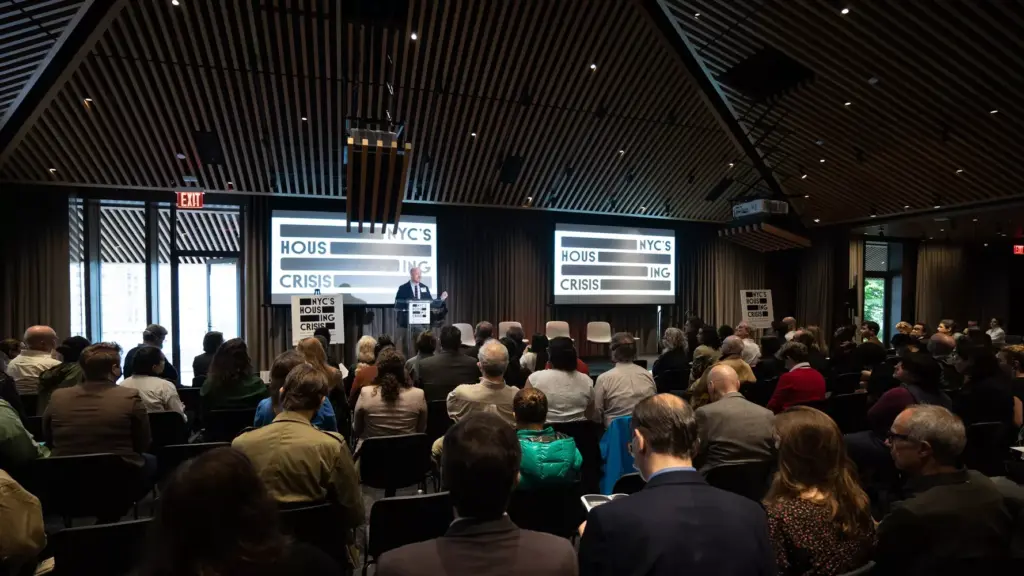
As New York City grapples with record rates of homelessness, soaring eviction numbers, and an ever-widening affordability gap, a coalition of architects, urban planners, policymakers, and community activists recently converged to re-examine how the metropolis approaches its most persistent challenge. Hosted at the newly opened Stavros Niarchos Foundation Library, the half-day conference titled “NYC’s Housing Crisis,” organized jointly by AIA New York and the Center for Architecture, served as an urgent pre-design call to action. Rather than focusing immediately on architectural blueprints, the event brought design professionals face-to-face with the policymakers and grassroots organizers who have spent years on the front lines of the urban housing emergency.
Benjamin Prosky, executive director of AIA New York, set the tone for the morning with a candid assessment of the architectural profession’s relationship to the issue. In his opening remarks, Prosky remarked that architects in many ways know everything and very little about affordable housing. He noted that while the collective instinct of the design community is to immediately begin designing a way out of any difficult situation, the conference was intentionally designed to take a step back and examine the broader systemic forces at play before putting pencil to paper.

The roots of New York City’s housing shortage run deep, stretching back across decades of economic shifts, shifting federal policies, and widening wealth disparities. By the conclusion of former Mayor Michael Bloomberg’s twelve-year administration in 2016, economic inequality in the city had reached staggering proportions, with the top one percent of earners making an average of 45 times more than the bottom 99 percent. Bloomberg’s successor, Bill de Blasio, campaigned on a promise to bridge this “tale of two cities” divide. Over the course of de Blasio’s two terms, the city administration successfully financed and created more than 465,000 units of affordable housing.
Yet, despite these massive numerical achievements, the core crisis has only intensified. More than half of all New York City households remain severely rent-burdened, meaning they spend upwards of 50 percent of their total income simply keeping a roof over their heads. At the same time, municipal homelessness rates have climbed to historic highs. Now, under the newly inaugurated mayoral administration of Eric Adams, the city faces renewed pressure to act. Mayor Adams has pledged a substantial $22 billion toward affordable housing initiatives over the coming decade—a figure that housing advocates argue is still insufficient to meet the overwhelming scale of the need.
In an eloquent and widely discussed keynote address, New York Times architecture critic Michael Kimmelman reminded the audience that crisis can also serve as an engine for profound change. Kimmelman’s sentiment reverberated throughout the morning sessions, which were structured primarily around policy, economics, and social equity. The conference was divided into three distinct panels: the first examining the historical origins of the crisis, the second evaluating the effectiveness of current legislative and administrative approaches, and the third exploring innovative future models of urban development and financing.

The opening panel, titled “The Past: Defining the Crisis,” featured experts who traced the current housing shortage back to the fiscal crisis of the 1970s, an era that fundamentally transformed how public-private partnerships operated in municipal development. Ingrid Gould Ellen of New York University’s Furman Center for Real Estate and Urban Policy provided stark economic context, noting that overall housing prices in New York City have skyrocketed twentyfold since 1974. Over that same fifty-year span, median incomes have grown by a factor of just 6.5. Ellen attributed this widening chasm to a combination of shrinking available land, steady federal divestment from public housing, and accelerating wealth inequality that allows high-earning residents to continuously drive up rental and purchase markets.
Joining Ellen on the first panel, Moses Gates of the Regional Plan Association turned the focus toward the physical and structural use of urban space. Gates argued that how space is utilized across the five boroughs is a core component of the housing emergency. He highlighted the troubling increase since the 1980s in the number of vacant housing units sitting empty across the city—many of them maintained as luxury pied-à-terres by non-resident owners—coupled with a concurrent weakening and decrease in effective rent regulation protections over the years.
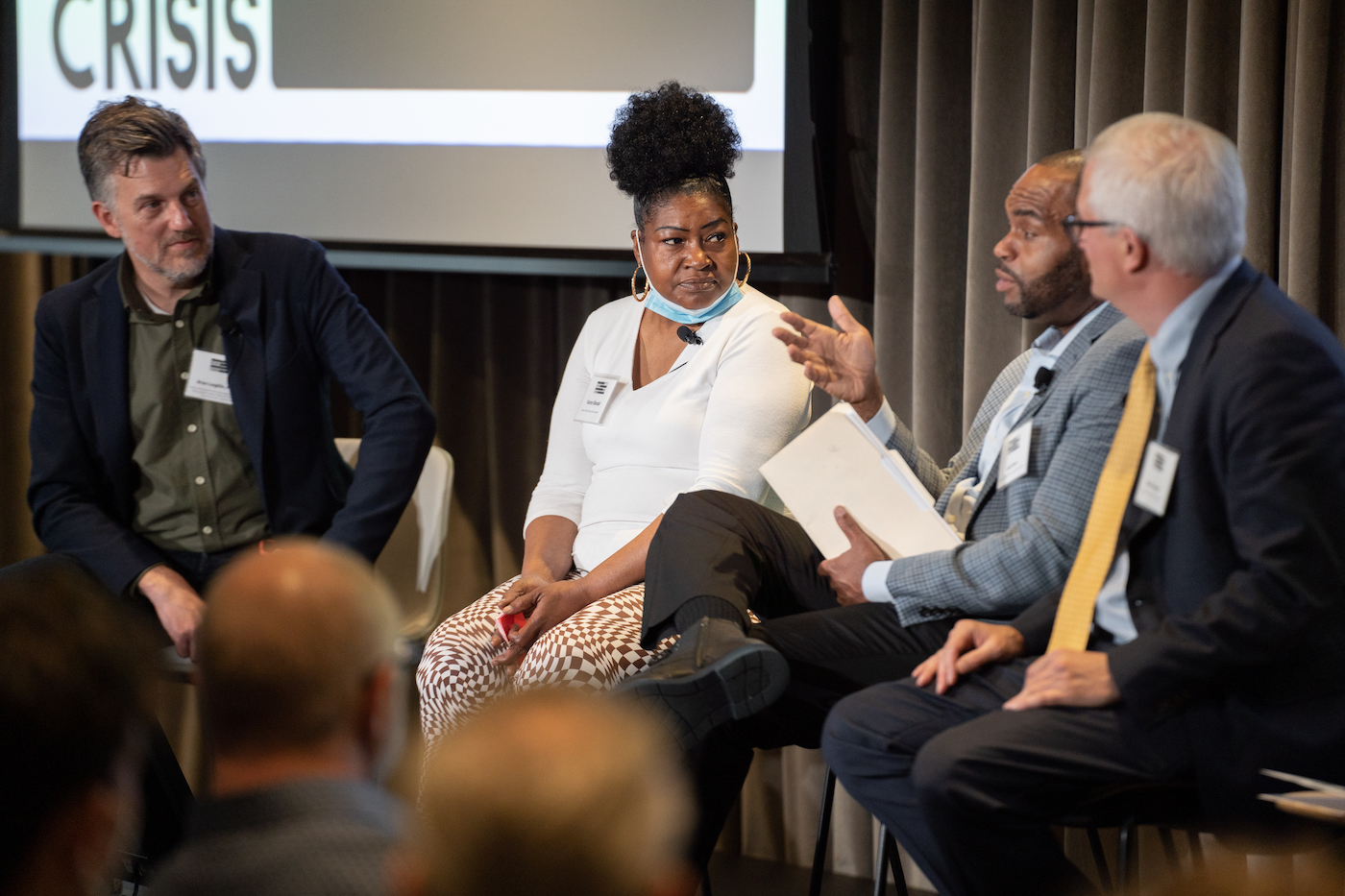
The conversation shifted to contemporary realities in the second panel, “The Present: What’s Working? What’s Not?”, which was moderated by Brian Loughlin, a principal at Magnusson Architects. Loughlin opened the discussion by challenging the status quo of urban development, arguing that the true interests of everyday residents are frequently sidelined or ignored within the public-private partnerships that have dominated New York’s construction boom in recent decades.
State Senator Brian Kavanagh offered a counterbalancing perspective by highlighting recent legislative victories, most notably the landmark tenant protection laws passed by the state government in 2019, which represent some of the strongest renter safeguards enacted in decades. Kavanagh also pointed to a revitalized state commitment to funding affordable housing development. Jamie Smarr, representing the nonprofit developer National Housing Partnership, suggested that everyday New Yorkers possess a strong, intuitive understanding of why aggressive affordable housing legislation is necessary, pointing to the tangible successes achieved through mandatory inclusionary zoning laws implemented across the city.
One of the most grounding and powerful voices of the morning came from Karen Blondel, founder of the Public Housing Civic Association. Blondel pulled the conference back from abstract policy discussions by emphasizing the urgent need for policymakers to genuinely listen to public housing residents and bring them directly into the decision-making process. Drawing from her own lived experience, Blondel spoke candidly about the physical decay, maintenance backlogs, and deeply unsafe living conditions that she and her neighbors at the Red Hook Houses in Brooklyn have been forced to endure over the past four decades. Her presence ensured that the dialogue remained firmly anchored in the daily reality of New York’s most vulnerable populations.
The third and final panel, “The Future: New Models of Development/New Approaches,” looked ahead to emerging paradigms in urban planning and municipal governance. The session featured newly elected Brooklyn Borough President Antonio Reynoso, who positioned himself as part of a rising generation of municipal leaders committed to refusing campaign contributions from traditional real estate developers. In a sharp preliminary speech, Reynoso criticized what he termed the counterproductive “YIMBY/NIMBY deaf loop,” a political cycle that frequently stifles comprehensive development and prevents the creation of necessary housing stock. Advocating boldly for increased urban density, Reynoso declared that height is a crucial mechanism for escaping the current stalemate, stating that the city needs significantly more vertical growth to accommodate its population.
Adding a practical operational perspective to the future of development, Muzzy Rosenblatt, executive director of the nonprofit Bowery Residents’ Committee (BRC), shared details of a successful initiative he spearheaded. Rosenblatt successfully convinced municipal authorities to subsidize both the development and the underlying mortgage for a new combined shelter and low-income housing facility located in the Bronx. By leveraging municipal financial aid, BRC was able to generate sustainable operational revenue that directly subsidizes rent for individuals transitioning out of temporary shelter and into permanent homes within the 130-unit residential project. Rosenblatt argued that the city possesses the capacity to design and build housing with inherent dignity while simultaneously capturing development profits to fund additional affordable units.
Concluding the conference, Benjamin Prosky announced that the event was merely the kickoff for a much larger, multi-phase initiative led by the Center for Architecture and AIA New York. He noted that the NYU Schack Center for Real Estate is slated to publish a comprehensive report later in the year to support and expand upon the findings and dialogues generated during the morning sessions. As the city moves forward, organizers emphasized that identifying viable pathways toward affordable, equitable, and sustainable housing will require an unprecedented confluence of progressive public policy, community-led activism, robust economic debate, and the dedicated expertise of the design community.