In the global legal system, creative works born from profound trauma—such as art crafted by refugees and incarcerated populations—serve a dual purpose. Beyond acting as a vital form of psychological therapy and personal expression, these pieces increasingly function as tangible evidence of mass atrocities in international courts.
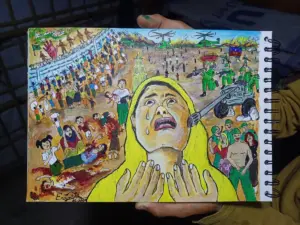
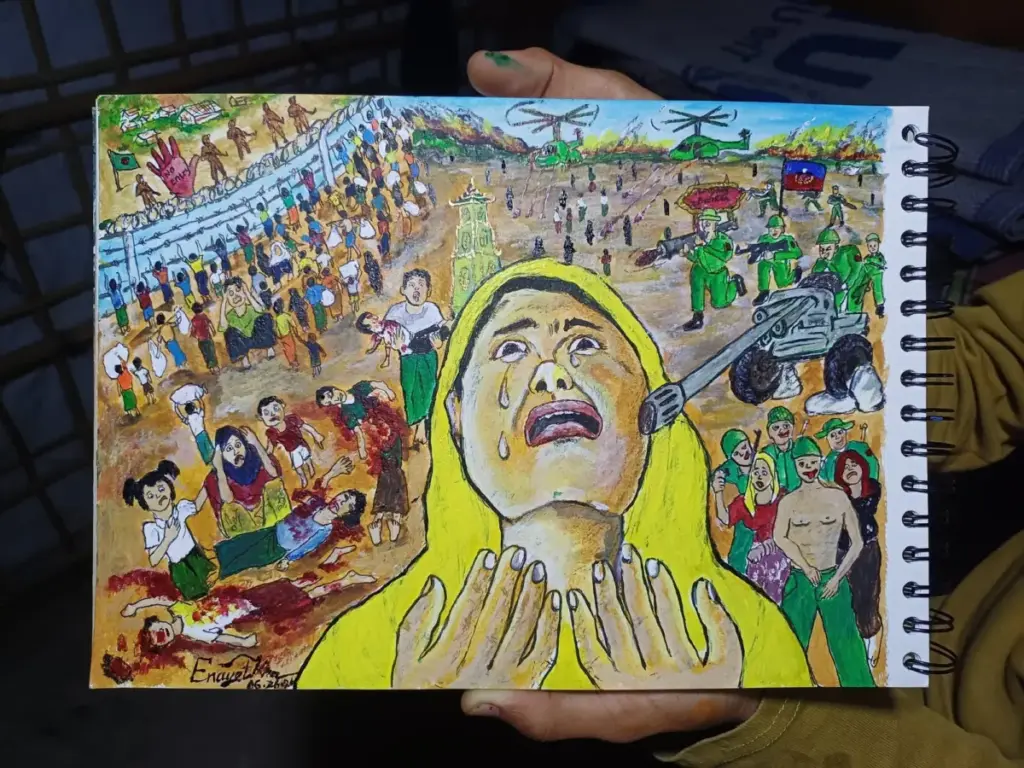
Enayet Khan understands this dual reality better than most. In 2017, Khan fled Myanmar under terrifying circumstances, embarking on a harrowing three-day journey through forests and fields alongside his family. As they moved from one village to the next, fires closed in behind them with relentless speed. Each temporary haven offered only brief respite; by morning, the latest village would also be reduced to ash. Their own home had already been destroyed, but there was no time to mourn what had been left behind. Armed soldiers moved swiftly through the region, and Khan witnessed people being shot dead right in front of him.
The primary objective was stark and immediate: to survive long enough to escape Myanmar entirely. Ten members of his family fled together, and three suffered injuries along the way. Ultimately, they succeeded in crossing the border into Bangladesh, stepping into an uncertain future as displaced persons.
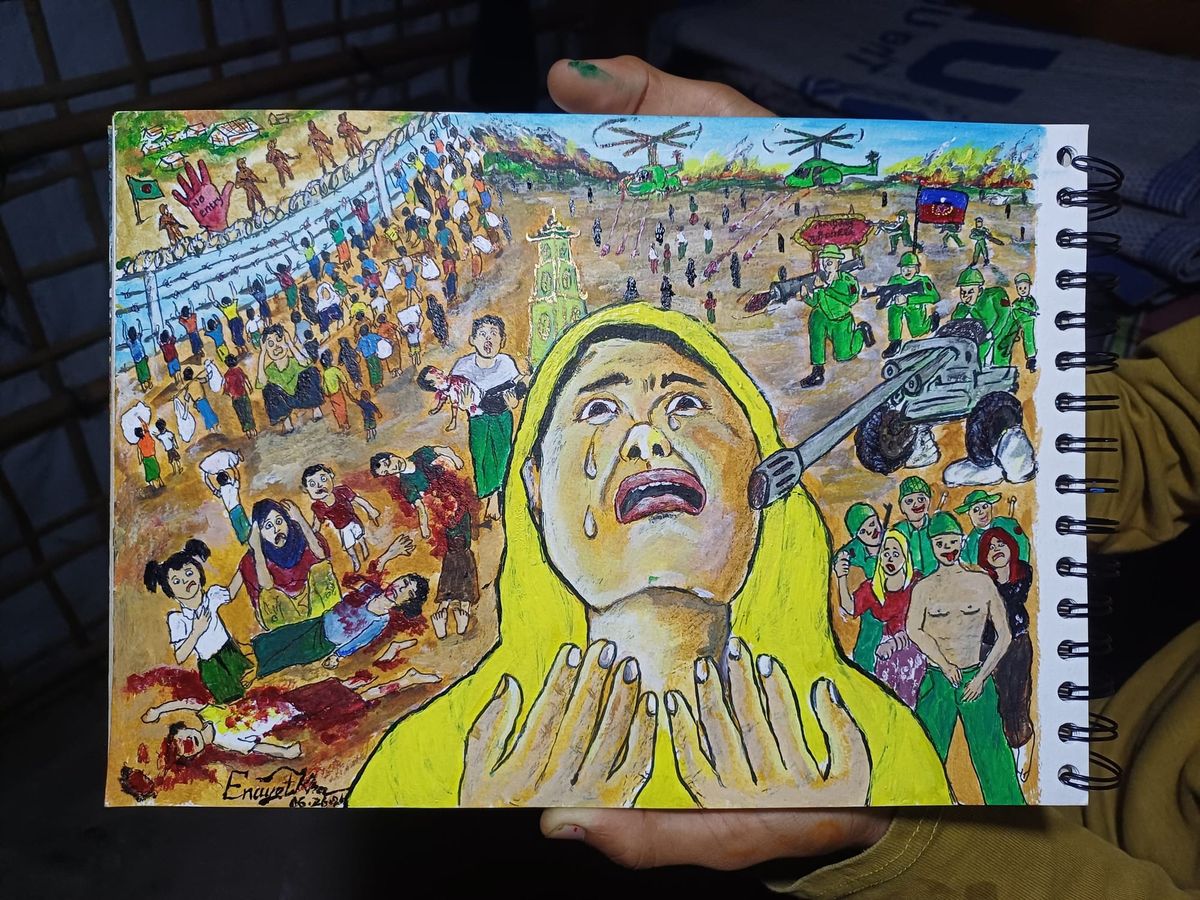
“I lost everything,” Khan told Hyperallergic in a phone call, reflecting on the magnitude of his displacement. “Home, documentation, property, a sense of security.”
Khan ultimately settled in Cox’s Bazar, Bangladesh, a sprawling settlement that now provides shelter to nearly one million Rohingya refugees. The Rohingya minority has endured decades of systemic discrimination, targeted violence, and severe political repression under successive Myanmar governments. Their marginalization was codified by a restrictive 1982 citizenship law that effectively stripped them of their nationality, leaving them as one of the largest stateless populations anywhere in the world. The vast majority of those living in Cox’s Bazar fled during the violent military crackdowns of 2017, escaping widespread crimes against humanity and acts that international investigators have classified as genocide.
Amid the grueling conditions of the camp, Khan sought a way to process the horrors he had witnessed—the burning homes, the fleeing families, and the summary executions. He turned to painting and drawing. Over time, his personal practice evolved into a community initiative. Khan began training other refugees in visual arts, eventually establishing the Rohingya Art Club (RAC). Through the club, he encouraged fellow survivors to use visual storytelling as a powerful medium for personal expression, cultural preservation, and quiet resistance.
Khan’s story mirrors that of countless other refugees worldwide who utilize art to record and communicate their firsthand experiences of conflict and systemic violence. According to legal experts and human rights investigators, these creative works do more than preserve memory; they play an increasingly instrumental role in accountability efforts. Drawings and paintings help convey complex testimonies, corroborate survivor accounts, and, in some instances, cross the threshold into formal legal proceedings as evidentiary support in cases investigating mass atrocities.
The need for such documentation is growing against a backdrop of unprecedented global displacement. A record 117.8 million people are currently forcibly displaced worldwide, marking a staggering escalation that has continued for 12 consecutive years. Concurrently, investigations and prosecutions concerning genocide, crimes against humanity, and war crimes have surged across the European Union, where new cases grew by 44% between 2016 and 2021. Today, an unprecedented number of displaced people are turning to international courts in search of justice and accountability, a wave of demand that the International Criminal Court (ICC) has formally characterized as unprecedented.
For legal advocates navigating this massive influx of cases, art has emerged as an invaluable tool to bridge communication gaps and meet the overwhelming demand for credible testimony.
Antonia Mulvey, executive director of Legal Action Worldwide and a former United Nations investigator, utilized artwork as part of her evidentiary collections in landmark cases. This included proceedings before the International Court of Justice charging the Myanmar military with genocide against Rohingya communities during the 2017 atrocities. Mulvey noted that high rates of illiteracy among the Rohingya population—particularly among women and children—pose significant challenges when attempting to record traditional written statements. In these specific contexts, drawings and visual narratives proved vital, serving as an accessible and powerful medium to accurately convey survivor testimonies to legal bodies.