Early in his career, designer and sculptor Fernando Mastrangelo entered a contemporary design scene still reeling from the shock of the 2008 financial crisis. Freshly armed with a Master of Fine Arts in sculpture from Virginia Commonwealth University and carrying a formative professional stint assisting artist Matthew Barney, Mastrangelo was eager to work, yet he quickly realized he could not rely on the conventional, historical channels traditionally used to establish a name in the art and design world. The standard pipelines for selling, exhibiting, and distributing collectible design were stagnating, and heritage manufacturer contracts had evaporated almost overnight in the tight credit market.
In that economic vacuum, an entrepreneurial cohort of resourceful American designers began establishing entirely new avenues for survival and visibility. Scrappy, independent showcases like Sight Unseen OFFSITE and the Collective Design Fair offered these emerging makers direct access to an eager market without the traditional gatekeeping of legacy institutions. Simultaneously, social media platforms—most notably Instagram—provided immediate, unfiltered links to high-end interior designers, architects, and private collectors. Mastrangelo was among the vanguard who championed a direct-to-collector business model, retaining total control over his brand and revenue.
That financial self-sustainability allowed his operation to expand at a breakneck pace. He grew from working entirely solo out of a makeshift space to managing a sprawling 20-person production hub in East New York. That industrial-scale workshop turned out nearly 200 distinct works each year, feeding a booming appetite for high-end collectible furniture and objects. Soon, Mastrangelo was collaborating with global luxury fashion and watch houses, crafting custom spatial installations for brands like Fendi, Stella McCartney, and Audemars Piguet. His signature ombre sand cylinders and other cast-mineral designs were routinely commissioned by top-tier interior design firms, including Kelly Wearstler and Ingrao.
Now, after nearly two decades running one of the most formidable, self-sustained studios in American collectible design, Mastrangelo is embarking on a significant career pivot by joining the roster of the Cristina Grajales Gallery in Tribeca. This move marks an intriguing about-face for a designer who has frequently offered candid critiques of the traditional artist-gallerist relationship—a dynamic often strained by delayed compensation for creators and intense market pressure to produce predictable, homogenous products that can easily repeat success.
Yet Mastrangelo’s choice to reenter the formal gallery system is more than just a personal recalibration; it underscores a broader, structural transformation in how studio design is currently being produced, valued, and sustained. Across the contemporary landscape, independent designers are actively streamlining their operations, pulling back from hyper-industrial growth, and zeroing in on the intimate aspects of making that matter most to them.
"After ten years of building a direct-to-collector business, I realized I wanted to spend less time managing an industrial infrastructure and more time creating the work," Mastrangelo reflects. "Joining Cristina allows me to return to the essence of a craft-led practice."
The tangible fruits of this labor-intensive pivot are set to go on public view in "Territories," Mastrangelo’s very first solo exhibition with Grajales’s Tribeca gallery. The comprehensive ensemble of pieces featured in the show includes a striking suite of sculptural tables, immersive seating, and monumental wall reliefs fashioned from hand-dyed sand, crushed glass, and rare-earth oxides. This body of work signals a profound evolution of his proprietary cast-mineral process, a technique he originally pioneered to shape furniture but has now elevated into pure sculptural territory.
The creation of these new pieces stems directly from having not only more time to dedicate to each object, but also working within a radically different physical and mental environment. Prompted in part by the operational disruptions and introspective pauses of the global pandemic, Mastrangelo took a hard look at the trajectory of his career and decided to step back from coordinating massive volumes of commercial products. Instead, he chose to focus on crafting a limited output of just 20 to 30 museum-grade, one-off pieces per year.
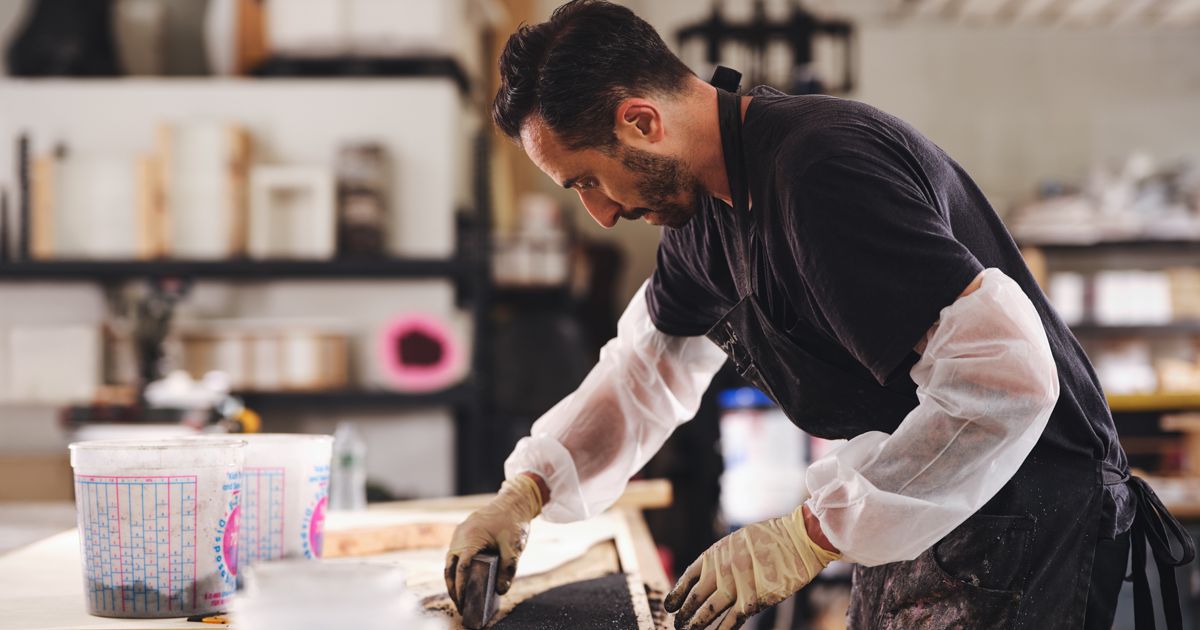
To achieve this, he made the deliberate decision to shutter his large industrial warehouse in Brooklyn and relocate to a more manageable, 6,000-square-foot studio space situated in Hudson, New York. "I wanted every single piece leaving the studio to pass directly through my own hands again," he explains, highlighting the tactile intimacy that drew him to sculpture in the first place.
This dramatic shift was years in the making, stretching out over a steady, five-year dialogue with Cristina Grajales, who patiently watched him test new ideas in the studio without applying any commercial pressure or rushing him toward an exhibition date. Their partnership today operates on a clear, complementary division of labor: Grajales assumes responsibility for global logistics, high-level client relations, and market positioning, while Mastrangelo is free to immerse himself entirely in the physical act of creation.
This newfound creative freedom has allowed Mastrangelo to reengage with a complex set of conceptual concerns that he initially approached early in his career. His work grapples with the sheer, incomprehensible scale of geological time, alongside the heavy historical shadows of colonialism, state sovereignty, and relentless modern consumerism. Deeply informed by contemporary geopolitical debates concerning national borders, resource extraction, and disputed topographies, the "Territories" collection makes heavy use of rare-earth oxides and minerals that are utterly central to modern global tech supply chains and defense infrastructure, including silica and crushed quartz.
Through these materials, the collection explores how physical landscapes carry the enduring stories of political power and environmental memory—noting, for instance, that current events such as political discussions surrounding the Arctic and disputed territories were top of mind during the creative process. This rigorous body of work notably recalls Mastrangelo’s earlier, more overtly conceptual and controversial art pieces, such as Felix, a 2009 sculpture that rendered a Colombian coca farmer using 22 kilograms of cocaine to provoke conversations about the illicit global drug trade.
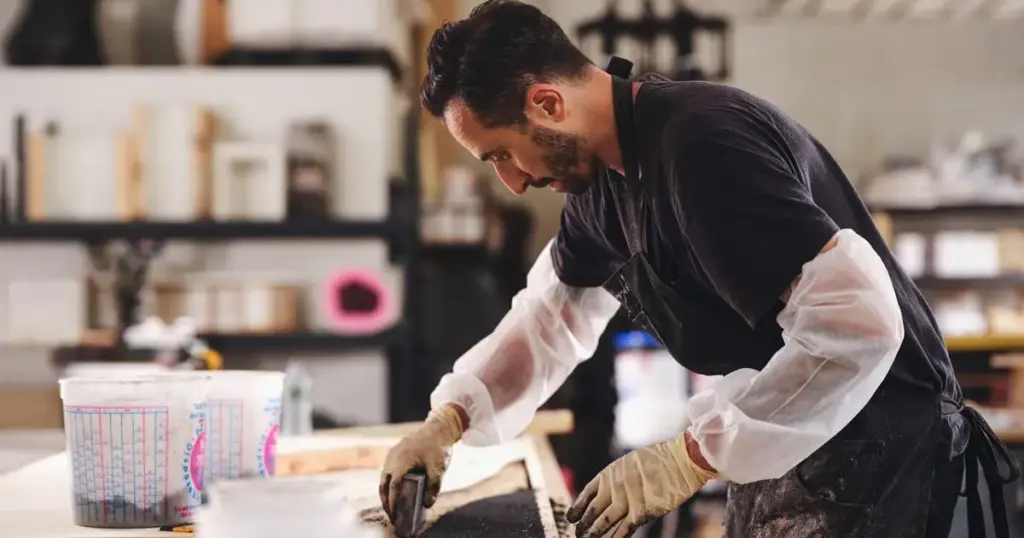
To physically execute the intricate surfaces of the new collection, Mastrangelo relied on a "blind-casting" process that he has spent the last few years reacquainting himself with. He pours custom aggregates of crushed glass and sand—sourced from diverse locations around the world—into inverse molds, working blindly without being able to actively see or control precisely how the individual colors and particles settle within the mix. The resulting surfaces, rendered as complex topographies and sweeping gradients of mineral hues, feel remarkably enduring and permanent, as if the pieces were physically hewn out of raw geographic formations rather than shaped by human hands in a workshop.
Looking ahead to the broader future of the design industry, Mastrangelo foresees a wider, industry-wide return to small-batch studio practices as a viable template for long-term business sustainability. His own course correction arrives at a critical inflection point for contemporary design as a whole. Escalating commercial real-estate prices in major cities, the skyrocketing costs of specialized fabrication materials, and shifting consumer market demands—compounded by the ever-present economic threat of recessions—have made the mega-indie studio business model increasingly difficult, if not impossible, to maintain in major urban centers.
Other notable peers in the design field have recently implemented similar strategic measures. Lighting designer Lindsey Adelman and the pioneering design gallery R & Company have both scaled down their operations in recent years, choosing instead to focus deeply on connoisseurship and supporting emerging talent more directly rather than chasing volume. Yet this widespread streamlining does not signal a decline in quality; rather, the field is undergoing a healthy, much-needed recalibration. It represents a deliberate turn away from surface-level decorative flourish and toward genuine material rigor, reconnecting contemporary makers with the foundational, craft-driven ethos of the American studio movement—a tradition that is currently being celebrated in numerous gallery and museum exhibitions across the United States.
"Territories" is on view at Cristina Grajales Gallery, located at 50 Vestry Street in Tribeca, New York City, from October 8, 2026, to February 12, 2027.