It began as a mundane errand. A walk past my alma mater, the School of the Art Institute of Chicago (SAIC), was intended for nothing more than a quick detour to J&J’s Fish and Chicken. Yet, the architectural gravity of the SAIC’s Sharp building proved more magnetic than the promise of a meal. As I passed the building’s threshold, a stunning, prismatic rainbow of glass caught my eye, drawing me into the SITE Galleries. What I discovered was Handle With Care, an exhibition that demands a fundamental reassessment of how we interact with one of the most fragile, labor-intensive, and precise mediums in the artistic canon.
In all my years associated with SAIC, I cannot recall a student-led exhibition that placed glass so firmly at the center of the conversation. Glass is often treated with a "look, don’t touch" reverence, a status that stems from its inherent fragility and the intense, specialized labor required to shape it. Most art enthusiasts—even those who own glass sculptures—seldom pause to consider the physical reality of the material: the extreme heat, the split-second timing, and the collective, rhythmic precision of the furnace room. The curator of Handle With Care, Kenny Kay, seeks to dismantle this wall of separation. By drawing from the forgotten, stored archives of Chicago’s Ignite Glass Studios and pairing them with new works, Kay has curated a space that demands the viewer abandon their passive gaze in favor of a tactile, inquisitive engagement.
Interactive Play and the Collective Process
For Kay, who is currently an SAIC student and a technician at Ignite Glass Studios, the exhibition serves as an intimate examination of glass as a medium that is as tangible as it is underappreciated. "Handle With Care is a collaborative exhibition with works of my own as well as works retrieved from the basement of Ignite Glass Studios, where I work," Kay explains. "Every piece was either made by me or kept in storage for months, years, or an undetermined length of time. I was really interested in getting people to touch glass and experience the tactile qualities of the medium—feeling the texture and listening to the sounds they make."
This philosophy stems from the brutal reality of the glassblower’s trade. As Kay notes, when one spends their life working with molten silica, one learns a certain emotional detachment from the finished product. Because glass can shatter at any moment, the process itself often holds more weight than the permanence of the object. "I want audiences to feel comfortable experiencing this medium up close and seeing how beautiful even simple objects can become," Kay says. By rescuing these "discarded" works from the dusty shelves of storage, Kay breathes new life into them, transforming the gallery into a space of play rather than a sterile viewing room.
The curatorial statement highlights a critical truth: glass is an inescapable part of our modern, daily existence, yet we are rarely cognizant of the collective effort required to bring it into being. It is a material forged not just by fire, but by shared trust. A glass object is rarely the result of a singular, isolated genius; it is the product of multiple hands working in synchronized, high-stakes choreography. By bringing these pieces out of the shadows, Kay forces the viewer to confront the hidden labor behind the material’s everyday functionality. The exhibition serves as a rejection of the idea that art must be distant, fragile, and untouchable to be valuable. Instead, Kay frames glass as something resilient, dynamic, and inherently open to transformation. By including works that might be considered "imperfect" by the rigid standards of professional glassmaking, the curator proves that these unresolved monuments possess their own unique, ongoing potential.
The Spectrum of Experience
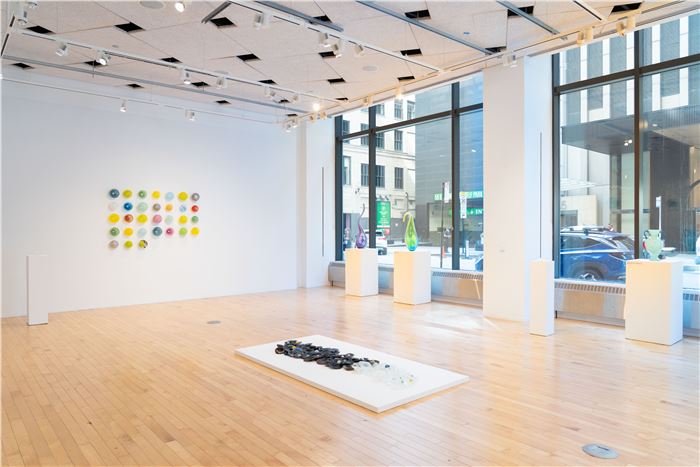
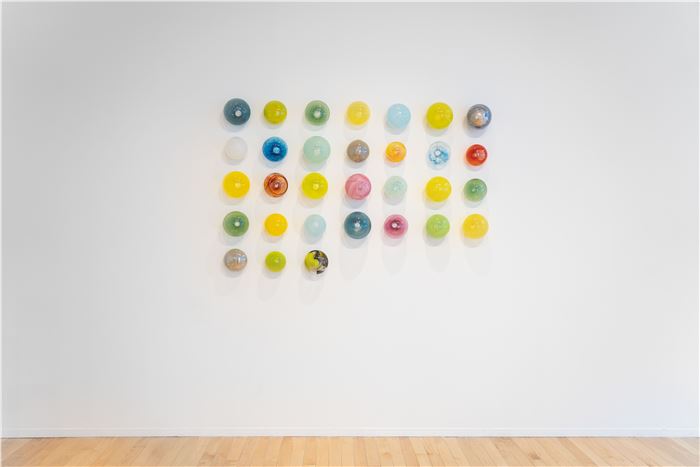
Inside the gallery, the curation adopts a scientific, almost rhythmic structure. The walls are bathed in a classic ROYGBIV spectrum, a deliberate choice that organizes the disparate works into a coherent, visual narrative. To the left, a vibrant wave of color—ranging from deep, saturated reds to ethereal violets—spans the gallery’s longest wall. This section is dominated by the Ignite Team’s Untitled: Wall Plates. The collection is a study in variance; some plates retain a flat, minimalist integrity, while others are pushed and pulled into decorative, bowl-like forms, their edges undulating like the contours of a landscape.
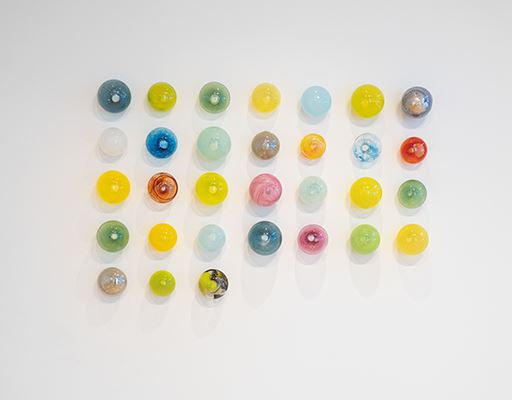
Moving deeper into the exhibition, the back wall shifts from the kaleidoscopic to the atmospheric. Here, visitors encounter Kay’s own Day By Day, a series of 31 blown, hollow glass spheres. Mounted in a precise, sequential order, the series acts as a visual log of the atmospheric shifts in the sky over the course of a single month. The transition from the rigid color spectrum of the wall plates to the natural, shifting hues of the spheres creates a visual odyssey, inviting the viewer to contemplate the passage of time through the lens of glass.
Vessels, Puddles, and the Freedom to Touch
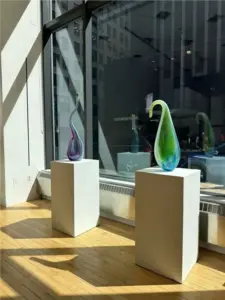
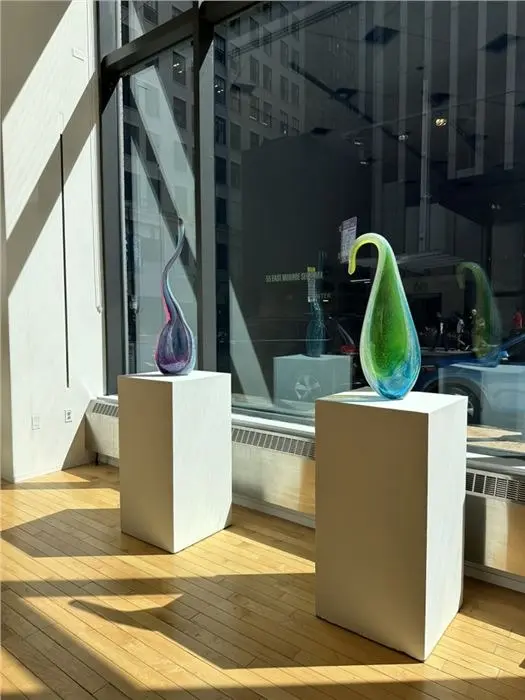
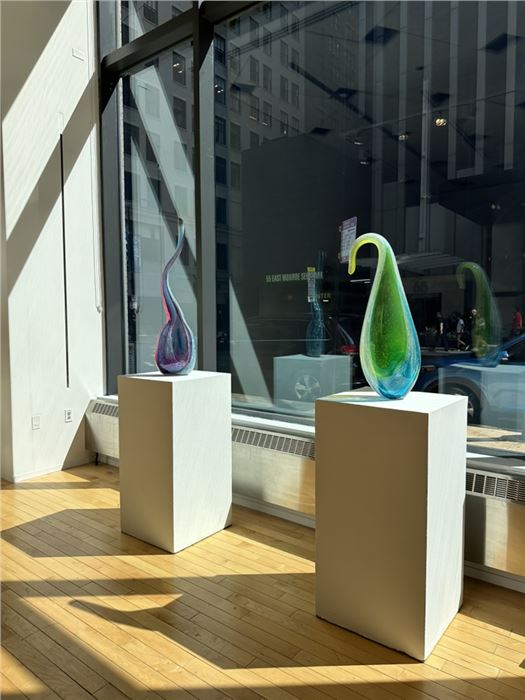
The gallery’s window space provides a different, more contemplative atmosphere. Here, a collection of objects—a water drop, a flame, a vase, and a glass puddle—seem to hold a silent conversation as the autumn sunlight filters through the glass, lengthening and shortening with the waning day. Two pieces by Ben Tullman anchor this display. His Untitled: Pink & Blue Vase features a masterful ombré technique that evokes the deepest, most dangerous colors of a fire. On the adjacent pedestal, his Untitled: Blue & Green Vase offers a stark contrast; it is a "droopy," organic form that captures the fluid, cooling nature of the material in deep shades of forest green and aquatic blue.
Nearby, Kay’s Low Bowls & Marbles offers an interactive "playpen" of clear glass, a work that challenges our understanding of liquid versus solid. It asks the viewer to consider how water might feel if it were frozen in time, inviting them to touch, move, and even juggle the glass pebbles. It is a sensory delight, bridging the gap between the static nature of the gallery and the kinetic energy of human curiosity. At the far end of the room, Kay’s Untitled: Pale Aqua Green Vase stands as a masterclass in transparency and light. The piece, a classic two-handed vessel, blends white, green, and lime tones, appearing to capture the way sunlight glints through canopy leaves or reflects off the surface of a submerged object. Its body, which mimics the movement of water, is contrasted by its handles, which hold a deep, Lake Michigan blue.
The emotional and physical heart of the exhibition, however, lies in the center of the room. Arvin Makhsous’s Untitled: Caviar Dishes & Orbs is a triumph of whimsy and tactile engagement. The work is explicitly designed to be rearranged. Small glass beads sit inside various dishes, creating a satisfying clink when moved, and the iridescence of the tiny spheres shifts with every change in the gallery’s light. By placing these dishes on a low pedestal just four inches off the hardwood floor, Makhsous invites the viewer to kneel, to get down on the level of the art, and to physically interact with the pieces. It is an act of defiance against the museum culture that demands we keep our hands in our pockets.
As I navigated the final corners of the space, I found myself drawn to three "globby" dishes placed in isolation. They were as clear as water, their glossy, tactile finish feeling almost like smooth, non-stick hard candies beneath the fingertips. These final objects solidified the curator’s premise: the joy of art is not found in the sterile distance between the observer and the observed, but in the physical connection to the object itself.
Leaving Handle With Care, I felt a lingering sense of gratitude. The exhibition succeeded in doing what few do: it made me question the barriers we place between ourselves and the objects that inhabit our world. Whether it is a display case, a museum artifact, or a simple household vessel, we are conditioned to believe that beauty is synonymous with untouchability. Kay’s exhibition asks, quite simply, Why can’t I touch it? It is a question that lingers long after you leave the gallery. And perhaps, as I finally headed out toward J&J’s for my fries, I realized the answer is simpler than the art world would have us believe. Some things are made to break, but that fragility is precisely what makes them worth holding in the first place.
Handle With Care was on view from August 27 to September 25 at SITE Galleries, School of the Art Institute of Chicago.