The prevailing narrative surrounding mid-century American painter Fairfield Porter (1907–1975) is one of steadfast defiance. In an era dominated by the muscular, often aggressive gestures of Abstract Expressionism, Porter remained an outlier. While his contemporaries—men like Jackson Pollock and Willem de Kooning—were dismantling the canvas and chasing the sublime through pure abstraction, Porter was doggedly committed to figuration. He was an artist who swam against the tide, maintaining a quiet, painterly dialogue with the traditions of the past while his peers sought to burn them down.
For much of his career, Porter occupied a strange, liminal space in the art world. He was widely admired by the very abstract painters whose work he seemed to reject, many of whom were his close personal friends. Yet, despite this intellectual camaraderie, he struggled to find sustained institutional recognition. He refused to compromise his style or his subject matter, famously asserting that “art does not stand for something outside itself.” Throughout his life, he drew inspiration from the intimate, domestic sensibilities of Édouard Vuillard and Pierre Bonnard, crafting landscapes, portraits, and quiet interior scenes that prioritized light, atmosphere, and the immediate reality of his surroundings.
It was only in his later years that Porter began to garner the sterling reputation he enjoys today. While he never achieved the household-name status of a Pollock or a de Kooning, he eventually secured his place in the pantheon of 20th-century American masters.
A Painter of Summer and Domesticity
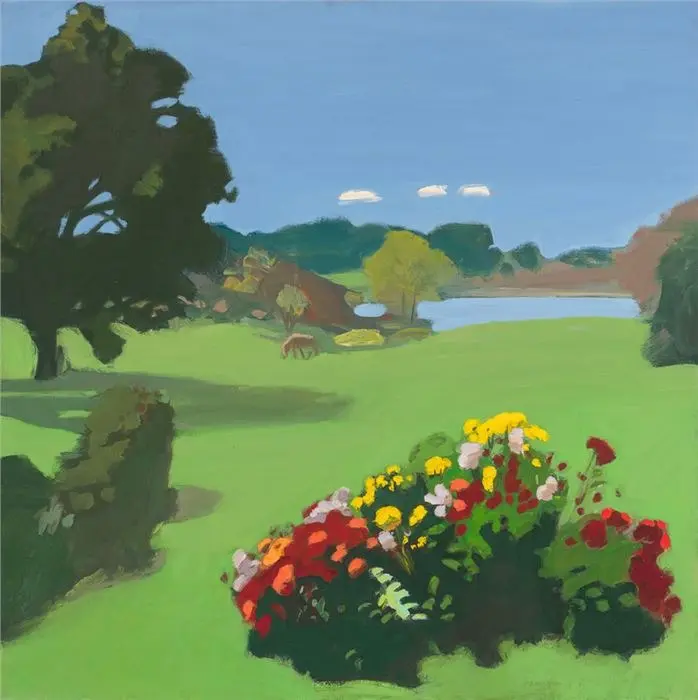
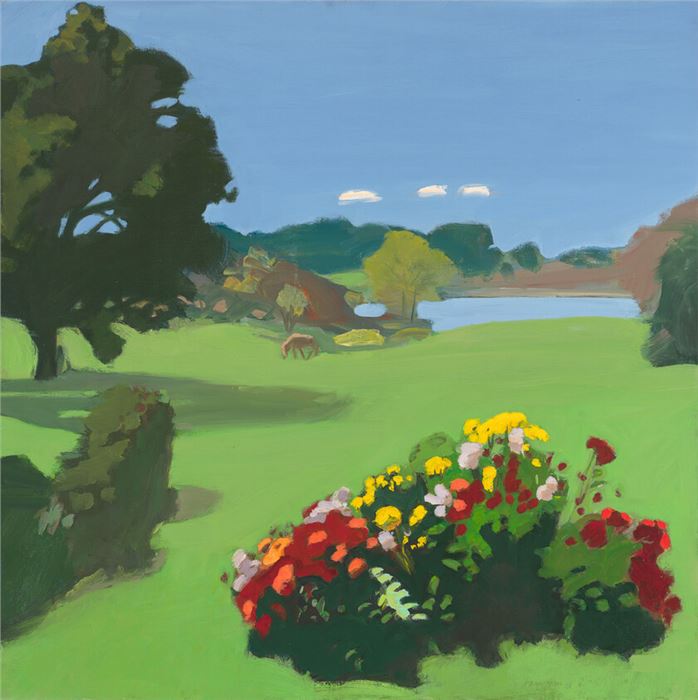
When the public thinks of a "typical" Fairfield Porter, they almost invariably summon images of a tranquil, sun-drenched landscape or a domestic interior. Works like Chrysanthemums under a Blue Sky (1961) serve as the archetype of his practice: a lambent green lawn, a serene, expansive sky, and the quiet, reflective surface of a pond. In this piece, the titular chrysanthemums pull the viewer into the frame, their vibrant shades of red, yellow, and orange acting as the focal point of an otherwise meditative composition.
Similarly, Claire White (1960) showcases his mastery of the interior scene. The subject, an elegant middle-aged woman in a simple white dress, sits quietly before a window. It is a work of immense restraint and taste, capturing a fleeting moment of stillness. His extensive body of work documenting his family homes in Southampton and Maine further cements this reputation. From The Harbor (1966) and Islands (1968) to Trees in Bloom (1968), Oak Tree (1969), and the poignant The Dog at the Door (1971), Porter’s output is a love letter to the familiar.
This consistent focus on the idyllic and the domestic led to a somewhat reductive assessment of his legacy. In 1985, Artforum famously—and perhaps dismissively—concluded that “Fairfield Porter floats in memory as a painter of summer, of dappled fields, of porches—a suburban painter, really.” For decades, this assessment clung to his reputation, framing him as an artist of the pastoral, largely ignoring the more complex, gritty, and occasionally unsettling dimensions of his urban work.
Reassessing the Urban Eye
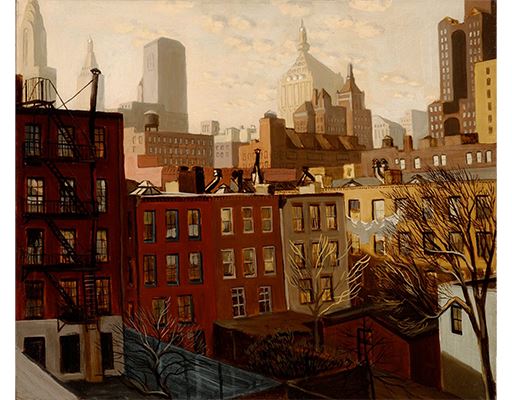
To categorize Porter solely as a “suburban painter” is to miss a significant, albeit smaller, thread of his oeuvre: his cityscapes. Spanning from the 1930s and 1940s through to the 1970s, these works reveal a different side of the artist. While his pastoral proclivities were certainly his primary mode, his forays into the urban environment are deeply evocative and dreamy.
These cityscapes reflect Porter’s own philosophy on the purpose of viewing art. He once remarked, “I do not like to be superior to a story or picture. I like to be able to be lost in it. This is not a desire for escape; it is a desire for direct understanding, which is a feeling that gives a sense of psychological power. That is my enjoyment of art.” In his cityscapes, Porter does not merely document the architecture of New York; he allows himself to be lost within its rhythm.
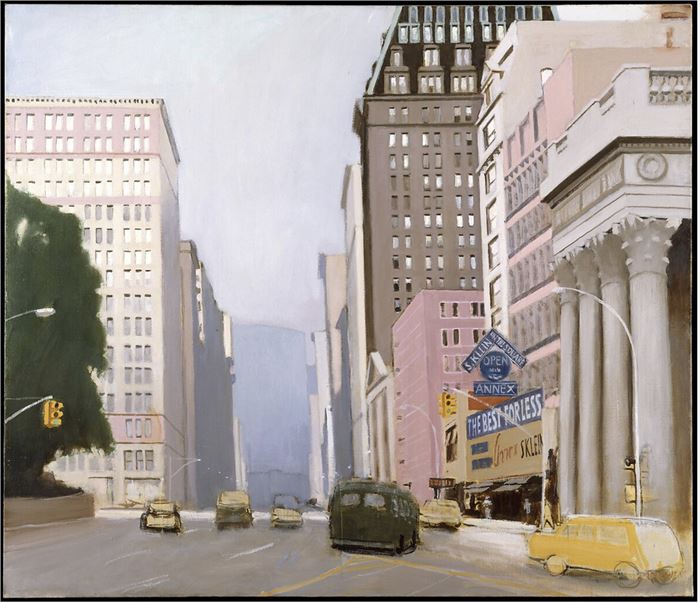
There appear to be two distinct strains within these urban works. The first is characterized by a sense of order and optimism, capturing mid-20th-century New York during a time that feels, in retrospect, like the city’s golden hour—before the decay and fiscal instability of the mid-1970s took hold. These paintings, primarily focused on Midtown and Union Square, are filled with well-dressed businessmen, elegant women, and bustling, wide streets.
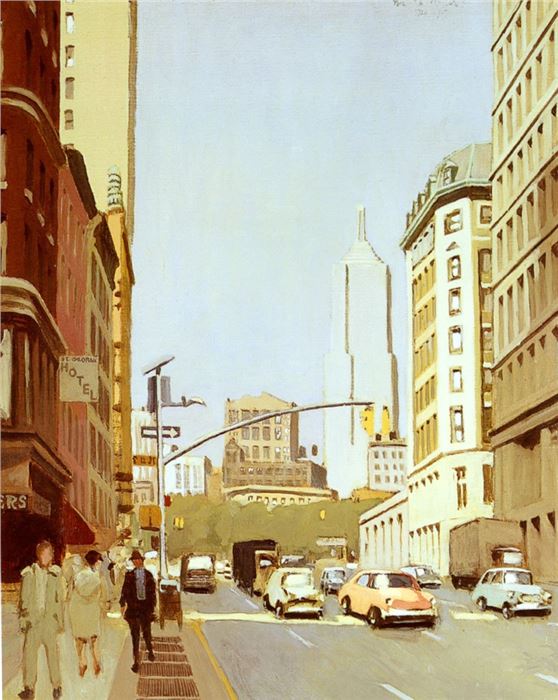
In Union Square, Looking up Park Avenue (1975), the viewer is presented with a city on a bright, purposeful day. Cars curve gracefully around the street in front of the Union Square Savings Bank. The palette is soft and inviting: a cool, cozy pewter sky set against buildings rendered in creamy taupes, beiges, and cotton-candy pinks. There is no dirt, no urban grit, only the promise of the city. Porter once noted in an interview that he found the light in New York to be superior to that of Paris or Rome. In these scenes, he applied his belief—borrowed from his hero Vuillard—that “the extraordinary is everywhere.”
The Uneasy City
However, to assume that the patrician Porter only saw the city in pastels would be a mistake. Beneath the surface of his orderly avenues, there exists a more ambiguous, often unsettling strain of work. In these pieces, Porter experimented with painterly abstraction to evoke mystery and a sense of the uncanny.
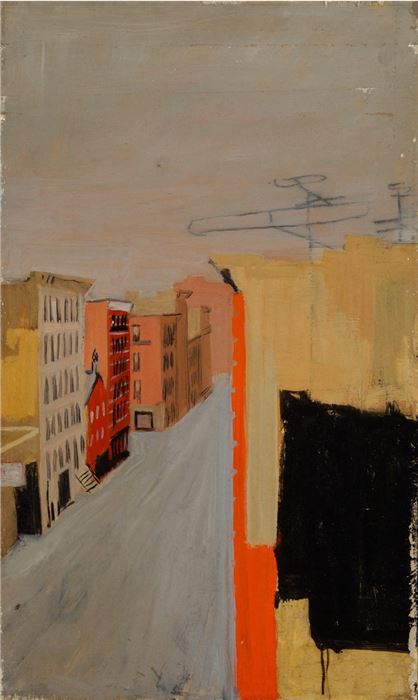
Consider Untitled (East 11th Street) (ca. 1961), where an empty street carves a divide through the canvas. To the left, a traditional row of urban buildings stands in recognizable detail. To the right, the structures are barely intelligible—splotchy, unfinished rectangles and squares. These forms are devoid of detail, echoing the geometric abstraction of Hans Hofmann more than any other work in Porter’s realist catalog.
Other works amplify this sense of isolation. City Street (ca. 1970) is completely devoid of human life or traffic, a silence that creates a palpable tension. Street Scene (ca. 1943) includes human figures, yet the woman in the foreground appears visibly nervous, her posture suggesting a fleeting, private anxiety. Art critic Lance Esplund has noted that while this anxiety is tempered by the beauty of the salmon and ochre building facades and a serene baby-blue sky, the overall effect of many of Porter’s cityscapes is one of being “grimy, gritty, [and] uneasy.”
This underlying tension culminates in Cityscape (ca. 1970s). The background is a quotidian rendering of a bridge and urban architecture, but the foreground is dominated by three spectral figures. A man, a woman, and a small conveyance—perhaps a stroller or a cart—hover on the left side of the canvas, their relationship to one another obscured by ambiguity. A ghostly girl, lightly limned in white, seems to emerge directly from the dirty brown pavement she is crossing.
Porter’s contemporary and friend, the artist Jane Freilicher, once observed that an “unfinished quality” was central to his work. In these urban scenes, that quality serves a specific purpose: it makes the paintings vibrate with an odd, nervous energy. It forces the viewer to confront the fact that, for all his love of the domestic and the pastoral, Porter was acutely aware of the city’s capacity to isolate and unsettle.
Ultimately, Fairfield Porter was not a chronicler of the city in the vein of the Ashcan School, who sought to capture the grit of the working class with sociological intent. Instead, his New York cityscapes are something more personal and enigmatic. They offer a rare window into a Mad Men-era New York of gray flannel suits and elegant avenues, while simultaneously reminding us of the city’s timeless, and perhaps more dangerous, ability to beguile, haunt, and unnerve. By looking past the label of the "suburban painter," we find in Porter an artist who was just as comfortable with the silence of a city street as he was with the light on a summer porch.