The prevailing narrative surrounding the mid-century American painter Fairfield Porter (1907–1975) is one of stubborn, principled isolation. In the popular imagination, Porter stands as the quintessential outsider: a highly gifted, largely self-taught artist who remained steadfastly committed to representational figuration at the very moment when Abstract Expressionism had become the dominant orthodoxy of the art world. While he maintained close personal friendships with the titans of the era—figures like Jackson Pollock and Willem de Kooning—Porter often found himself on the periphery of critical acclaim, struggling to gain traction in a cultural climate that viewed his chosen path as anachronistic.
Porter’s resistance to the prevailing currents was not a mere act of contrarianism, but a philosophical stance. He famously posited that "art does not stand for something outside itself," a belief that empowered him to continue painting portraits, intimate interior scenes, and lush landscapes throughout his life. Drawing heavily from the aesthetic lineage of Edouard Vuillard and Pierre Bonnard, Porter cultivated a style defined by sensitivity to light and the quiet dignity of domestic life. By the time he reached his later years, his reputation began to crystallize, cementing his place in the pantheon of 20th-century American masters, even if he never attained the singular, household-name status of his abstract contemporaries.
A Painter of Summer
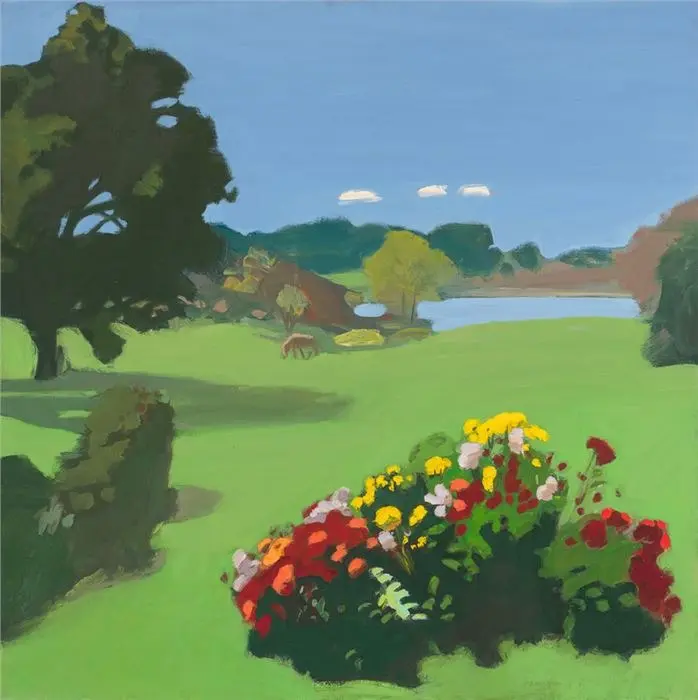
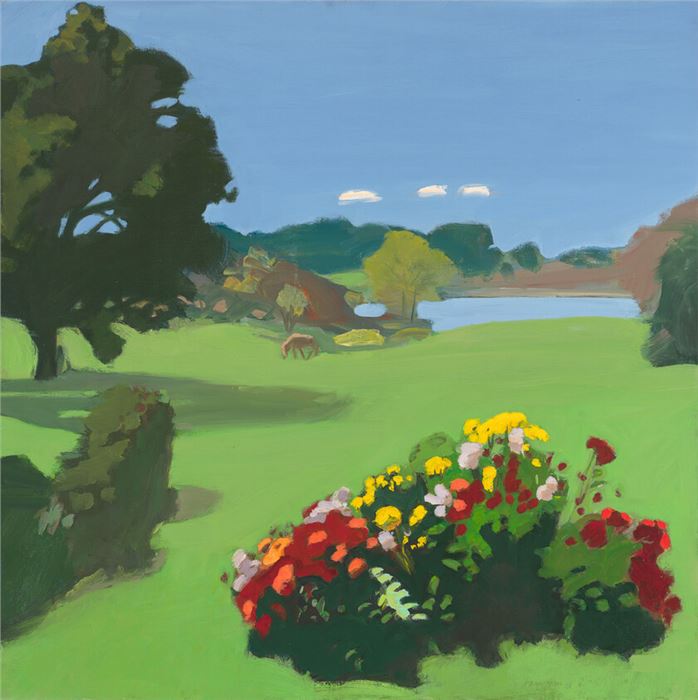
To discuss the "typical" Porter work is to enter a world of tranquil observation. Critics and scholars often point to pieces like Chrysanthemums under a Blue Sky (1961) as the blueprint of his practice. In this work, the viewer is drawn into a lambent green lawn, a serene, expansive sky, and the gentle stillness of a pond. The central cluster of chrysanthemums, rendered in striking, vibrant shades of red, yellow, and orange, serves as the anchor of the composition.
This theme of the domestic idyll is echoed in Claire White (1960), a masterclass in interior portraiture. The subject, a middle-aged woman in a simple white dress, sits with quiet composure before a window, the light capturing the stillness of the moment. Throughout his career, Porter frequently returned to the settings of his own life: his homes in Southampton and Maine. Works such as The Harbor (1966), Islands (1968), Trees in Bloom (1968), Oak Tree (1969), and The Dog at the Door (1971) collectively paint a portrait of an artist deeply rooted in the comfort of familiar surroundings.
However, this focus on the pastoral occasionally led to a reductive critical assessment of his work. In 1985, Artforum famously, and somewhat dismissively, characterized Porter as "a painter of summer, of dappled fields, of porches—a suburban painter, really." While this description captures a significant portion of his output, it ignores the complexities and contradictions that existed just beneath the surface of his career. To label him merely a painter of the suburbs is to overlook a haunting, significant, and recurring theme in his body of work: the cityscapes of New York.
The Urban Gaze
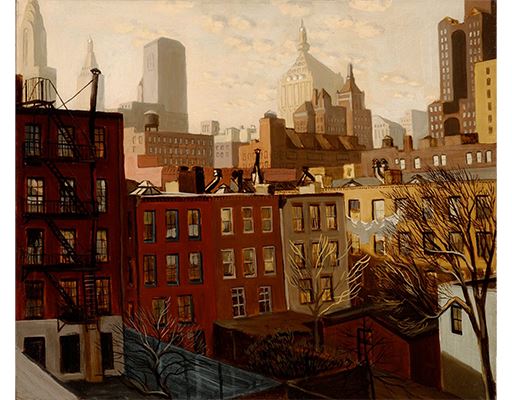
Porter’s urban scenes, which span from the 1930s and 1940s through the 1960s and 1970s, reveal a different side of his artistic consciousness. While they are far fewer in number than his pastoral scenes, they are deeply evocative, carrying a dreamy, psychological weight. These works reflect Porter’s own stated approach to art: "I do not like to be superior to a story or picture. I like to be able to be lost in it. This is not a desire for escape; it is a desire for direct understanding, which is a feeling that gives a sense of psychological power."
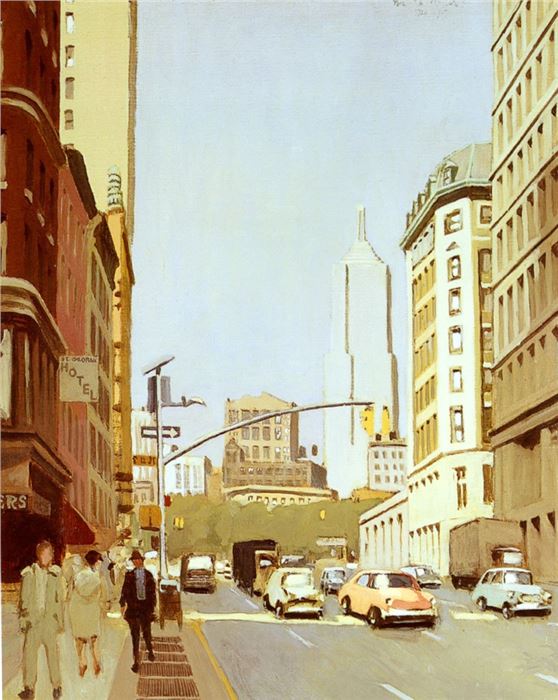
There appear to be two distinct, sometimes overlapping strains within his cityscapes. The first is characterized by a sense of order, light, and promise. These paintings capture a mid-century New York that feels poised and bright, often focusing on Midtown and Union Square. In these scenes, we see a city of bustling streets filled with automobiles, well-dressed figures, and manicured urban greenery.
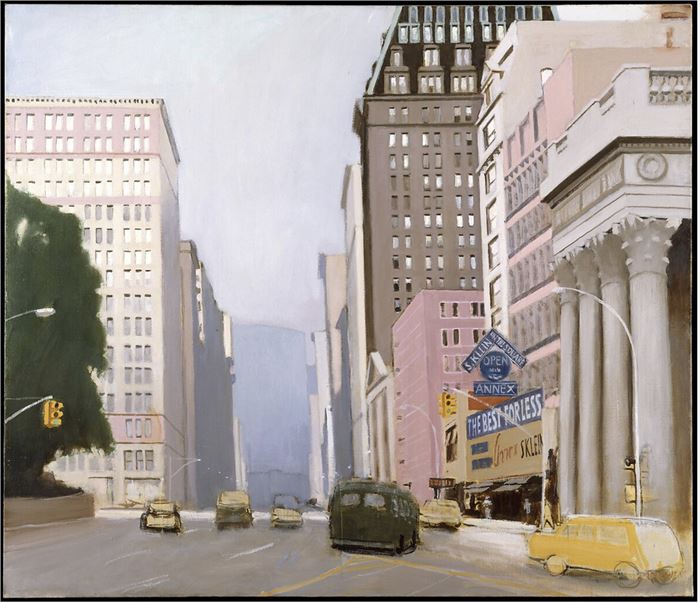
Consider Union Square, Looking up Park Avenue (1975). The painting depicts a handful of cars navigating the curve of the street near the Union Square Savings Bank. The palette is dominated by cool, cozy pewter grays, balanced by the creamy taupes, beiges, and soft pinks of the building facades. There is a notable absence of decay or grit; instead, the city is presented on a day filled with purpose. Porter, who once remarked in an interview that the light in New York was superior to that of Paris or Rome, possessed an ability to find the extraordinary in the ordinary. He echoed the sentiment of his mentor Vuillard: "The extraordinary is everywhere."
The Unease of the Streets
Yet, the patrician, orderly vision of the city was only one facet of Porter’s engagement with New York. His cityscapes are frequently haunted by an ambiguity that drifts into the uncanny. In Untitled (East 11th Street) (ca. 1961), for instance, the composition is bisected by a completely empty street. While the left side of the canvas features a recognizable row of urban architecture, the buildings on the right are rendered in splotchy, abstract squares and rectangles. These forms, stripped of architectural detail, lean closer to the geometric abstraction of Hans Hofmann than to the realism for which Porter is best known.
This sense of alienation is heightened in works like City Street (ca. 1970), which is devoid of both people and vehicles—a haunting, unlikely stillness that creates an immediate sense of unease in the viewer. Even when people are present, as in Street Scene (ca. 1943), the atmosphere remains charged. The woman in the foreground, poised to cross the street, appears visibly nervous. Art critic Lance Esplund has noted that while the "anxiousness is tempered by beauty" through the use of lovely ochres, salmons, and a serene blue sky, the overall impression is one of a "grimy, gritty, uneasy" urban landscape.
This underlying tension reaches a peak in Cityscape (ca. 1970s). The background, a standard arrangement of bridges and buildings, is overshadowed by a foreground featuring three spectral figures rendered in rough, heavy, and seemingly hurried brushstrokes. A man, a woman, and a small conveyance—perhaps a stroller or a cart—hover on the left, their connection to one another left intentionally obscure. A ghostly girl, outlined in faint white, seems to emerge directly from the dirty brown pavement as she crosses the street.
The "unfinished" quality of these works, which his friend and contemporary Jane Freilicher noted was a deliberate part of his process, serves to give the paintings a vibrating, restless energy. This style suggests that Porter was not merely documenting the architecture of New York, but was attempting to capture the psychological experience of living within it—the moments of isolation, the fragility of the human figure against the hard, industrial backdrop of the city, and the strange, lingering power of urban space.
Ultimately, it would be inaccurate to categorize Fairfield Porter simply as a "painter of the city" in the vein of the Ashcan School, whose work was explicitly focused on the social realities of urban life. Porter’s cityscapes are far more personal, meditative, and, at times, abstract. However, they remain an essential, under-appreciated contribution to his oeuvre. They provide a vital window into the Mad Men-era New York of gray flannel suits and architectural permanence, while simultaneously acknowledging the city’s timeless, inherent ability to both beguile and unnerve. By looking at these works, we see a Fairfield Porter who was not just a painter of summer lawns, but a keen observer of the complicated, often unsettling, beauty of the modern urban experience.