For decades, the art historical narrative surrounding Fairfield Porter (1907–1975) has been remarkably consistent, if somewhat limiting. The story typically frames Porter as an isolated, dogged defender of figurative painting, a man who maintained his commitment to the representational image at a time when the American art world was entirely captivated by the explosive, gestural power of Abstract Expressionism. While he moved in the same circles as giants like Jackson Pollock and Willem de Kooning—many of whom were his close friends—Porter often found himself on the periphery of critical acclaim, struggling to gain recognition in an era where abstraction was considered the only vital, relevant path forward.
Porter remained steadfast in his refusal to conform to the prevailing trends of the mid-20th century. He was a man of firm convictions, famously declaring that “art does not stand for something outside itself.” Throughout his career, he focused his gaze on landscapes, intimate portraits, and quiet, domestic interior scenes, drawing deep inspiration from the French masters Edouard Vuillard and Pierre Bonnard. It was only toward the twilight of his life that he began to secure the sterling reputation he holds today. While he may never have achieved the ubiquitous household fame of his more bombastic contemporaries, he firmly established his place in the pantheon of significant American painters.
A Painter of Summer and Domesticity
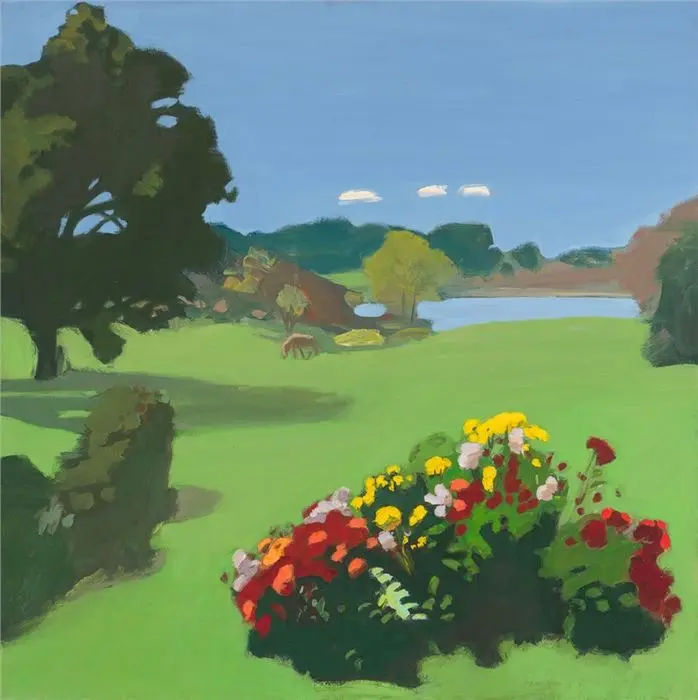
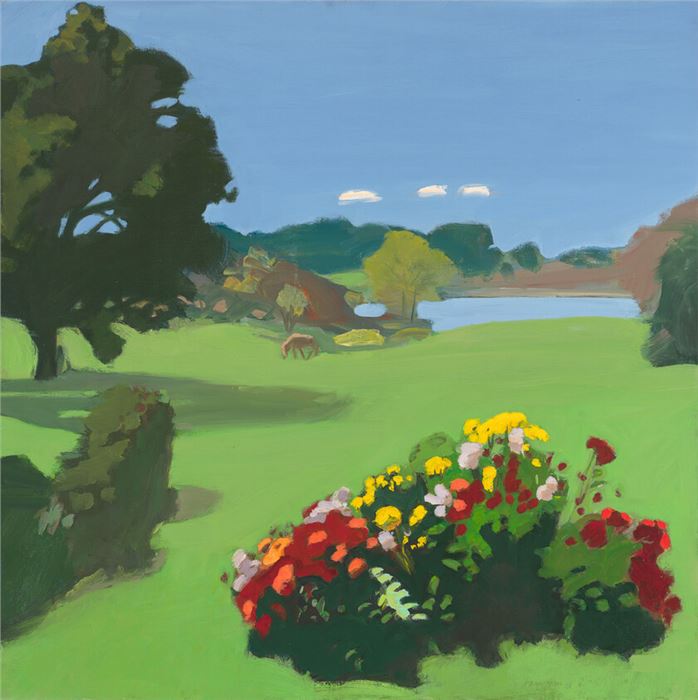
When one envisions a quintessential Fairfield Porter, the mind often wanders to works like Chrysanthemums under a Blue Sky (1961). The canvas is a testament to his ability to capture the lambent, shimmering quality of a green lawn, the serenity of a vast sky, and the quiet stillness of a pond. The titular cluster of flowers, rendered in vibrant, striking shades of red, yellow, and orange, acts as a visual anchor, drawing the viewer into a scene of profound tranquility. Similarly, Claire White (1960) showcases his mastery of the interior, presenting a middle-aged woman in a simple, elegant white dress, seated in a chair before a window. The scene is quiet, dignified, and deeply personal.
His oeuvre is heavily populated by the familiar domestic spaces of his own life, particularly his homes in Southampton and Maine. Paintings such as The Harbor (1966), Islands (1968), Trees in Bloom (1968), Oak Tree (1969), and the charming The Dog at the Door (1971) serve as a collective diary of his idyllic natural environs. These works cemented his reputation as an artist of the domestic sphere. This perception was perhaps best—if rather dismissively—summarized by Artforum in 1985, which noted that "Fairfield Porter floats in memory as a painter of summer, of dappled fields, of porches—a suburban painter, really."
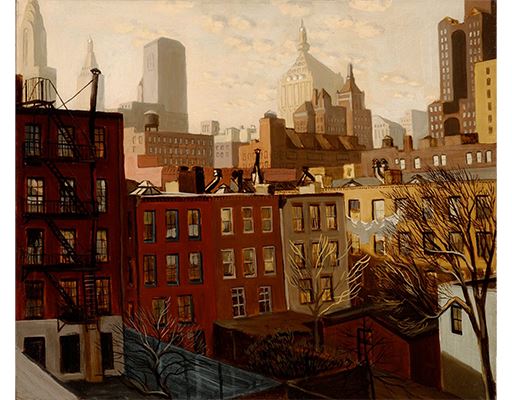
However, this characterization, while grounded in the sheer volume of his pastoral works, risks ignoring a significant, albeit smaller, portion of his output. To label Porter solely as a "painter of summer" is to overlook the evocative, often haunting cityscapes he produced throughout his career. From his early efforts in the 1930s and 1940s to his later, more mature works in the 1960s and 1970s, Porter’s engagement with the urban environment offers a necessary counterpoint to his rural idylls. These cityscapes are not merely incidental; they are deeply representative of his broader artistic philosophy. Porter once remarked that he did "not like to be superior to a story or picture. I like to be able to be lost in it. This is not a desire for escape; it is a desire for direct understanding, which is a feeling that gives a sense of psychological power. That is my enjoyment of art."
Union Square, Midtown, and the Ambiguity of the City
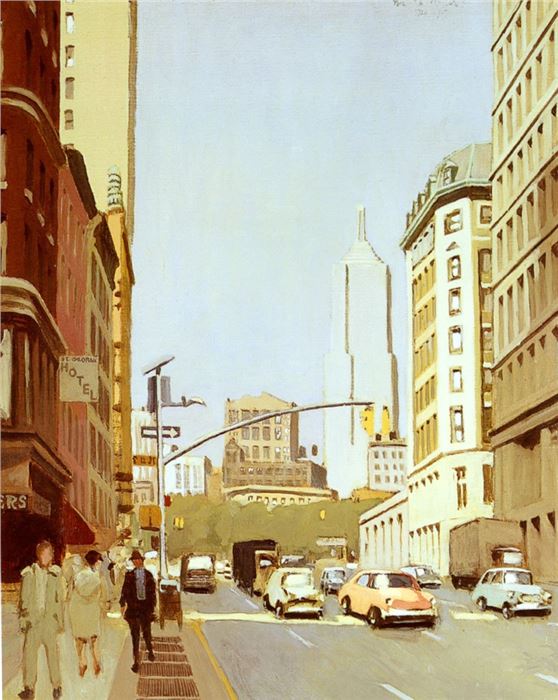
Porter’s urban paintings seem to fall into two distinct categories. The first is a collection of orderly, almost optimistic scenes that capture the mid-20th-century vitality of New York before the city’s slide into the fiscal crises of the 1970s. These works, primarily focusing on midtown and the Union Square area, are filled with the hallmarks of the era: well-dressed professionals, bustling thoroughfares populated by classic automobiles, and the clean lines of building facades accented by patches of urban greenery.
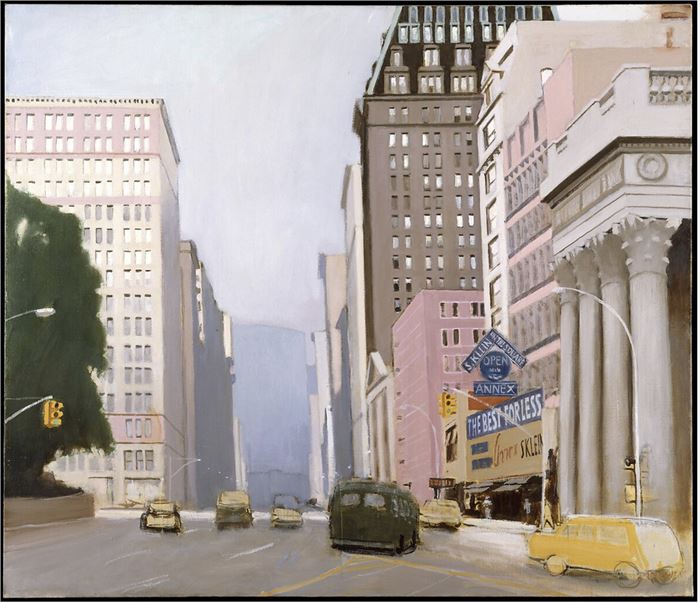
In Union Square, Looking up Park Avenue (1975), Porter depicts a stream of cars curving past the Union Square Savings Bank. The palette is muted yet warm, defined by a cool, pewter-gray sky that sits atop buildings painted in creamy taupes, beiges, and soft cotton-candy pinks. There is a notable absence of urban decay or chaos; the city is portrayed as a place of promise and purpose on a bright, clear day. Porter, who once stated that he found the light in New York to be superior to that of Paris or Rome, possessed a rare ability to elevate the ordinary. As he wrote of his idol Vuillard, "the extraordinary is everywhere."
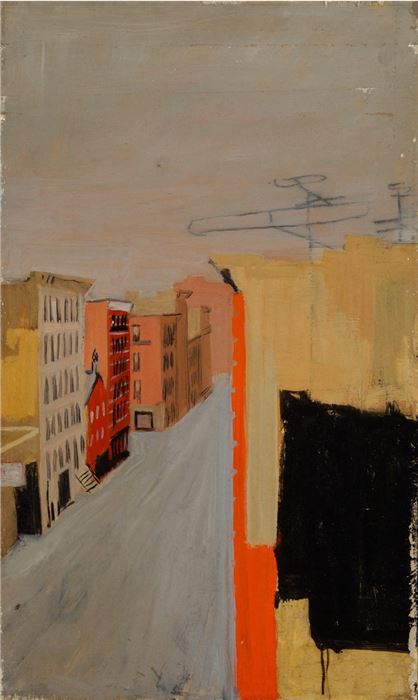
Yet, the patrician eye of Fairfield Porter was not always fixed on the serene or the pastel-hued. There exists a more complex, ambiguous side to his urban work, where he leans into painterly abstraction to cultivate a sense of mystery and even uncanniness. Untitled (East 11th Street) (ca. 1961) serves as a prime example of this duality. The composition is bisected by a stark, empty street that stretches from the foreground to the horizon. On the left, a row of recognizable urban buildings stands in contrast to the right side of the street, where the structures are rendered as barely intelligible, splotchy rectangles. These forms, stripped of architectural detail, bear a striking resemblance to the color-field abstractions of Hans Hofmann, standing in stark contrast to the rest of Porter’s realist catalog.
Other works lean further into this psychological tension. City Street (ca. 1970) presents a desolate, people-less thoroughfare that evokes a sense of profound unease. Even when figures are present, as in Street Scene (ca. 1943), the atmosphere remains charged. The woman in the foreground, poised to cross the street, carries a look of palpable nervousness. Art critic Lance Esplund has noted that while this "anxiousness is tempered by beauty" through the artist’s use of lovely salmons, ochres, and a serene baby-blue sky, the cumulative effect of these works is often "grimy, gritty, [and] uneasy."
This underlying tension reaches a peak in his later works, such as Cityscape (ca. 1970s). The background remains a quotidian depiction of bridges and buildings, but the foreground is dominated by three spectral figures rendered in rough, heavy, and deliberately unrefined brushstrokes. A man, a woman, and a small conveyance—perhaps a stroller or a cart—hover on the left, their spatial and social relationship to one another left intentionally obscure. A ghostly, barely limned girl in white seems to materialize out of the dirty brown asphalt as she crosses the street.
The painter Jane Freilicher, a close friend and contemporary of Porter, once observed that an "‘unfinished’ quality… was part of his paintings." In his cityscapes, this quality transcends mere technique; it becomes a mechanism for imbuing the urban landscape with a vibrating, restless energy. While Porter cannot be categorized as an "urban painter" in the vein of the Ashcan School—who were dedicated to the documentary grit of city life—his New York scenes represent a crucial, often under-appreciated dimension of his work. They provide a vital window into the "Mad Men" era of the city, capturing not just the gray flannel suits and the architecture of the time, but also the enduring, paradoxical ability of New York to both beguile and unnerve those who walk its streets. By looking past the porches and the dappled fields, one discovers that Porter’s vision was as complex and multifaceted as the city he chose to paint.