Scientists have reached a major milestone in the quest to build an entirely new kind of clock. After decades of intensive global research, a pioneering team of physicists in Vienna has successfully developed the world’s first self-stabilizing nuclear clock, a groundbreaking device that could eventually measure time with far greater precision than today’s most advanced atomic clocks.
Unlike earlier experimental prototypes, the newly unveiled nuclear clock possesses the remarkable ability to maintain its own stability entirely on its own, without depending on a conventional atomic clock for correction or reference. In rigorous laboratory testing, researchers have successfully demonstrated that the apparatus can operate steadily and autonomously for more than 24 hours without any external human intervention.
This monumental achievement represents a vital, long-sought advance in the field of precision measurement, widely known as metrology. By harnessing atomic nuclei as exceptionally stable natural references, nuclear clocks could eventually allow scientists and researchers to measure time and other fundamental physical quantities with levels of accuracy that existing technologies simply cannot reach.
Why Thorium Holds the Key to Nuclear Clocks
The fundamental breakthrough relies heavily on a deeply unusual and specific property of thorium atomic nuclei that scientists have investigated, debated, and analyzed for decades.
In the realm of quantum physics, atomic nuclei can naturally exist in various distinct energy states, but moving between those states typically requires enormous, highly prohibitive amounts of energy. Thorium stands as a rare and fortuitous exception to this general rule. Two of its specific nuclear energy states are separated by an unusually small energy gap, making it uniquely possible to trigger a direct transition between them using precisely tuned laser light.
This rare property is fundamentally crucial because it allows researchers to directly control the energy state of an atomic nucleus using a laser beam—a feat that is not possible in the same reliable way for most other atomic nuclei found in nature. Scientists can subsequently use this extremely precise quantum transition as a pristine reference point for measuring the passage of time.
A major historical turning point came in April 2024, when researchers led by Prof. Thorsten Schumm at the Institute of Atomic and Subatomic Physics at TU Wien, working in close collaboration with a team led by Prof. Ekkehard Peik at PTB Braunschweig, successfully identified this long-sought nuclear transition experimentally. For the very first time in history, they demonstrated conclusively that laser beams could successfully excite thorium nuclei.
Further technical progress followed swiftly in the fall of 2024. Building directly on their earlier success, the researchers physically connected their thorium excitation apparatus to a conventional optical atomic clock, demonstrating for the first time that the atomic nuclei could indeed serve as a highly precise timekeeping reference.
Although this crucial milestone established the basic underlying principle of a nuclear clock, one essential capability was still missing from the technology: the ability to maintain its own accuracy and stability completely independently, without external assistance.
Scientists Build a Nuclear Clock That Stabilizes Itself
"What you really want is a self-stabilizing nuclear clock," explains Prof. Thorsten Schumm, detailing the long-term vision of the project. "The basic idea is simple: you have a laser and you have thorium. The laser changes the energy state of the thorium nuclei, and the thorium nuclei are used to stabilize the frequency of the laser."
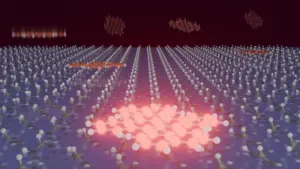
To make this complex feedback loop possible, the researchers engineered an innovative system built entirely around a specially designed crystal containing embedded thorium atoms, manufactured directly in the laboratories at TU Wien. In this setup, a laser shines continuously onto the crystal, interacting directly with the thorium nuclei housed securely inside.
The laser’s light oscillates at a particular, highly regulated frequency, providing a steady, regular rhythm that can theoretically be used to measure time. However, even the tiniest, almost imperceptible changes in the surrounding laboratory environment—such as microscopic vibrations, electromagnetic interference, or ambient shifts—can interfere with that delicate rhythm.
"The oscillation of this laser light can be used for timekeeping, but the laser frequency can shift slightly from time to time, for example due to temperature fluctuations," explains Thorsten Schumm. "For high-precision measurements, you therefore need a mechanism to keep the laser frequency exactly stable, so that the clock continues to tick with precisely the same rhythm."
Traditional atomic clocks solve this persistent problem by using the energy transitions of electrons orbiting the outer shells of atoms as a stable, reliable reference. The Vienna research team has now convincingly demonstrated that the dense, heavily shielded nuclei of thorium atoms can perform that exact same critical function, but with inherently superior performance characteristics.
The physical mechanism works because thorium nuclei absorb laser light only when the incoming light has precisely the correct frequency. If the laser begins to drift even slightly away from that exact resonant frequency, the amount of light absorbed by the thorium nuclei decreases noticeably.
The system’s built-in monitoring electronics detect this subtle change in absorption and automatically adjust the laser system to bring it right back to the correct frequency. This continuous, closed-loop feedback keeps the clock operating at a remarkably consistent rate, without requiring a conventional atomic clock to maintain its stability from the outside.
For the first time in scientific history, researchers have successfully demonstrated a self-regulating nuclear clock that can function entirely independently in a laboratory setting.
A Clock With an Error of Just One Second in 30 Million Years
The profound potential advantage of nuclear clocks stems directly from the extraordinary, unique properties inherent to atomic nuclei compared to entire atoms.
"The great advantage of the new nuclear clock in Vienna is that, if you use atomic nuclei rather than atoms, much higher precision is possible in principle," notes Thorsten Schumm.
Atomic nuclei are astonishingly small—more than 10,000 times smaller than complete atoms. Because of their extremely compact physical size, they are vastly less affected by external environmental influences, such as stray magnetic fields, electric fields, and thermal blackbody radiation, all of which can severely disrupt precise measurements in traditional atomic systems.
This innate resistance to environmental disturbances makes nuclear energy transitions especially promising for the future of ultra-precise timekeeping.
To rigorously evaluate the performance of their newly built prototype, the researchers measured its stability and operational performance continuously over the course of a full day. The experimental nuclear clock achieved an impressive relative precision of approximately 10 to the power of minus 15, an elite performance tier roughly equivalent to an error of just one second over a staggering span of 30 million years.
That figure formally describes the clock’s measured short-term precision during the test rather than an actual continuous test lasting millions of years. Nevertheless, it vividly illustrates the remarkable accuracy that the researchers have already managed to achieve with an early-stage laboratory prototype.
Despite this milestone, the new nuclear clock is not yet quite as precise as the world’s leading optical atomic clocks, which currently remain the undisputed global benchmark for high-performance timekeeping.
"This is not yet at the level of the world’s best optical atomic clocks, but for a first prototype it is a fantastic result," emphasizes Thorsten Schumm.
The Next Step Toward Even More Precise Timekeeping
Looking ahead, the researchers firmly believe that their newly demonstrated nuclear clock design has considerable room for substantial improvement. By incorporating more powerful, refined lasers and developing significantly higher-quality thorium-doped crystals, they hope to dramatically increase the system’s overall precision in the near future.
These upcoming technological upgrades could eventually allow nuclear clocks to surpass and outperform existing atomic clocks, ultimately establishing an entirely new global standard for measuring time and frequency.
The wider scientific implications extend far beyond simply building a better clock for everyday or industrial use. Dramatically more accurate timekeeping can also profoundly improve the measurement of other fundamental physical quantities, providing theoretical and experimental physicists with increasingly sensitive tools for investigating the deepest, most elusive properties of nature, such as potential variations in fundamental physical constants over cosmological timescales.
For now, the Vienna research team’s monumental achievement firmly demonstrates that a long-pursued scientific concept can successfully operate as a self-sustaining timekeeping system in the real world. With the world’s first self-stabilizing nuclear clock now successfully running independently in the laboratory, scientists have taken a massive, definitive step toward a future in which time can be measured with unprecedented precision.