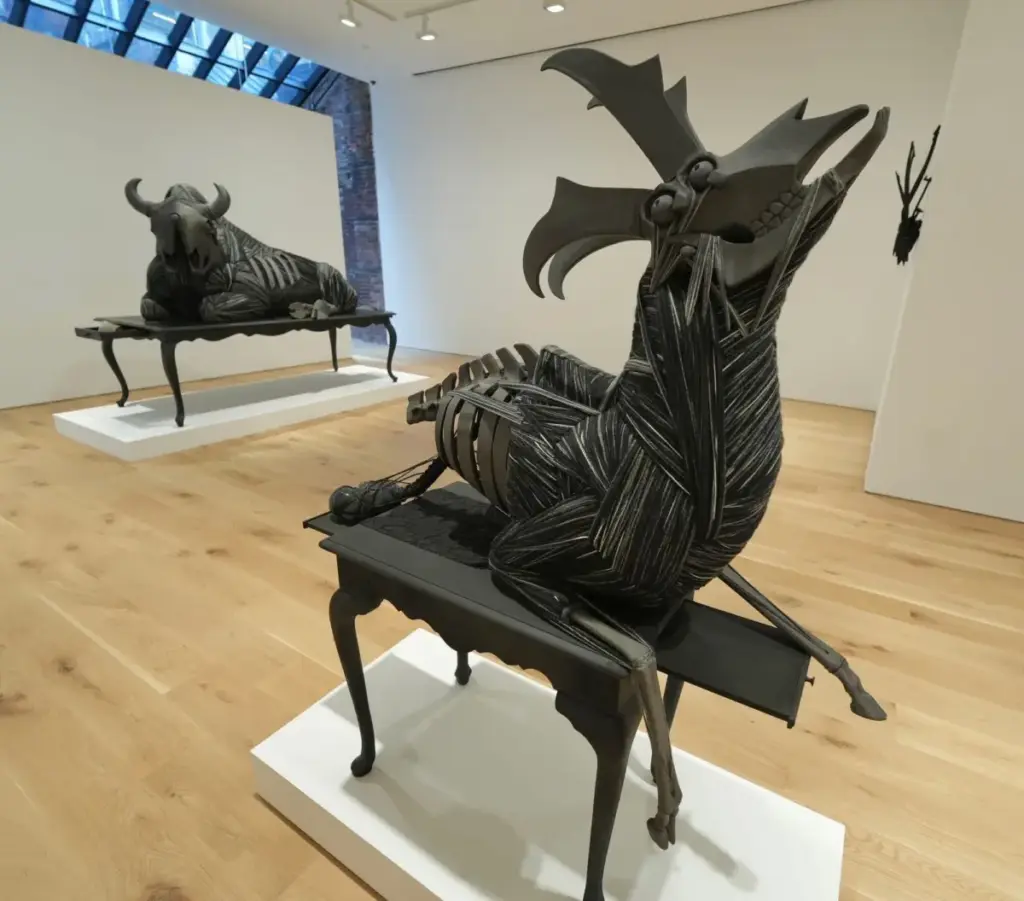
When visitors step into the Garth Greenan Gallery in Soho, they are immediately met by a powerful, declarative synthesis of wood, ink, and historical archives. This is American Traditional, the newest exhibition by multidisciplinary artist Cannupa Hanska Luger. Known widely for his participatory, ceramics-heavy projects that engage communities in collective action and storytelling, Luger shifts gears here. In this latest body of work, he arrives at something sharper and more permanent, setting aside mass collaboration to confront a harrowing visual history of destruction that is embedded into the very fabric of the American landscape.
The emotional architecture of Luger’s exhibition echoes other recent institutional efforts to recontextualize the brutal iconography of westward expansion. Two years ago, encounters with historical artifacts in major museums sparked vital conversations about how society confronts historical trauma. At the Baltimore Museum of Art, as part of the landmark exhibition Preoccupied: Indigenizing the Museum, visitors came face-to-face with the infamous 1892 photograph of two men standing atop an immense, towering hill of buffalo skulls. That shocking image—disturbing and jarring even after more than a century of public circulation—was deliberately covered by a small wall-mounted curtain designed by Yurok artist Stormi Turner.
Turner’s curatorial intervention granted the historical photograph the depth of tragedy that it always warranted. It mirrored the modern protocols applied to human remains in cultural institutions today, which are frequently safeguarded behind protective doors that visitors must actively open, or placed beneath weighted covers that demand conscious engagement to remove. This gesture of shielding and unveiling honored an animal that numerous Native American groups and communities lived in a profound, symbiotic relationship with for millennia. It acknowledged that looking at violence requires care, solemnity, and respect.
That haunting memory of the skull mountain rises to the surface upon entering Luger’s Soho exhibition. Born on the Standing Rock Reservation and an enrolled citizen of the Three Affiliated Tribes of the Fort Berthold Reservation, Luger possesses deep ancestral roots on the Great Plains. His heritage informs an intimate understanding of the devastating campaigns that systematically tore the North American bison away from the Indigenous nations of the region.
To understand the magnitude of what Luger’s work addresses, one must look back at the ecological and cultural reality of the continent before industrial slaughter reshaped it. In her classic 1954 study, The Buffalo Hunters: The Story of the Hide Men, historian Mari Sandoz documented that North American bison once roamed the plains in numbers far exceeding the human population. According to Sandoz, there was "apparently no disease on all the continent that threatened the buffalo in any number." This seemingly charmed existence for the largest land animal on Turtle Island came to an abrupt, violent halt with the arrival of European settlers. Armed with horses, high-powered guns, and the relentless expansion of the railroads, newcomers transformed the hunting of the bison into an industrialized, calculated mechanism of annihilation.

For the Plains Indian nations, the buffalo was far more than a resource; as Sandoz noted, the animal was "almost the sole subsistence of the Plains Indian — his shelter, clothing, food and fuel." Cree scholar Tasha Hubbard has expanded upon this historical reality, moving deeper into the cultural and ontological dimensions of the catastrophe. For Plains nations, the buffalo were cherished kin, recognized as part of the First Peoples rather than merely a separate, exploitable species. Consequently, Hubbard frames the systematic eradication of the bison not merely as an environmental disaster, but as a deliberate genocide carried out by proxy—a devastating "second major wave of trauma for Plains Indigenous peoples" that followed closely on the heels of catastrophic epidemic diseases brought by Europeans.
Historical records demonstrate that military strategists and government officials understood the genocidal calculus of the slaughter all too well. Hubbard’s research highlights the chilling advice offered by Colonel Richard Irving Dodge to hide hunters, encapsulated in the cruel maxim that "every buffalo dead is an Indian gone." General Philip H. Sheridan held an identical strategic vision long before modern historians began documenting the mechanics of the slaughter. In 1875, when the Texas legislature attempted to pass a bill protecting the dwindling bison herds, buffalo hunter John R. Cook recorded Sheridan’s fierce objection to the measure. Sheridan argued that the hide hunters had accomplished more to permanently settle the government’s "vexed Indian question" than the entire regular United States military had achieved over the preceding thirty years. Urging lawmakers to supply the hunters with ample ammunition, Sheridan declared, "Send them powder and lead if you will, but for the sake of a lasting peace let them kill, skin and sell until the buffalo are exterminated."
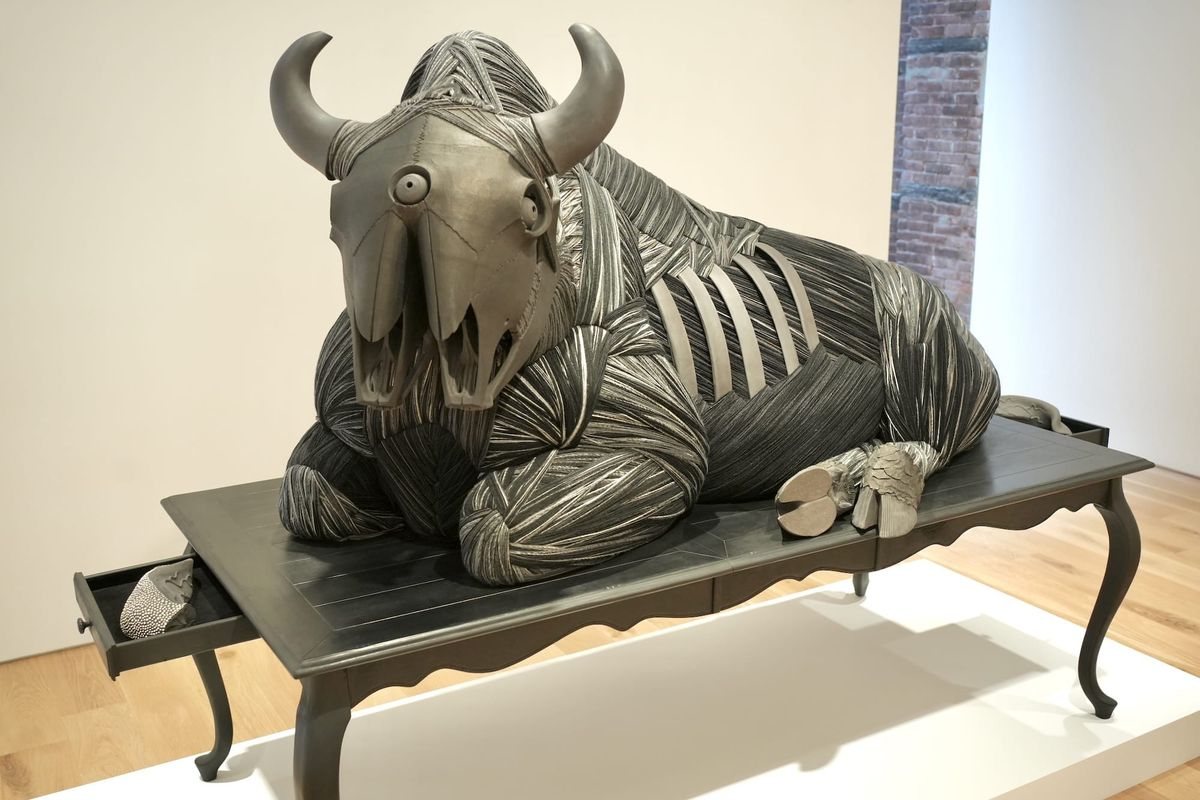
In American Traditional, Luger weaves these dark threads of history into material form. In one striking piece entitled Requiem, the artist places a black, abstracted bison silhouette directly atop a blackened rendering of a 19th-century American wood dining table. The domestic object, painted and charred, speaks to the quiet, everyday complicity of domestic colonial life, contrasting sharply with the monumental loss of kin and ecosystem represented by the animal form above it. Throughout the gallery, pieces like Shoots Today, Kills Tomorrow further anchor the exhibition in the stark realities of archive, ink, and wood, allowing Luger to present a declarative, unyielding critique of the foundational violence upon which modern America was built.