Christie’s London delivered a powerful statement to the international art market on Wednesday, bringing in a combined £218.6 million ($289.4 million) across two high-profile evening sales. The robust total more than doubled the house’s equivalent figures from last year, providing a much-needed wave of encouragement and positive momentum for the global art market as collectors, dealers, and advisors look ahead to the crucial New York auctions scheduled for next month.
The eventful evening featured seven new auction records, highlighted by a flurry of five records broken during the dedicated sale of British businessman Peter Simon’s celebrated collection. Meanwhile, a magnificent early masterpiece by Wassily Kandinsky commanded £31.6 million ($41.8 million) to anchor the night’s second major auction. All financial figures reported by the auction house include the standard buyer’s premium.
Timing and Attendance Amid Frieze Week
The two consecutive sales were strategically timed to coincide with the bustling atmosphere of Frieze London and Frieze Masters, capturing the attention of a global contingent of collectors visiting the British capital. Together, the auctions achieved an impressive sell-through rate of 91 percent by lot and 96 percent by value, demonstrating strong underlying demand for blue-chip and premier-tier works despite broader economic headwinds.
The Peter Simon collection emerged as the undisputed centerpiece of the week. Several market insiders had previously described the offering to ARTnews as the primary attraction in London, and the results validated those predictions. The Simon collection alone accounted for £107.5 million ($142.3 million) of the evening’s grand total, cementing its status as the highest-value single-owner collection ever sold at Christie’s London. The subsequent 20th- and 21st-century art sale followed up strongly, bringing in an additional £111.1 million ($147 million).
Despite the eventual success, the evening began with a minor logistical hiccup regarding the schedule. While the Simon sale officially got underway at 6:00 p.m., Christie’s live-auction website mistakenly advertised a 7:00 p.m. start time in certain regions. At least three prominent market professionals, including an international art adviser with a global clientele, arrived or tuned in under the impression that the proceedings would begin an hour later. Whether this scheduling confusion caused any prospective buyers to miss out on active bidding remains difficult to determine.
Monsoon: The Peter Simon Collection
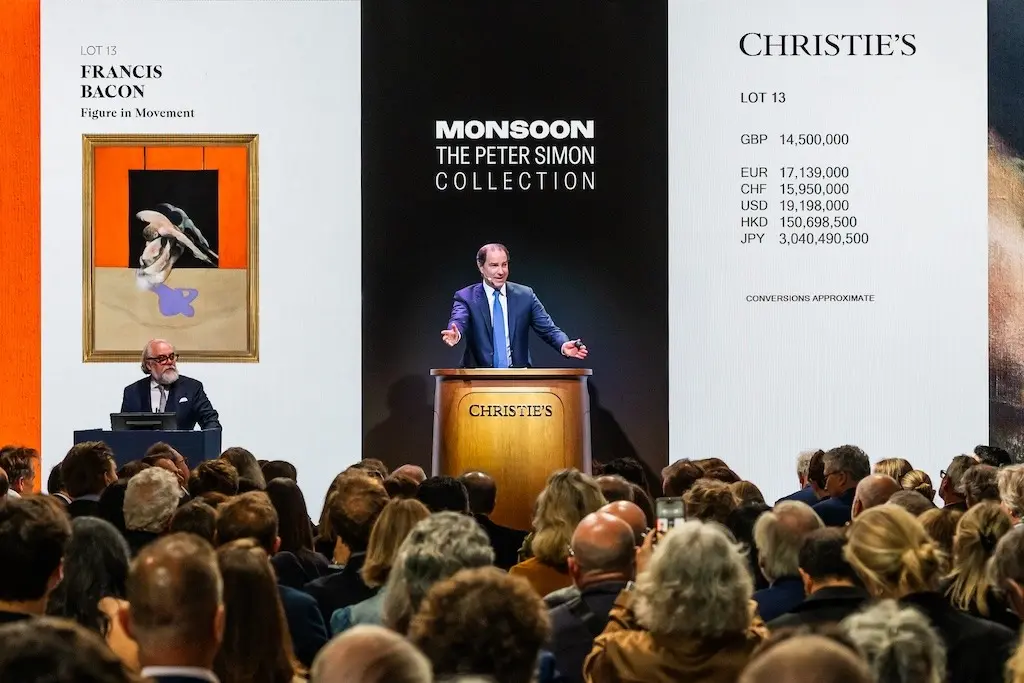
Even with the initial web discrepancies, the salesroom was packed to capacity when the auctioneer initiated "Monsoon: The Peter Simon Collection." Assembled by Peter Simon, the founder of the British retail brand Monsoon who has maintained a consistent presence on ARTnews’s Top 200 Collectors list since 2005, the collection performed exceptionally well. It achieved an astonishing sell-through rate of 98 percent by lot and 99 percent by value, with only a single work out of the 41 offerings failing to find a buyer.

The top-earning work within the Simon collection was Francis Bacon’s haunting Figure in Movement, which fetched £17.19 million ($22.8 million) after being claimed by a determined bidder physically present in the room. Following closely behind was Piet Mondrian’s precisely balanced Composition A, with Double Line and Yellow, which brought in £9.71 million ($12.86 million). Joan Miró’s surreal Peinture (Les amants – Adam et Eve) realized £8.56 million ($11.33 million), while Hurvin Anderson’s vibrant Last House significantly outperformed expectations to bring £5.7 million ($7.5 million) against a modest pre-sale estimate of £2 million to £3 million ($2.6 million to $3.9 million).
One of the night’s most dramatic surprises came early in the session from Russian avant-garde painter Liubov Popova. Her striking abstract composition Painterly Architectonic sparked a fierce, nearly eight-minute bidding war that unfolded across the room and over multiple telephone lines. It ultimately sold for £7.64 million ($10.1 million)—more than triple its high estimate of £2.5 million ($3.3 million)—handily setting a new auction record for the artist.
Additional records set during the Simon sale included Bridget Riley’s optical masterwork Streak 2, which achieved £5.21 million ($6.9 million), and David Bomberg’s luminous San Miguel, Toledo, Afternoon, which brought £3.26 million ($4.32 million). The intense bidding for the Bomberg canvas visibly energized the room, prompting the auctioneer to invite a closer inspection of the painting’s textured surface from the podium. Further artist records were also established for Portia Zvavahera and Barbara Hepworth.
Market Analysis and Guarantees
Philip Hoffman, chairman and founder of the Fine Art Group, offered a measured perspective on the market dynamics prior to the auction. Speaking with ARTnews, he noted that while a select group of masterworks in Simon’s collection would race ahead with fierce competition, much of the remaining material would likely trade with relatively subdued interest. He observed that many high-end buyers attending Frieze Masters had deliberately reserved their capital in anticipation of the evening’s marquee events.
Following the conclusion of the sales, Hoffman assessed the results as a clear indication of a solid and functional market, though he advised caution against overinterpreting the headline totals. A significant factor in the evening’s success was the heavy reliance on financial backing: 29 of the 41 lots in the Simon evening sale carried third-party guarantees. This meant that a substantial portion of the financial risk had already been mitigated and accounted for well before the first public bid was cast.
"These auctions are staged, managed, and already pumped up to the max for the best guarantees they can get," Hoffman remarked to ARTnews, pointing to the structured nature of modern high-end evening sales.
The mood in the saleroom experienced distinct emotional shifts as the evening progressed. Near the conclusion of the Simon collection sale, the final two paintings—Glenn Ligon’s Large Silver In Show Business and Beatriz Milhazes’s O Rapaz (The Boy)—sold for identical sums of £192,000 ($250,000) against low pre-sale estimates of £400,000 ($529,000) and £300,000 ($397,000), respectively, leaving the room noticeably quiet as the hammer fell.
The 20th- and 21st-Century Evening Sale

Following a brief intermission, the room’s palpable energy quickly returned for the second auction of the night. Early momentum was established when two works by Josef Albers comfortably surpassed their pre-sale estimates. They were swiftly followed by René Magritte’s enigmatic Le seize septembre, which brought in £3.26 million ($4.3 million), outperforming its high estimate of £1.8 million ($2.4 million).
A distinct wave of national pride swept through the crowd when David Hockney’s Dog Painting 17 made its debut appearance at auction. The painting generated immediate applause and touched off a spirited contest led by Christie’s London specialist Edmond Francey alongside at least three other specialists fielding bids via telephone. The canvas ultimately fetched £3.51 million ($4.64 million). This patriotic enthusiasm continued with British painter Flora Yukhnovich’s exuberant Capriccio, which achieved £2.2 million ($2.9 million), comfortably exceeding its high estimate of £1.5 million ($1.98 million).
However, an atmosphere of reverent silence fell over the room during the offering of Mondrian’s Composition III (1920). Spectators and prospective buyers alike reached for their smartphones to capture the moment as the painting realized £25.2 million ($33.4 million), landing squarely in the middle of its £20 million to £30 million ($26.5 million to $39.7 million) estimate.
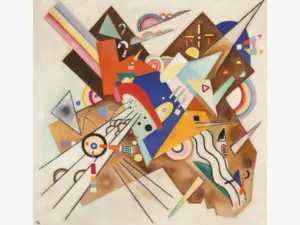
Despite the Mondrian drawing immense pre-sale attention, Wassily Kandinsky’s early masterpiece Das bunte Leben proved to be the absolute star of the night. Auctioneer Adrien Meyer introduced the vibrant canvas as "the most important early work by the artist to ever come to auction." The painting, which had been restituted to the heirs of Hedwig Lewenstein-Weyermann in 2023, sparked nearly 20 competing bids. Christie’s specialists Amelia Walker, Katharine Arnold, and Maria Los actively vied for the lot before Los successfully secured the painting with a £27 million hammer bid. This brought the final realized price to £31.56 million ($41.79 million), surpassing its £25 million high estimate.
As the second sale wound down, the rhythm of the auction shifted once more. When the rostrum changed hands at the 27th lot—Andy Warhol’s Mona Lisa (Reversal Series), which eventually sold for £1.5 million ($1.98 million)—auctioneer Adrien Meyer stepped away, and Yu Ge Wang took over. A challenging stretch followed, during which high-profile works by Cy Twombly, George Condo, Alberto Giacometti, and Lucian Freud failed to attract buyers. By 8:52 p.m., the crowd of suited attendees and collectors began to disperse.
Even a charitable initiative struggled to fully reignite the room’s momentum. Igshaan Adams’s intricate textile and bead sculpture, The certainty of being a rose (ii), fetched £96,000 ($127,000). Although the result established a new auction record for the artist, and the auctioneer explicitly reminded the room that proceeds were designated to benefit environmental charities, bidding remained cautious.
The second evening sale ultimately concluded with an 85 percent sell-through rate by lot—notably trailing the exceptional 98 percent achieved by the Simon collection earlier in the evening. Nevertheless, with two individual works crossing the £25 million threshold, the combined results provided Christie’s with substantial cause for celebration as leadership prepares to travel across the Atlantic for the upcoming New York sales series beginning on November 17.
For market observers like Hoffman, the evening’s outcomes offer an encouraging data point while warranting a careful approach. He noted that he is awaiting the upcoming sale of the Antonio Homem Sonnabend collection—which is estimated to bring in more than $50 million and will be offered entirely without financial guarantees—to gain a clearer, unshielded reading of the current art market’s true strength.