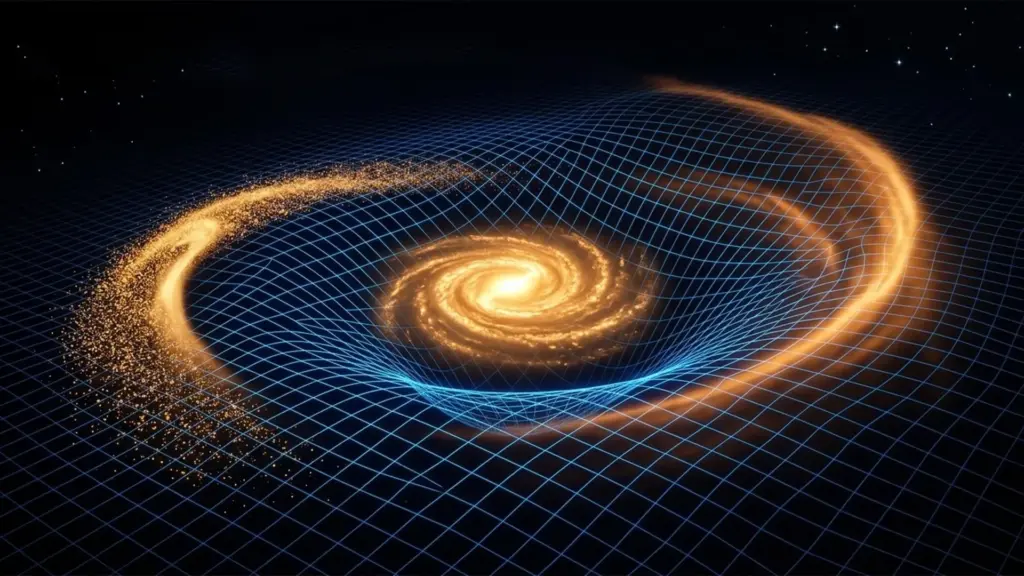
The largest global survey of physicists ever conducted has revealed just how unsettled some of the biggest questions in modern physics remain. Researchers found surprisingly little agreement on topics ranging from black holes and dark matter to the long-running effort to reconcile Albert Einstein’s theory of general relativity with the counterintuitive rules of quantum mechanics.
The comprehensive poll, which captured the perspectives of scientists from around the world, highlights a profound lack of consensus across nearly every major pillar of contemporary physics. Even the standard model of cosmology, widely known as the $Lambda$CDM (Lambda Cold Dark Matter) model, failed to win support from a majority of respondents.
This lack of majority backing for the standard cosmological framework may reflect recent observational findings, such as those produced by the Dark Energy Spectroscopic Instrument (DESI). Recent data from DESI have suggested that dark energy—the mysterious force driving the accelerated expansion of the universe—could actually be changing over time. Such a dynamic possibility directly conflicts with the foundational assumptions of the standard model, which has long treated dark energy as a constant energy density of empty space.
Yet, cosmology was far from the only scientific domain where physicists found themselves deeply divided over fundamental realities.
Standard Answers Fail To Win Broad Support
The implications of the survey extend far beyond cosmological models, touching on the core assumptions that guide theoretical and experimental research today.
"The most striking result is how few of the ‘standard answers’ in fundamental physics command overwhelming support, with most falling short of a majority. The interesting point is not that physicists are confused. It is that the frontier is genuinely alive," says Niayesh Afshordi, an associate faculty member at the Perimeter Institute and a professor at the University of Waterloo.
Afshordi led the landmark study alongside coauthor Phil Harper and the American Physical Society’s Physics Magazine, creating a detailed portrait of contemporary scientific thought.
Across the broad spectrum of questions included in the survey, remarkably only two topics managed to cross the threshold of majority agreement among the participating physicists.
The first point of consensus concerned the nature of the Big Bang. Despite the way the cosmic origin event is frequently portrayed in popular culture, textbooks, and media, 68% of the physicists surveyed stated that the Big Bang does not necessarily represent the absolute beginning of time. Instead, the prevailing scientific view among the respondents is that the Big Bang theory describes how the universe evolved and developed outward from an extremely hot, dense, and compact state. By itself, the mathematical framework does not definitively explain whether time had an absolute starting point or what might have existed "before" that initial phase.
The second point to clear the majority threshold involved cosmic inflation. Just 51% of the respondents agreed that the very early universe experienced an extremely brief, exponential period of accelerated expansion known as inflation, a hypothesis introduced to solve several major cosmological puzzles regarding the uniformity and flatness of the observable universe.
Aside from these two concepts, however, unity vanished, revealing a fractured landscape of competing hypotheses, alternative models, and open-ended inquiries.
Dark Matter Remains Wide Open
On many other major questions that define modern astrophysics and particle physics, the responses were far more fragmented, reflecting a discipline searching for answers in the dark.
Dark matter serves as a prime example of this persistent uncertainty. Only 17% of the surveyed physicists favored the hypothesis that dark matter is composed of a yet-undiscovered low-mass particle or family of particles, such as weakly interacting massive particles (WIMPs) or axions, which have long been favorites of particle physicists. Meanwhile, another 12% voiced support for modifications to the laws of gravity—such as Modified Newtonian Dynamics (MOND)—as an alternative to introducing unseen matter particles altogether.
However, the single largest group of respondents, clocking in at 21%, favored some combination of the many different proposed explanations, suggesting that the true nature of dark matter might not fit neatly into any single existing theoretical box.
This wide spread of responses highlights how little consensus truly exists around one of the central and most persistent mysteries of modern cosmology, leaving the door wide open for future discoveries from underground detectors, particle colliders, and astronomical surveys.
No Clear Winner for Quantum Gravity
Physicists were similarly divided when turning their attention inward to the microscopic realm and the monumental challenge of quantum gravity—the long-sought effort to develop a unified theoretical framework that can successfully describe gravity within the principles of quantum mechanics.
String theory, which posits that the fundamental constituents of the universe are not point-like particles but rather tiny, vibrating strings of energy operating in higher dimensions, received the most individual support. However, even string theory was selected by only 19% of respondents as the most likely solution to the puzzle.
Meanwhile, loop quantum gravity—an approach that attempts to quantize spacetime itself without requiring extra dimensions—received 12% of the vote. Notably, 18% of the physicists favored the provocative possibility that gravity cannot be quantized at all, suggesting that spacetime might remain fundamentally classical even as it interacts with quantum matter.
These results demonstrate that even after decades of intense theoretical work, mathematical development, and philosophical debate, no single approach has managed to emerge as the dominant, widely accepted answer to physics’ greatest theoretical hurdle.
Why Disagreement Could Be Good for Physics
Faced with such widespread disagreement across nearly every major branch of the discipline, the natural question arises: What does this lack of consensus mean for the future of the science?
Rather than viewing the fractured opinions as a sign of institutional failure or professional confusion, Afshordi interprets the lack of consensus as a sign of vibrant scientific opportunity.
"Scientific truth is not decided by a vote. But consensus, or its absence, tells us where the evidence feels settled and where researchers still see room for radically different ideas. In this sense, lack of consensus can be a clue. It marks places where better data, sharper theory, or new connections between subfields may be needed," Afshordi explains.
To encapsulate the philosophical upside of this ongoing uncertainty, Afshordi invokes a famous line from the late Canadian singer and songwriter Leonard Cohen: "There is a crack in everything, that’s how the light gets in."
Rather than suggesting that physicists have lost their way or that the scientific method is faltering, the findings point directly to areas where monumental discoveries may still be waiting to be made. Some of the most fundamental questions about the structure, origin, and ultimate fate of the universe remain entirely open, leaving ample room for new observational data, stronger theoretical frameworks, and unexpected ideas to reshape humanity’s understanding of reality.
The complete survey results and their broader implications are described in an article published in Physics Magazine. Additionally, an interactive online dashboard has been made available to allow researchers, students, and curious readers alike to explore the survey responses in greater detail.