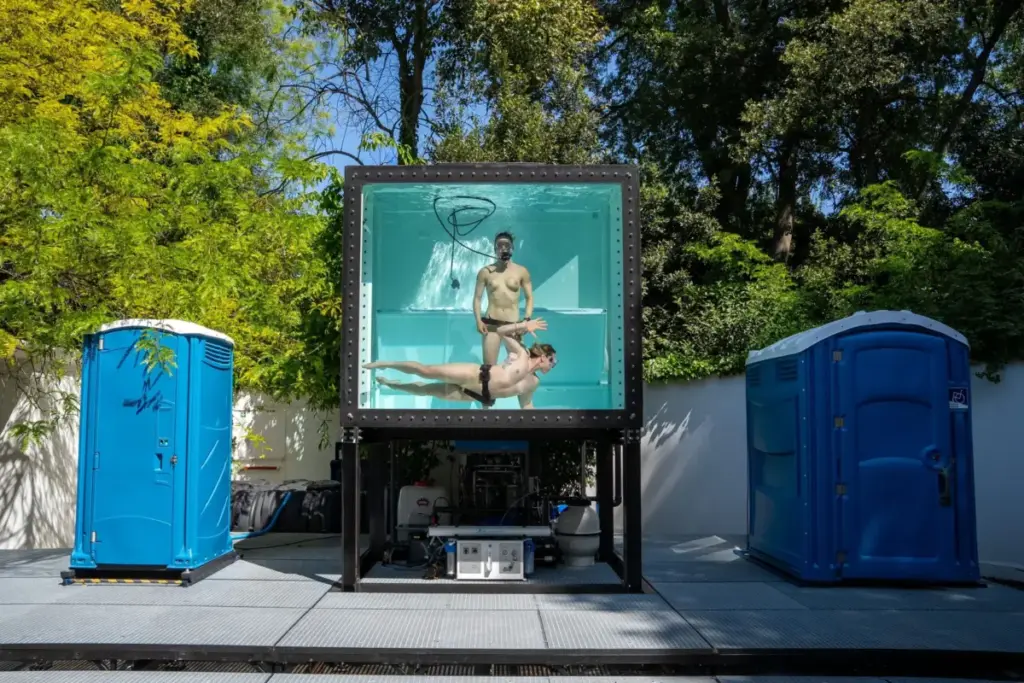
In classical piano parlance, an étude is a technically demanding piece of music traditionally practiced to push a musician far beyond their conventional limits, testing both their stamina and their technical mastery. Following that exact logic, the title of Florentina Holzinger’s final Venice Biennale performance, CLOSING ÉTUDE, suggests that after seven months of her propriety-imploding, waste-wonderland spectacle SEAWORLD VENICE, there are still grueling feats of endurance ahead for both the artist and her audience.
Part performance art and part sprawling, dystopian installation, SEAWORLD VENICE first opened at the Austrian Pavilion back in May, heralded by the piercing, industrial peal of a colossal bell salvaged directly from the murky depths of the Venice Lagoon. True to her signature body-first philosophy, a nude Holzinger initially served as the bell’s human clapper, establishing a visceral tone for the months that followed. Even without the artist swinging inside it day and night, the massive bell has continued to mark the relentless passage of time, ringing out every single hour over the pavilion and its startled guests—acting as a grotesque, haunting altar to the ongoing Venetian ecological and cultural apocalypse.
The materials of the installation itself are drawn straight from the surrounding environment. Human refuse, freshly sourced on-site, and actual lagoon waste of the sort that occasionally washes in with the high tide form the physical fabric of her immersive work. During the run of the exhibition, visitors were actively encouraged to use the portable toilets set up on-site, after which the collected urine was filtered directly into a dramatic dunk tank. It is an uncompromising, sensory-heavy environment that forces viewers to confront the uncomfortable realities of waste, bodily functions, and ecological decay within one of the world’s most historic and fragile cities.
The Journey to the Scuola Grande della Misericordia
For the grand finale, titled CLOSING ÉTUDE, the monumental bell is set to travel in a solemn, ceremonial procession moving away from the pavilion and toward the Scuola Grande della Misericordia, a deeply historic building located in Venice’s Cannaregio district. Founded originally during the Middle Ages as a religious and civic guild, the magnificent building eventually reopened as a contemporary exhibition space in 2015 following an extensive architectural restoration.
With its soaring ceiling, cavernous belly, and historic frescoes that are attributed to the school of Paolo Veronese, the venue is uniquely suited to house the bell and match the deeply sacred, almost liturgical tone that Holzinger has struck throughout her Biennale tenure. Conjuring strong shades of Christian iconography and narrative, CLOSING ÉTUDE is being framed by the artist and her team as “a final dinner.”
According to official announcements regarding the concluding event, “This last Venice Étude traces a material transformation from solid to liquid, forging a relic. Containing all the bodily waste collected from pavilion visitors over the past seven months, the distilled remains serve as a monument for the future, which will be presented in front of the closed pavilion on November 22.” The intense, multi-month show will finally come to its official close only when the bell eventually “falls silent” and the circulating water “stops circulating.”
A Global Future for a Site-Responsive Spectacle
Despite the dramatic conclusion of its run in Venice, the ambitious show is destined to be born anew very soon. An adapted version of SEAWORLD VENICE has already been scheduled to be presented at the prestigious Gropius Bau in Berlin next spring. That German engagement will be followed closely by another major stop at the Kunsthalle Wien in Vienna during the following fall, before the entire project embarks on its final leg in March 2028 at Amant in Brooklyn, New York.
Nora-Swantje Almes, the curator for live programs and outreach at Gropius Bau who originally helped organize the high-profile Venice presentation, is slated to oversee this new, international iteration of the work. Meanwhile, a spokesperson for Amant officially confirmed to ARTnews back in June that extensive preparations were already well underway for the Brooklyn exhibition, though they declined to confirm at the time whether the heavy theatrical elements like the jet skis and portable toilets featured in Venice would manage to make the long transatlantic trip.
“If you saw the show in Venice, you know it’s very site-responsive, so [Almes] needs to figure out how to adapt it for Berlin after the Biennale closes in Venice this fall,” the spokesperson explained. “After that, we’ll have a better idea of how our own team can further adapt it for Brooklyn.”