Listen to Ibrahim Mahama speak for any length of time, and he is likely to deflect personal praise, choosing instead to credit his success to a sprawling, interconnected community. That community includes market women, weavers, craftsmen, studio assistants, railway workers, curators, professors, and fellow artists. The internationally celebrated Ghanaian artist is quick to recognize these collective contributions, particularly as he reflects on a remarkable series of recent accolades.
Ranked at the top of the influential ArtReview Power 100 list, Mahama also claimed an Art Basel Gold Award and received the Arnold Bode prize. Adding to these international honors, he was recently named a chevalier of the French government’s Ordre des Arts et des Lettres. The prestigious distinction was formally bestowed upon him in Ghana by Diarra Dime Labille, France’s Ambassador to the West African nation.
"We live and work in a community and nobody is an island by themselves. I built my practice based on the idea of collectivity and working with different collaborators," Mahama explained in an interview with ARTnews.
To illustrate this philosophy, he recalled the early days of his career when he began collecting worn-out jute sacks from the Mallam Atta market women in Accra. As a college student producing unconventional works, his initial overtures were met with skepticism, and at times, outright suspicion from the vendors. However, as he spent time listening to them and integrating himself into their daily routines, the women came to understand his artistic vision. They became enduring supporters, helping him source the jute sacks that continue to serve as a foundational material in his practice.
"I think the artist is just a vessel, and I see myself as that vessel in order to put all these different things together to do the work that we do," he added.

Over the years, Mahama has evolved into one of the most visible and impactful Ghanaian artists on the global stage, presenting large-scale installations at biennials and museums worldwide. Crucially, he channels the proceeds from his international sales directly back into building cultural and educational institutions in Ghana. He has founded spaces such as the Tamale-based Red Clay Studio and the Savannah Centre for Contemporary Art. Furthermore, he has acquired dilapidated or abandoned buildings, industrial factories, and even decommissioned airplanes, transforming them into vibrant art and learning hubs—most notably with Nkrumah Voli-ni, also located in Tamale.
Mahama describes these architectural and institutional endeavors as a "lifetime work" designed to breathe new life into collected materials, national archives, and industrial heritage. His collaborative ethos occasionally stretches beyond Ghana’s borders, fostering meaningful dialogues with peers like Kenyan-British artist Michael Armitage and his Nairobi Contemporary Art Institute. By participating in these cross-cultural conversations, Mahama continuously expands the conceptual and practical boundaries of his artistic scope.
A Monumental Takeover in Paris
This week, Mahama unveils his most expansive international project to date: "The Harvest Season," a monumental exhibition that takes over the entire building of the Fondation Cartier pour l’art contemporain in Paris. "It is the most ambitious exhibition I’ve done," Mahama noted.
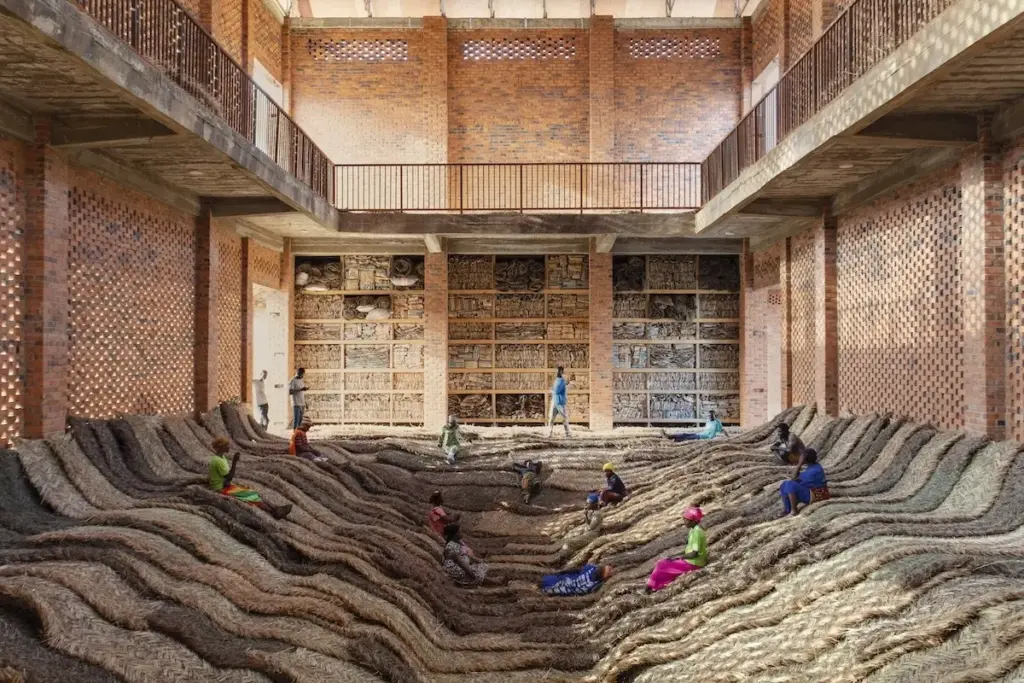
A centerpiece of the Paris presentation is a new iteration of Parliament of Ghosts, an ongoing installation that originally premiered in 2019. Constructed from discarded train seats, railway sleepers, school furniture, worn-out jute sacks, and government archives, this updated version incorporates approximately 200 collected and restored royal stools from the Asante Empire.
Mahama explained that the inclusion of these artifacts is intended to highlight a profound cultural contradiction. Too often, such royal stools are looted and subsequently displayed in Western museums, placed behind cold glass cases out of reach of the living culture that produced them. At the Fondation Cartier, visitors will encounter these objects with open access. By bringing these items from Ghana to Europe as "living" objects utilized for their original purposes rather than as static museum specimens, Mahama hopes to invert traditional debates surrounding the restitution of African cultural heritage. The installation summons the "ghosts and histories" of the stools, generating a dynamic framework for alternative conversations.

Another major component of the exhibition is a new project centered on the Aboso Glass Factory. Established in 1966 by Kwame Nkrumah, Ghana’s first president, the facility was a cornerstone of the country’s early industrialization efforts before Nkrumah was overthrown in a coup later that same year. Titled Things Fall Apart—a nod to the classic 1958 novel by Nigerian author Chinua Achebe—the installation is a partial reconstruction of the abandoned bottle manufacturing plant. Mahama purchased the derelict site roughly two years ago with production support from the Fondation Cartier.
The Paris installation represents only a fraction of the broader revitalization effort. The glass factory is currently being systematically rebuilt across multiple locations, including Red Clay Studio in Tamale and a British-era colonial building. Once the Fondation Cartier exhibition concludes, the structure will return to Ghana for a permanent installation in Kumasi, where Mahama is laying the groundwork for a new cultural institution. Concurrently, he is collaborating with local cinema owners and craftsmen to explore the restoration of abandoned movie theaters across the country.
The exhibition also features an extensive collection of works examining the Ghanaian railway system. Additionally, a newly commissioned textile installation—woven from northern Ghanaian fabrics, truck inner tubes, jute sacks, and found textiles—drapes dramatically across the arcades of the Fondation Cartier building’s 19th-century facade.
"There is a dialogue between this old building, constructed in the 1850s, and Ibrahim’s work, which addresses the history of the 19th century in Ghana, and the links between what was happening between Europe and West Africa at that time," said Aby Gaye-Duparc, curator of the exhibition.
Gaye-Duparc emphasized that the exhibition aims to communicate the dual nature of Mahama’s practice. On one hand, audiences experience the visible fruits of his labor: installations, videos, and works on paper that originate from his community in Tamale before traveling to international venues. On the other hand, there is the foundational labor happening behind the scenes in northern Ghana, where the artist is actively constructing sustainable artistic infrastructure. These structures have significantly broadened access to the arts for populations historically excluded from mainstream cultural institutions.

True to his collaborative philosophy, Mahama has invited several other artists and collectives to exhibit alongside him in Paris. Participants include James Barnor, Gideon Appah, CATPC (Cercle d’Art des Travailleurs de Plantation Congolaise), Tjaša Rener, Postbox Ghana, Courage Dzidula Kpodo, and Dorothy Akpene Amenuke, who is Mahama’s mentor.
Kpodou, an architect, contributes work that critiques modernism by steering the narrative away from tropical modernism—typified by concrete structures frequently erected by foreign architects in Ghanaian cities. His central installation features a reconstructed wall made of laterite, a material native to traditional vernacular architecture, sourced from a building he owns in Gyampo in the Eastern Region. Accompanying this piece is an archive of roughly 100 postcards curated by the Postbox Ghana collective, depicting modernist architectural landmarks in urban centers such as Accra, Kumasi, and Takoradi.
"I would describe Ibrahim as someone who makes space within his own abilities and means for people that he thinks are doing interesting, important work," Kpodo observed.
Resilience Amid Adversity
The opening of the Fondation Cartier exhibition follows a turbulent period for the artist. Earlier this year, Mahama was targeted in a violent attack by a special operations unit of the Ghana Police Service in Tamale, where he maintains his home and primary studio. In the wake of the incident, the outpouring of solidarity from his local community was profound.
"It was fantastic, I must say. I was really overwhelmed, because sometimes you don’t realize how much your work means to people," Mahama reflected. He recalled how residents from Tamale, as well as travelers from Accra and Kumasi, made the journey to visit him, express their regret, and condemn the police action, particularly given his extensive contributions to the region’s development.

Regarding the official response, Mahama noted that he has not received recent updates regarding the investigation ordered by Ghana’s Inspector General of Police and handled by the Criminal Investigation Department. For now, however, he remains focused on his creative output.
"I want to channel my energy into this positive part of my practice of what I do and what it means to the community," he explained. "But certainly, I am also quite disappointed in the way that it was handled by the police. And I hope that at some point, we will be able to at least know more, so that we see what direction to take it in." He plans to press for updates upon his return to Ghana at the end of the year.
For the present moment, Mahama’s priority lies in championing the community he has helped foster and extending the reach of African contemporary art globally.
"I’m happy that the work I do has a very profound meaning and effect on people who live on our continent, in particular Ghana," Mahama said. "I am also interested in how this work is traveling around the world, stretching the African sensibilities, and what we are bringing to art in the 21st century."