Jamie Courville and her husband, Chris Reynolds, moved to Gowanus in 2009, arriving just a year before the heavily polluted canal running through the heart of the Brooklyn neighborhood was designated a federal Superfund site. As filmmakers, they were immediately captivated by the raw, melancholic beauty of the desolate postindustrial landscape. The area offered a stark visual contrast to the rest of rapidly changing New York City, featuring rows of old brick warehouses, defunct factories, and sweeping vistas that seemed immune to time. "You couldn’t take a bad photo of it," Courville recalls.
Beyond the visual appeal, those neglected industrial buildings served a practical purpose, functioning as expansive, affordable studio spaces for artists and creators. While residential housing options were sparse—aside from the New York City Housing Authority (NYCHA) complexes—apartments were relatively spacious and inexpensive, even if they required some maintenance. Courville and Reynolds rented a generous 1,100-square-foot loft in an older residential building for roughly $2,000 a month, using the space as both their home and workplace. At a time when nearby industrial districts like Williamsburg and Long Island City were undergoing glossy commercial makeovers that scrubbed away their rough edges, Gowanus retained a mysterious, untamed energy. "There was a lot going on behind closed doors," Courville says. "It felt feral and gross and hopeful and free."
The Paradox of the Superfund Site
That unique atmosphere existed for a very practical reason: the lingering presence of the Gowanus Canal, a toxic waterway choked with sewage, heavy metals, coal tar, and chemical solvents. For decades, the noxious body of water kept widespread gentrification at bay, preserving a pocket of affordability and creative freedom. Yet, the 2010 Superfund designation by the Environmental Protection Agency (EPA) fundamentally altered the neighborhood’s trajectory. Rather than scaring off real-estate investors, the federal intervention acted as an invitation, signaling that the century-old industrial cesspool would finally be cleaned up at federal expense.
Commercial investment followed quickly. Whole Foods opened a massive retail location with a rooftop greenhouse on a bleak corner of Third Avenue and 3rd Street, setting off a wave of trendy businesses. Establishments like Lavender Lake, a bar with a sprawling patio serving craft beer and kale salads, opened in 2011, followed by Dinosaur Bar-B-Q in 2013 and the Royal Palms Shuffleboard Club in 2014. Sensing the momentum, developers who had quietly accumulated property over decades began pushing for spot rezonings to pave the way for luxury residential towers.
The 2021 Rezoning and the Promise of Community Benefits
As development pressures mounted, local leaders recognized that inaction would surrender the neighborhood’s future entirely to private interests. Brad Lander, then the local city councilmember, argued that the community needed to proactively shape the transformation rather than watch it happen to them. Drawing on his background as a community organizer and urban planner, Lander envisioned a radically different model for Gowanus—one that would avoid the pitfalls of Williamsburg or Hudson Yards.
In 2016, Lander spearheaded a comprehensive five-year rezoning initiative designed to permit high-density residential development while extracting unprecedented community benefits. The plan aimed to create a socially and economically diverse neighborhood featuring thousands of permanent affordable housing units, protected spaces for artists, vital capital repairs for local public housing, and a continuous public esplanade along the canal.
To document this historic evolution, Courville and Reynolds began filming the neighborhood in 2013, capturing the demolition of redbrick warehouses, active construction sites, barges hauling toxic sludge, and the contentious public hearings leading up to the historic 2021 City Council vote. Over the years, their footage swelled to more than 400 hours, culminating in their documentary, Gowanus Current. "What happened is such a complex thing. People call it gentrification, but it’s not," Courville reflects. "The neighborhood was knocked down and a new one was built."
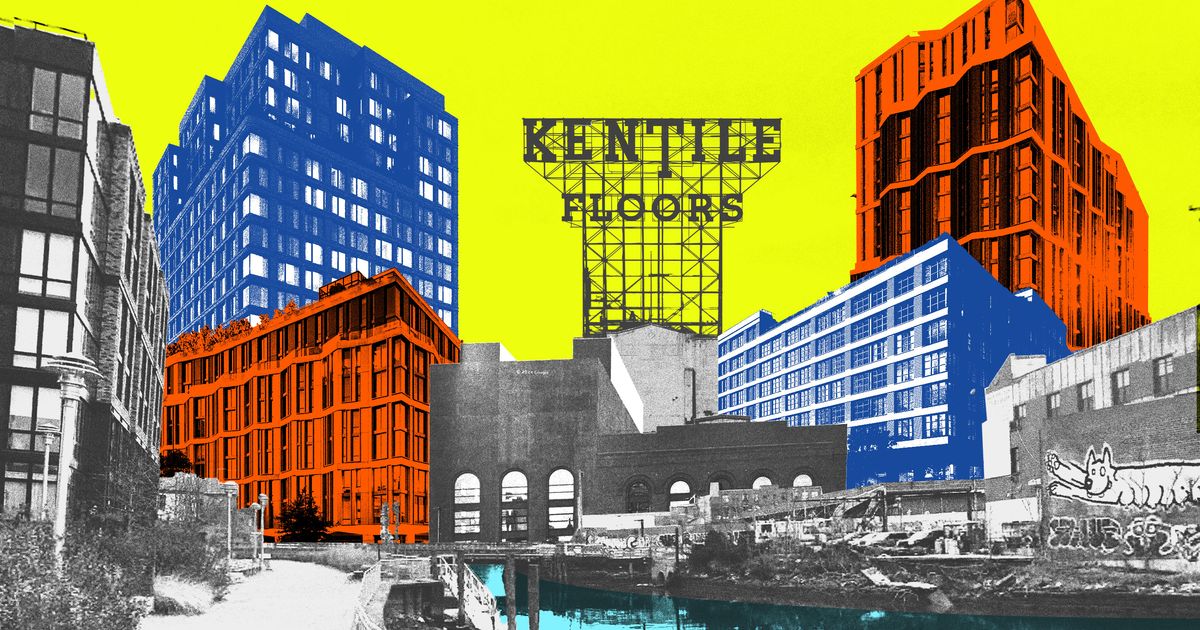
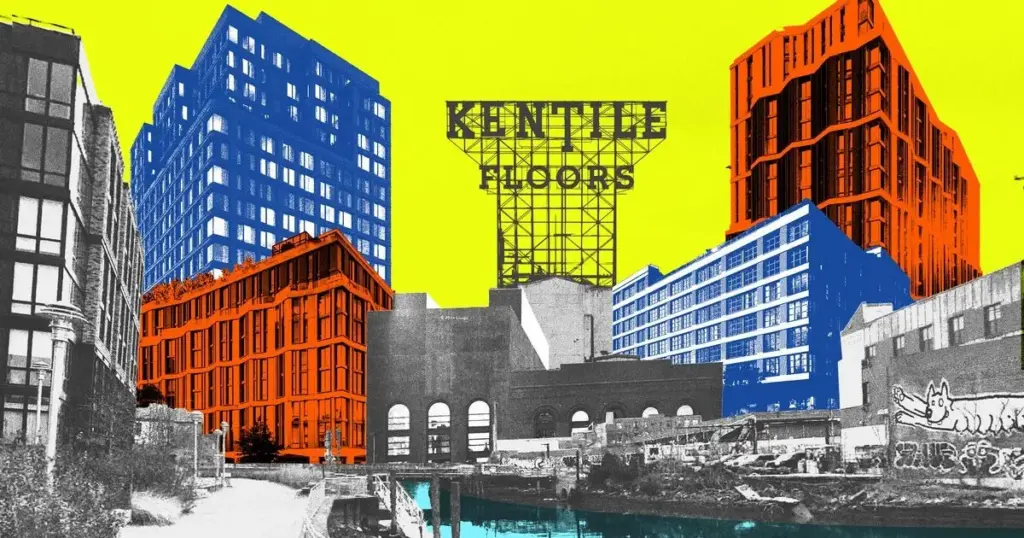
That assessment is borne out on the ground across the 82 blocks covered by the rezoning. Nearly every corner features either a recently completed residential tower, an active construction site, or a fenced-off lot awaiting development. Projections indicate the neighborhood will absorb roughly 9,000 new apartments before the decade is out.
Luxury Towers Meet Toxic Real Estate
The post-rezoning construction boom kicked off immediately, turbocharged by developers rushing to beat the expiration of the 421-a affordable-housing tax exemption in mid-2022. One of the first wave of luxury buildings to open was Avery Hall’s development at 544 Carroll Street, located at the boundary of Park Slope and Carroll Gardens. Brian Ezra, a founding partner of Avery Hall, noted that the location made development inevitable. The building set a high standard for luxury rentals in the area, offering high-end finishes, panelized appliances, and marble countertops, with penthouses commanding monthly rents as high as $25,000.
Despite the sleek new additions, the physical reality of the neighborhood remains complex. Gowanus is fundamentally a patchwork of brownfields laden with decades of industrial contamination, including coal tar and chemical solvents. While urban planners and developers frequently float optimistic comparisons to clean, progressive Northern European waterfronts like Copenhagen, environmental advocates caution that New York’s messy, bureaucratic reality makes such smooth transformations difficult.
Andrea Parker, executive director of the Gowanus Canal Conservancy, notes that leaving the neighborhood untouched was never a viable option. Without a comprehensive rezoning, Gowanus likely would have succumbed to an uncoordinated sprawl of luxury complexes and boutique recreation without meaningful public infrastructure upgrades.
The rezoning did secure historic concessions, including a $200 million investment for NYCHA repairs, mandatory inclusionary housing requirements dedicating 25 percent of units as affordable housing for households earning between 40 and 80 percent of the area median income, and the implementation of a racial-impact study. Furthermore, the plan mandated that individual developers remediate their specific brownfield sites, while original polluters—where identifiable—were tagged with the cleanup costs for the canal itself.
The Slow Pace of Environmental Remediation
While private residential towers have risen rapidly, the massive environmental cleanup required for the surrounding area has lagged significantly behind schedule. Dredging and capping have only been completed along the first of three sections of the 1.8-mile canal, while projected costs have ballooned from an initial $500 million to approximately $1.5 billion. Essential combined sewage-overflow tanks designed to prevent raw sewage from flowing into the waterway are not slated for completion until 2029—a delay that raises concerns that newly dredged sections of the canal may become recontaminated before the project concludes.
Meanwhile, major affordable housing initiatives have faced severe bottlenecks. Gowanus Green, a planned 957-unit 100 percent affordable housing development slated for a former manufactured gas plant site at Fifth and Smith streets, has been stalled for years due to complex jurisdictional disputes over cleanup standards involving developers, local stakeholders, and National Grid. However, recent approval from the state Department of Conservation for a phased remediation plan has offered renewed hope for the long-delayed project.

The environmental hurdles extend far beyond the canal. In late 2023, public records obtained via Freedom of Information Law requests by local activist group Voice of Gowanus revealed that toxic trichloroethylene (TCE)—a carcinogenic industrial solvent used historically in metal degreasing and dry cleaning—was vaporizing through the soil and collecting in the basements of several local buildings. State testing detected vapor levels inside the Royal Palms Shuffleboard Club that exceeded allowable state guidelines by 20 times, with significantly higher concentrations found directly beneath the structure. Similar vapor intrusion issues were discovered at a former box factory converted into artist studios at 543 Union Street, as well as at a local public school.
Because state and environmental agencies cannot legally compel private property owners of existing buildings to test their structures without consent, the true scope of the underground vapor plume remains difficult to quantify. State data indicates that out of 1,604 property owners contacted for voluntary testing between 2024 and 2025, only about 16 percent agreed to participate.
Navigating the New Landscape
For prospective residents, deciding to move to Gowanus often involves weighing the neighborhood’s notorious environmental history against the stark realities of the broader Brooklyn rental market. With traditional brownstone neighborhoods like Park Slope facing severe inventory shortages and soaring prices, renters are increasingly turning to new Gowanus developments that offer modern amenities, central air conditioning, gyms, and rooftop pools.
New arrivals often rationalize living near active remediation zones by noting that modern residential towers are constructed on remediated soil over thick concrete slabs and fitted with specialized vapor barriers, flood gates, and advanced air-filtration systems. For many renters living on upper floors, the construction noise and industrial legacy are minor inconveniences compared to the financial strain of securing comparable space elsewhere in brownstone Brooklyn.
At the same time, community advocates have fought to ensure that the neighborhood’s creative identity is not entirely paved over. Organizations like Arts Gowanus successfully negotiated for more than 100 affordable artist studios within new development buildings, complete with rent increases capped at 2 percent annually. Venues like Public Records and Powerhouse Arts have added fresh cultural energy to the district, blending seamlessly with the remaining auto body shops, breweries, and local hangouts.
As the physical landscape continues to evolve, the cultural shift remains palpable for those who knew the neighborhood before the rezoning boom. Yet, whether viewed through the lens of urban revitalization or over-development, Gowanus has firmly cemented its status as one of New York City’s most dynamic and fiercely contested modern real-estate frontiers.