As households across the country continually seek cost-effective methods to manage escalating household expenses and improve living conditions, industry experts are placing a renewed focus on cavity wall insulation as a high-yield home improvement investment.
Unlike traditional surface-level insulation methods that address only the roof or loft space, cavity wall insulation tackles the structural envelope of a property. By filling the empty gap typically found between a home’s interior and exterior walls—a space generally measuring between 50mm and 100mm wide—this specialized process creates a thermal barrier designed to prevent heat from escaping directly through the masonry.
The practical implications of this thermal barrier extend across seasons. Not only does proper insulation help keep living spaces significantly warmer during the cold winter months, but it also assists in maintaining cooler indoor temperatures during the heat of summer. Beyond comfort, the intervention drastically cuts down a household’s overall energy consumption, directly translating to a lower carbon footprint for the property.
Recent studies indicate that implementing cavity wall insulation can yield savings of up to 25% on annual heating bills. For property owners weighing long-term financial strategies against rising utility costs, the investment serves as a pragmatic solution to enhance both building efficiency and indoor climate control.
What is Cavity Wall Insulation?
To understand the mechanics of the upgrade, it is necessary to examine standard wall construction. Many homes feature a dual-wall system consisting of an inner and outer skin of brick or block, separated by an empty space known as the cavity. Left uninsulated, this gap acts as a conduit for heat transfer, allowing warmth generated by heating systems to seep out into the open air.
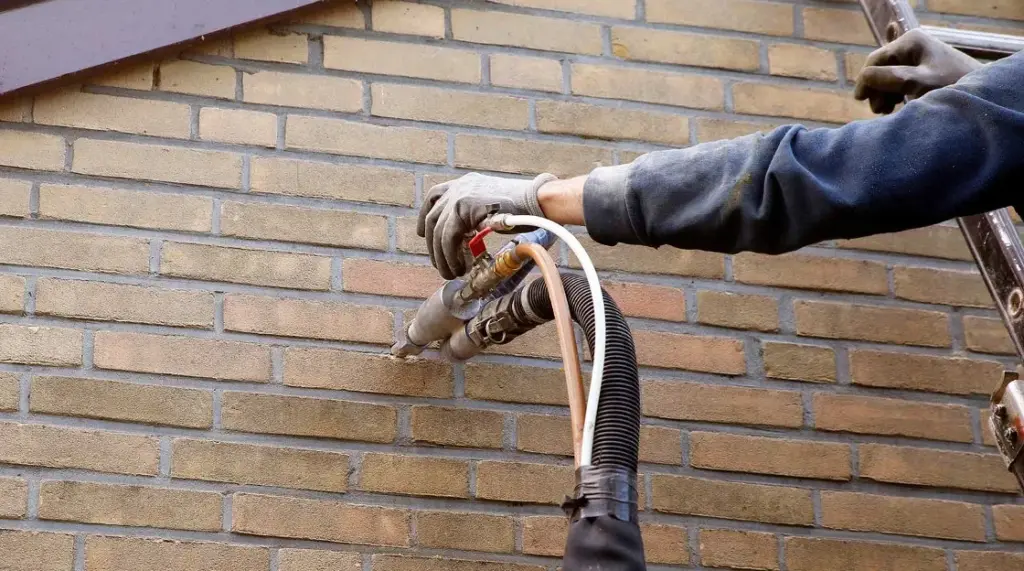
Cavity wall insulation addresses this vulnerability by filling the gap with specialized insulating materials. The application generally falls into two primary categories: blown insulation and injected insulation. Blown insulation involves utilizing specialized machinery to force loose materials, such as high-grade mineral wool or lightweight polystyrene beads, directly into the cavity spaces. In contrast, the injected method requires technicians to systematically drill small access holes into the exterior mortar joints, pumping the insulating substance through a specialized nozzle to ensure complete and uniform coverage throughout the wall framework. Both methods are widely deployed and remain suitable for the majority of standard building types.
The popularity of the process among homeowners stems from its efficiency. Rather than undergoing disruptive structural overhauls, property owners can significantly upgrade their building envelope through targeted exterior interventions.
Benefits of Cavity Wall Insulation
The advantages associated with a properly insulated cavity wall extend well beyond basic temperature regulation, impacting household finances, daily living standards, environmental responsibility, and long-term asset value.
Reduced energy bills remain the most immediate draw for property owners. Because the insulation successfully curtails the volume of heat escaping through the exterior walls, heating systems do not need to work as hard or run as frequently to maintain a stable indoor temperature. According to data from the Energy Saving Trust, implementing cavity wall insulation can save households anywhere from £180 to £690 annually on heating expenditures. When projected across the standard lifespan of the insulation—which typically endures for approximately 25 years—the cumulative financial savings become substantial.
Alongside monetary relief, residents frequently report a noticeable increase in overall domestic comfort. The installation directly targets and minimizes persistent drafts and cold spots that often plague older or uninsulated rooms. By stabilizing internal temperatures year-round, the living environment becomes significantly more agreeable.
From an environmental perspective, cutting down the energy required to heat a residence directly correlates with a reduced household carbon footprint. As communities worldwide strive to meet broader sustainability targets and lower greenhouse gas emissions, domestic energy conservation stands out as a crucial contributor.
Furthermore, property market dynamics increasingly favor energy-efficient homes. Because cavity wall insulation permanently improves a building’s energy performance rating, it frequently serves as a valuable selling point, potentially increasing the overall market value of the property for prospective buyers who prioritize sustainability and low running costs.
The Cost of Cavity Wall Insulation
While the long-term financial advantages are clear, prospective investors must navigate initial capital outlays. The total cost of installing cavity wall insulation can vary considerably depending on several distinct variables, including the physical footprint and overall size of the property, the specific type of insulating material selected, and the technical method required for installation.

For a standard semi-detached house, average installation costs generally hover between £900 and £1,200. However, larger detached properties, homes with unusually complex architectural layouts, or structures requiring specialized extraction and replacement of degraded legacy insulation may see significantly higher estimates. Conversely, smaller flats or terraced homes may require lower outlays.
Industry specialists emphasize that this outlay should be viewed as a long-term capital investment rather than a standard maintenance expense. While the upfront costs demand careful budgeting, the continuous reduction in utility bills and the concurrent boost in property equity mean the system typically recoups its initial price tag over time.
How to Know if Your Home Needs Cavity Wall Insulation
Crucially, not every residential property is structurally compatible with cavity wall insulation. Historic buildings constructed prior to the widespread adoption of cavity walls—such as those featuring solid brick construction—completely lack the necessary void space. Similarly, some modern or altered properties may possess cavities that are too narrow, obstructed by construction debris, or subject to severe exposure to wind-driven rain, making them unsuitable for standard filling techniques.
To determine whether a specific building qualifies for the procedure, property owners are advised to consult a certified, professional insulation firm. Accredited technicians possess the diagnostic tools required to perform a comprehensive borescope survey of the property, inspecting the interior of the wall cavity and providing informed recommendations regarding the most appropriate thermal solutions.
It is also worth noting chronological indicators regarding building regulations. Properties constructed from the 1990s onward were typically built to updated regulatory standards that mandated the inclusion of insulation during the initial construction phase. Consequently, homes built in recent decades are statistically likely to already feature adequate cavity insulation.
The Installation Process of Cavity Wall Insulation
Executing cavity wall insulation requires specialized technical equipment, safety gear, and professional expertise, rendering it unsuitable as a standard do-it-yourself weekend project. Incorrect installation—such as failing to achieve uniform fill density or inadvertently blocking ventilation paths—can lead to severe moisture retention and damp issues.
Professional installations generally follow a controlled sequence overseen by accredited specialists. Established contractors, such as Dyson Energy Services—which has operated as a prominent provider of residential energy-saving solutions in the UK since 1982—employ vetted technicians to ensure work complies with rigorous industry standards. The process typically involves an initial site survey, careful drilling of precise injection holes in a predetermined pattern across the exterior mortar, the methodical insertion of the chosen insulating medium, and the subsequent repointing of the drill sites to match the existing brickwork seamlessly.
How to Choose the Right Insulation Material
Selecting the appropriate material for a cavity insulation project requires careful consideration of environmental factors, building architecture, and performance specifications. The primary substances utilized in modern construction include mineral wool, expanded polystyrene beads, and specialized synthetic foams.
Each material brings distinct performance characteristics to the project. Mineral wool offers exceptional fire resistance and acoustic dampening properties, while polystyrene beads provide high fluid resistance and flow easily into tight or irregular cavities. Foam insulation, meanwhile, is frequently selected for properties situated in exposed geographic regions subject to high levels of wind-driven rain, as it creates an impermeable barrier against moisture penetration. Consulting with a qualified specialist ensures that the material selected aligns perfectly with the micro-climate and physical structure of the building.
Maintenance and Upkeep of Cavity Wall Insulation
Once successfully installed, cavity wall insulation is designed to be a low-maintenance home improvement requiring virtually no routine upkeep. The materials are engineered to remain stable and effective within the sealed wall cavity for decades.
However, building envelopes must still be monitored periodically. Homeowners should remain vigilant for early warning signs of structural distress, such as persistent damp patches, interior mold growth, or peeling interior paint. These symptoms can occasionally indicate moisture bridging across the cavity, which may stem from compromised exterior rendering, blocked weep holes, or issues with the underlying insulation. If such signs emerge, property owners should promptly engage a certified professional to conduct a thorough diagnostic inspection.
Potential Savings on Energy Bills with Cavity Wall Insulation
The economic argument for cavity wall insulation rests firmly on cumulative utility savings. With the potential to cut heating bills by up to 25%, the financial impact over the multi-decade lifespan of the product is substantial.
For instance, a household currently incurring an annual heating expenditure of £1,000 could theoretically realize annual savings of up to £250. Multiplied across the typical 25-year operational window of the insulation material, the total financial retention can approach £6,250, shielding the household against ongoing volatility in global energy markets.