Before the art world’s focus shifts to the major hubs of London, Paris, and New York, Hong Kong has firmly seized the spotlight, launching the autumn marquee auction season with a series of high-profile sales at Christie’s and Sotheby’s. The results from this week of intense bidding reinforce a trend of sustained positive momentum that has been building over the past 18 months. Rather than relying on the spectacle of a single, record-breaking "trophy" lot, the season’s strength was defined by a remarkable depth of quality, signaling a mature and discerning collector base capable of absorbing a wide range of significant works.
The combined evening sale turnover for the two leading auction houses has demonstrated a steady upward trajectory, rising every season since the spring of 2025. Current figures now stand 62.5 percent above the market low experienced during that period. For this autumn’s cycle, the houses entered the fray with a combined presale estimate ranging from HK$1.05 to 1.60 billion ($133.6 to 204.6 million). While the total realized turnover for the week—including both evening and day sales—reached an impressive HK$1.91 billion ($243.7 million), it remained slightly shy of the approximately $185.8 million achieved during the autumn 2024 evening sessions. However, given the broader economic climate, these results are widely viewed as a testament to the resilience of the Hong Kong art market.
A Milestone for Vu Cao Dam at Sotheby’s
Sotheby’s initiated the marquee week on September 28, 2026, at its Hong Kong Maison, hosting two back-to-back evening auctions that set the tone for the days to follow. The Modern & Contemporary Evening Auction was a clear success, realizing HK$671.3 million ($85.6 million), a figure that fell comfortably within its presale estimate of HK$531.2 to 832.9 million. Notably, this result represents nearly double the turnover of the equivalent sale held exactly one year prior, illustrating a significant rebound in confidence and appetite among regional buyers. Bolstering this performance was "The Foujita Lexicon: Works from the Lewis Collection," which marked the house’s first-ever single-artist auction in Asia, contributing an additional HK$67.2 million ($8.6 million) to the house’s coffers.
The evening was anchored by Yoshitomo Nara’s Present (1994), which outperformed expectations to fetch HK$71.7 million ($9.1 million). The canvas, created during Nara’s influential period in Germany between 1988 and 2000, had recently been the subject of significant public attention, having served as a centerpiece in the exhibition PSYCHO: Identity Alienation Shadow Duality at the Maison—a show that attracted nearly 85,000 visitors in just 12 days. The sale also provided a critical market temperature check for Yayoi Kusama, marking the first major auction cycle following her death in August. Four of her works were featured in the evening sales, all of which met with steady, enthusiastic demand. Specifically, her Pumpkin (TWPOT) (2010) achieved HK$60.7 million ($7.7 million), while her Infinity-Nets (LHLUJ) (2017) soared past its high estimate to close at HK$15.4 million ($2.0 million).
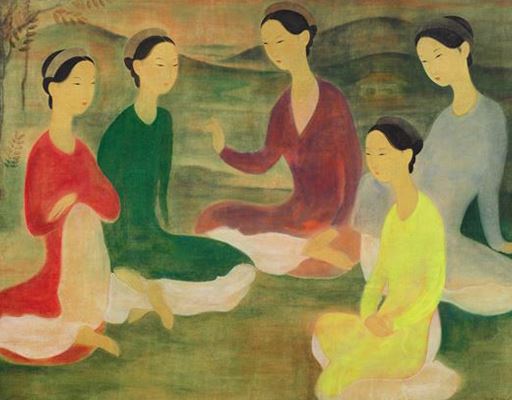
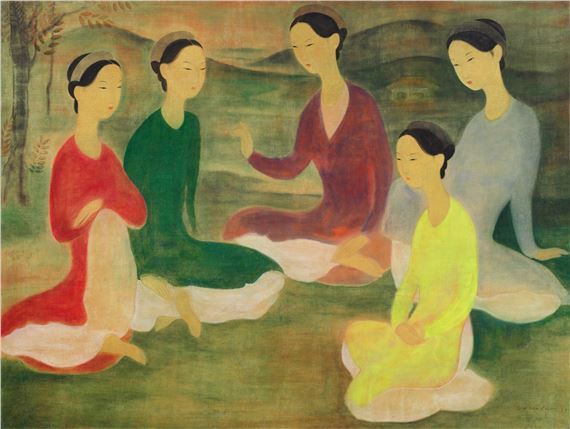
The most historic moment of the Sotheby’s series, however, belonged to the Vietnamese painter Vu Cao Dam. His 1939 work, Conversation d’élégantes au jardin (Conversation of Elegant Ladies in the Garden), became the subject of a spirited bidding war, drawing 14 individual bids before realizing HK$29.0 million ($3.7 million). This result shattered the previous auction record for a Vietnamese work—held by Mai Trung Thu’s Portrait de Mademoiselle Phuong, which sold for HK$24.4 million in 2021. The painting, executed in ink and gouache on silk, reflects the artist’s early career in Paris, where he moved on a scholarship in 1931 to develop his signature style of idealized Vietnamese scenes. The work’s journey is emblematic of the surging interest in Southeast Asian modernism, having last sold in 2008 for approximately $262,900.
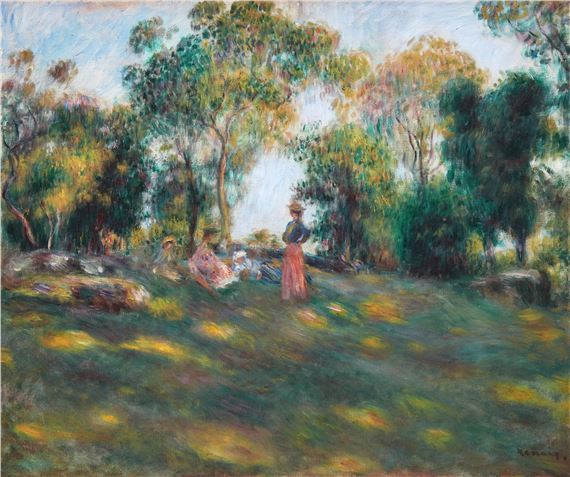
The record-breaking trend continued throughout the session. Pierre-Auguste Renoir’s Paysage avec figures (1890–1893) hammered at HK$52.1 million ($6.6 million), more than doubling its high estimate and setting a new auction record for the artist in Asia. The "ultracontemporary" market also saw a historic high when a 2023 canvas by Li Hei Di drew 18 bids, eventually selling for HK$3.3 million ($424,200)—nearly three times its high estimate. These individual milestones, alongside records for artists like Hu Xiaoyuan, Tran Luu Hau, and Park Seo-bo, underscored the sheer breadth of demand across disparate genres and eras. By the time the final gavel fell on the two-day auction series, Sotheby’s had achieved a total of HK$956.0 million ($121.8 million), with an impressive 91 percent of lots finding new homes.
Christie’s Achieves a "White-Glove" Success
The following evening, September 29, 2026, Christie’s held its 20th/21st Century Evening Sale at The Henderson. The atmosphere was electric, resulting in a "white-glove" outcome—every single lot that went under the hammer found a buyer. The sale realized HK$722.3 million ($92.1 million), landing in the upper half of its presale estimate and reflecting a 28 percent increase over the previous year’s equivalent auction.
The marquee lot of the entire week was Jean-Michel Basquiat’s Ancient Scientist (1984), which was sold by Rahul Kadakia, Christie’s President of Asia Pacific. The work, a haunting, skull-like representation that speaks to the artist’s lifelong obsession with anatomical precision, realized HK$77.0 million ($9.8 million), squarely within its estimated range. The painting’s provenance—having sold for $1.6 million in New York in 2005 and later for HK$58.3 million in 2020—demonstrates the enduring investment potential of Basquiat’s work in the secondary market.
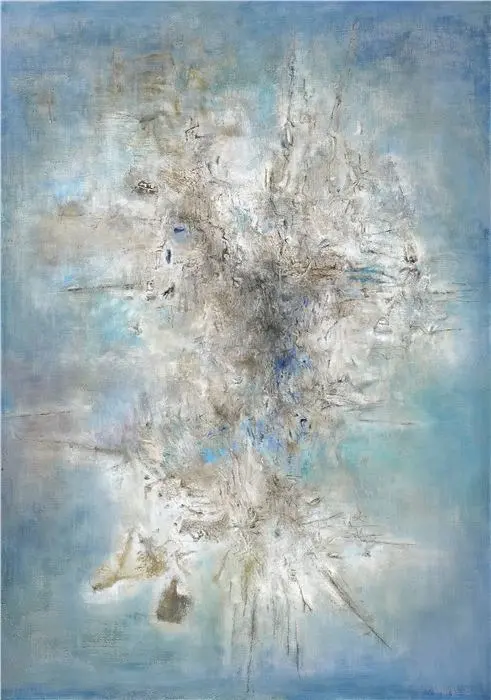
Following closely in value was Zao Wou-Ki’s Voie lactée – 09.11.56 (1956), which achieved HK$58.9 million ($7.5 million). This ethereal piece captures the artist at a pivotal moment in his career, as he began to synthesize the principles of abstraction with the rhythmic, calligraphic signs derived from oracle-bone script. Kusama also featured prominently in Christie’s lineup; her A-Pumpkin (YHP) (2011) realized HK$58.2 million ($7.4 million), securing the third-highest spot of the evening.
The evening was also notable for the success of European modern masters, who accounted for three of the four auction records set at Christie’s during the week. Paul Cézanne’s delicate still life L’Assiette bleue (1879–1880) outperformed expectations to reach HK$40.6 million ($5.2 million). Similarly, Henri Matisse’s Jeune femme au canapé (1944) commanded HK$38.1 million ($4.9 million), and Salvador Dalí’s Ensorcellement – Les sept arts (1957) fetched HK$17.3 million ($2.2 million). Including the day sales that spanned September 29 and 30, Christie’s total for its 20th/21st Century series reached HK$956.5 million ($121.9 million), marking a 17 percent year-on-year increase.
As the Hong Kong marquee week concludes, the industry is left with a clear takeaway: the market is currently driven by a hunger for high-quality, diverse offerings rather than a dependence on a single, high-priced anchor lot. This depth of interest, spanning from Vietnamese silk paintings to French modernism and contemporary Asian icons, provides a solid foundation for the remainder of the autumn season. The global art community now turns its gaze to London, where the next major tests of market sentiment will take place on October 14 and 15. With the upcoming sale of the Peter Simon collection and a significant Piet Mondrian estimated to reach between £20 and £30 million ($26.5 to 39.7 million), the momentum established in Hong Kong looks set to carry forward into the heart of the autumn circuit.