By Benjamin Blake Evemy / MutualArt
02 October, 2026
The legacy of Franz Ritter von Stuck—a titan of the Munich Secession who mastered the disciplines of painting, printmaking, architecture, and sculpture—remains tethered to his uncanny ability to bridge the gap between classical antiquity and the psychological depths of the human condition. To gaze upon his work is to embark on a journey into a dark, Symbolist universe where ancient mythologies, raw human desires, and existential turmoil collide. While many artists of his era drew inspiration from the pantheon of Greek myth and religious iconography, Stuck’s approach was distinct; he did not merely illustrate these narratives, he imbued them with a palpable, mystical intensity that pulls the viewer headfirst into realms previously unexplored.
Stuck’s artistic power lies in his rejection of the dry, academic rigidity that defined much of 19th-century history painting. Instead, he treated his subjects as living, breathing manifestations of primal instincts. His work serves as a window into the "all-consuming," a collection of imagery that lingers in the consciousness long after the viewer has turned away.
The Duality of Myth and Pain
Nowhere is this command of tension more evident than in his 1905 oil painting, Wounded Amazon. The composition presents a scene of visceral, bloodied combat between an Amazon and a Centaur. The subject is captured in a moment of agonizing transition, sinking to her haunches while clutching a wound at her breast. Stuck masterfully balances the brutality of the injury with a haunting, almost discordant sense of sensuality. As the dark blood seeps from her unseen wound, she is framed by the body of a fallen comrade—a pale, cadaverous figure that continues to support a raised shield even in death.
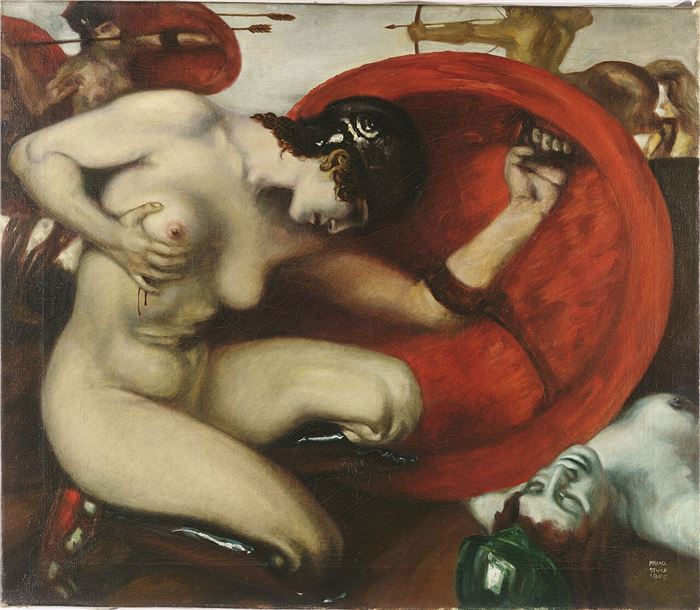
This piece encapsulates the duality that defined the Amazonian legend: a race of women who were both symbols of supreme physical prowess and targets of relentless, mythological violence. While the specific battle depicted in the canvas does not exist within the established canons of ancient Greek literature, the juxtaposition of these two formidable, often competing, forces serves as a poignant meditation on the nature of conflict and the fragile intersection of strength and vulnerability.
The Sisyphusian Struggle
The existential weight of Stuck’s work found perhaps its most profound expression in his 1920 depiction of Sisyphus. The Greek king, famously condemned by the gods to an eternity of futile labor, is rendered here not just as a figure of legend, but as a portrait of exhaustion and resignation. Against an infernal-red sky, streaked with clouds the color of charcoal, Sisyphus is locked in his perpetual cycle of labor.
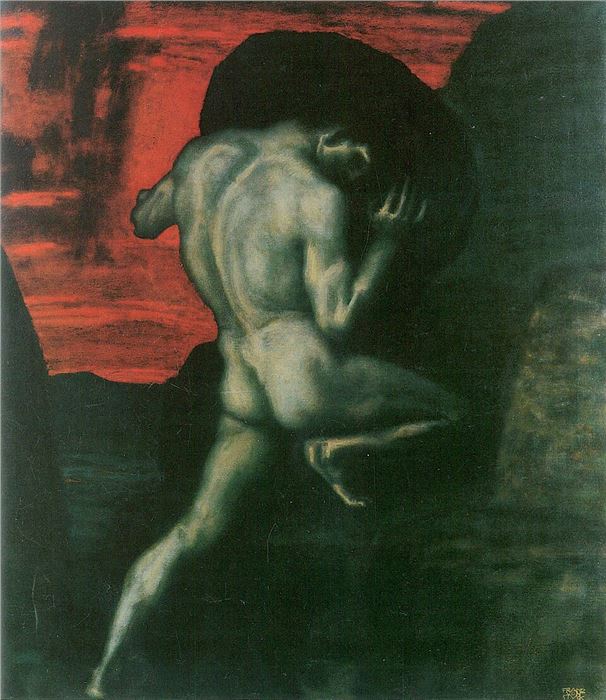
Stuck’s choice of palette and lighting is crucial to the impact of this work. The corpse-pale flesh of the figure, set against the suffocating, ink-black darkness of the Stygian vault, creates a stark contrast that emphasizes the hopelessness of his task. His face is a mask of gloom, his muscular frame strained and devoid of the promise of rest. By focusing on the physical toll of this "sempiternal plight," Stuck transforms a classical metaphor into a visceral, relatable experience of human suffering and the burden of repetition.
Divine Light and the Fallen Angel
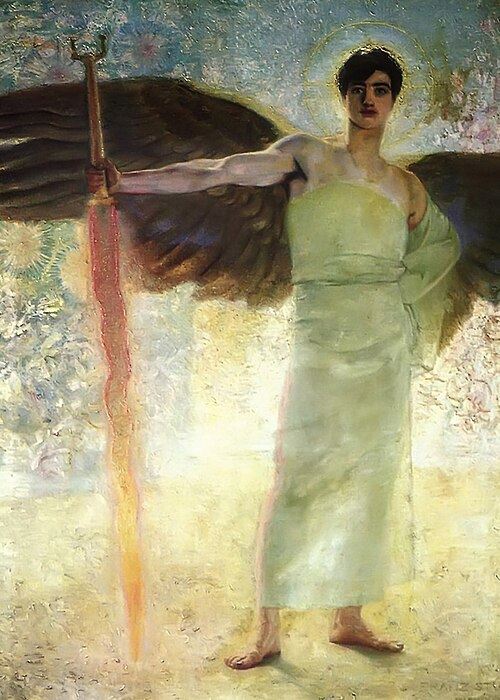
In contrast to the darkness of his later works, Stuck’s 1889 painting The Guardian of Paradise remains a testament to his ability to capture the sublime. As his first major oil painting, it garnered the artist a gold medal at the Munich Glaspalast and solidified his reputation as a premier Symbolist. The work depicts an angel, marked by an androgynous, ethereal beauty, standing guard with a searing sword. The scene is defined by the light of paradise—an albescent, all-consuming glow that seems to burst forth in a constellation of stars. The piece acts as a personification of divine purity and serves as a powerful reminder of the traditional, moralistic battle between good and evil.
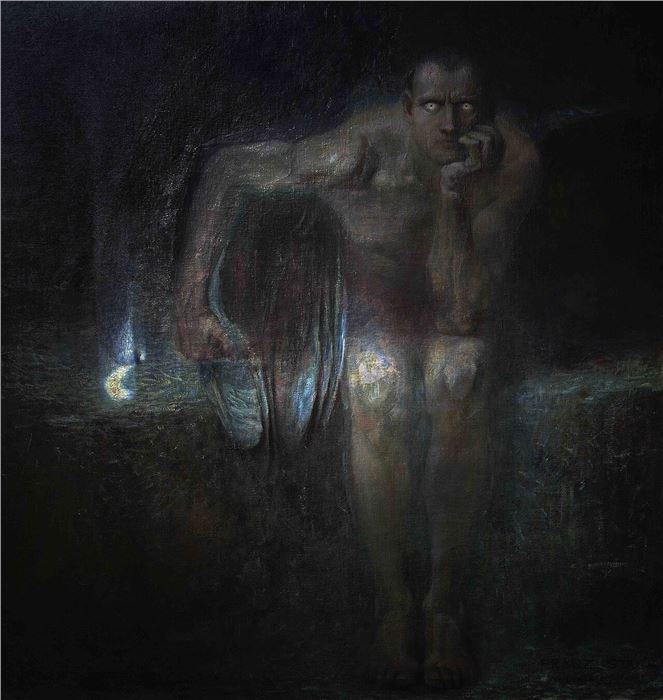
However, Stuck’s fascination with the darker side of theology is perhaps more famous. His 1890 masterpiece, Lucifer, remains one of his most haunting portraits. The fallen angel is depicted with eyes that act as piercing black pinpricks, staring directly into the soul of the viewer. The pose, reminiscent of a thinker lost in contemplation, is subverted by a subtle, underlying sense of molten rage.
The brilliance of the composition lies in its technical execution. The viewer’s attention is drawn to the clenched right fist of the "Morning Star," signaling an imminent strike, while the muscles of the arm remain tense and strained. Stuck employs eldritch elements—metallic blues shimmering across the draped wings and swirling, liquid-like textures on the ledge—to create a sense of unease. The inclusion of what appears to be an oversized teardrop, catching the light like a crescent moon as it falls into obscurity, serves as a masterful analogy for the cataclysmic descent of the Light-Bringer.
The Allure of Sin and Scandal
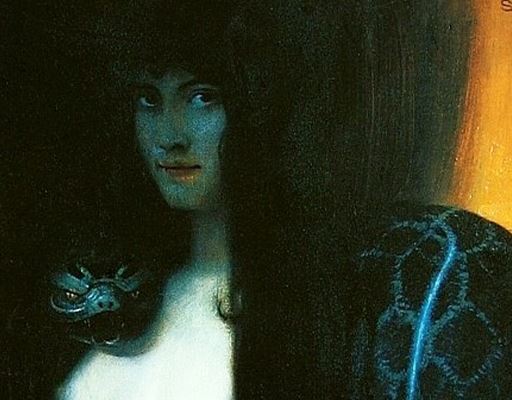
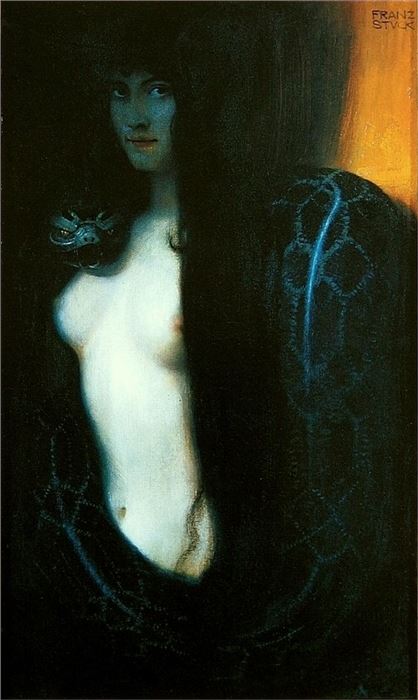
Stuck’s fascination with the darker impulses of humanity reached its zenith in his 1893 work, The Sin. Here, Eve is portrayed not as the submissive figure of biblical tradition, but as a seductive, dangerous entity, more akin to the mythological Lilith. Her only garment is a coiled, leech-black serpent that blends seamlessly with her cascading hair. This dark mass provides an intense chiaroscuro contrast to her pallid, glowing flesh, creating a powerful, provocative invocation of Eros and Thanatos.
The psychological impact of The Sin is profound. The amber light in the upper corner of the canvas infuses the subject with an undeniable, unsettling life. Stuck was so enamored with this specific motif that he produced approximately a dozen versions throughout his career, one of which was prominently displayed on his Künstleraltar. Even the renowned psychologist Carl Jung lauded Stuck’s exploration of this theme, noting the artist’s mastery in blending the complex, often contradictory emotions of anxiety and lust.
The Dance of Salome and a Shadowed Legacy
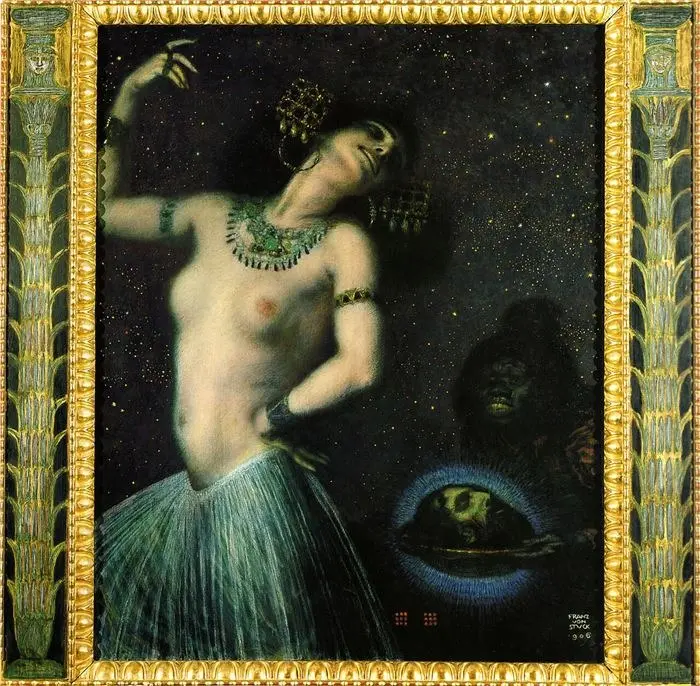
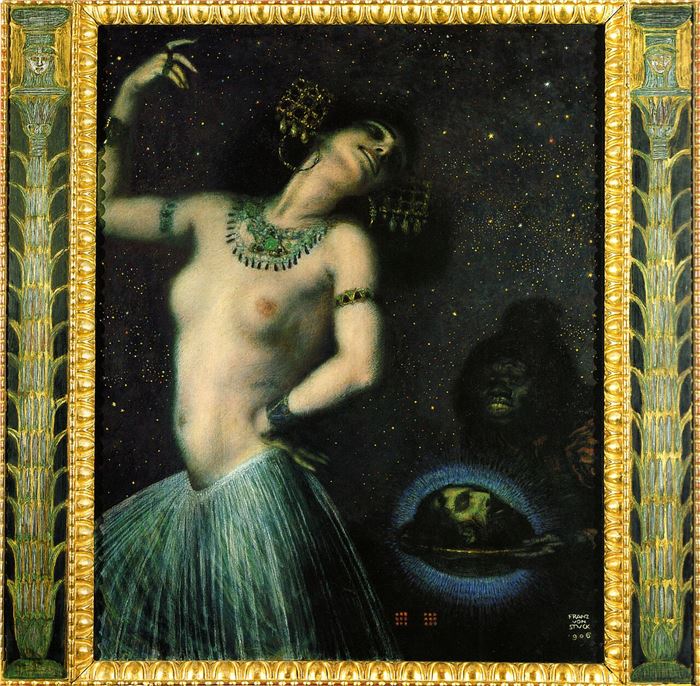
In his 1906 work Salome, Stuck returns to the themes of seduction and death. Against a night sky heavy with stars, Salome is captured in a state of ecstatic motion, her body curved and her neck elongated in a display of calculated allure. A dark-skinned servant presents the severed head of Saint John the Baptist, bathed in a cold, holy blue light that sharply contrasts with the warmth of the scene’s carnal energy.
Stuck’s preoccupation with the dangerous feminine and the corruption of power was a recurring hallmark of his career. It is worth noting that he completed three versions of this painting during the same year he received his knighthood. While two versions remain documented, the third vanished during the chaos of the Second World War. This disappearance adds a layer of historical intrigue to his work, particularly given his status as a favored painter of the Third Reich. Scholars have frequently noted the uncomfortable, and perhaps prophetic, proximity between his aesthetic and the imagery favored by the Nazi regime. Some have even suggested that certain works, such as his 1889 Wilde Jagd (The Wild Hunt), prefigured the dark, nationalistic fervor that would later engulf Germany.
Ultimately, Franz von Stuck’s brilliance lay in his ability to dismantle the constraints of Neo-classical and Academic art. He did not simply paint scenes; he built worlds. By abandoning the role of a mere recorder of history and stepping into the shoes of a psychological explorer, he transformed his subjects from costumed models into archetypes of the human condition. Whether he was depicting the agony of the condemned, the rage of the fallen, or the seductive pull of original sin, Stuck’s work remains an all-consuming experience—one that continues to entice, disturb, and captivate the modern viewer.