For over three decades, filmmaker and producer Steve Willis has called the legendary Hotel Chelsea his home. Moving into the iconic New York City landmark in 1994, Willis initially took up residence in a one-bedroom apartment complete with a balcony and a fireplace—a historic space famously inhabited by Janis Joplin decades prior. To this day, Willis retains everyday artifacts from the late rock icon’s tenure in the building, including her original soap dish and toothbrush holder.
The weight of cultural history hangs thick in the halls of the Chelsea, a building that has served as a crucible for artists, musicians, and writers for generations. Willis recalls being told by Patti Smith that she was standing right inside his apartment when Kris Kristofferson first sang "Me and Bobby McGee" to Joplin. Over the years, Willis’s own creative trajectory has intertwined with the entertainment world; he has directed music videos for prominent artists such as Patti LaBelle and Mary J. Blige, and later pivoted to choreographing elaborate, large-scale fountain shows for major hospitality destinations like the Bellagio in Las Vegas. He even documented that monumental undertaking alongside actress Rebecca Romijn in a film titled Wet Dreams.
When Willis first arrived at the property in 1994, however, the landscape of the building and its surrounding neighborhood bore little resemblance to its current polished reputation. Back then, West Chelsea was a vastly different environment.
"Chelsea was sort of a no-man’s-land," Willis recalls, noting that the area had not yet evolved into the vibrant, design-centric gay neighborhood it later became. "There was almost nothing. It had Rawhide," he adds, referring to the now-shuttered local dive bar. Inside the hotel itself, the security and atmosphere reflected a much grittier era of New York City. "When I moved in, there was bulletproof glass at the front desk and you had to get buzzed in."
Willis’s journey to the Hotel Chelsea began during his time living in Los Angeles. He initially traveled to New York to produce the music video for Mariah Carey’s "Anytime You Need a Friend." During the production, Stanley Bard—the legendary owner and manager of the property at the time—suggested that Willis forgo traditional hotel accommodations and take a room in the building instead.
"He was sort of the casting director for the building," Willis says of Bard. "We were all invited to live here."
Upon moving in, Willis found an apartment that had seen better days. The space was severely run down, featuring worn-out carpeting and multiple coats of heavy white paint slathered directly over the building’s original dark woodwork. Rather than tearing everything out for a modern renovation, Willis methodically stripped away the layers of paint to reveal the historic wood underneath, and began filling the rooms with a dense collection of street finds, antiques sourced from the Chelsea Flea Market, and discarded set pieces from his professional film and television work.
"The basement here also had furniture, and I could pilfer that. Stanley was really easygoing about stuff," Willis explains.
The space evolved further in 1996 when the studio directly across the hall became vacant, prompting Willis to rent that unit as well. His maximalist, preservationist design approach expanded into the second studio. Initially, he lined the walls with a metallic patterned wallpaper that appeared to hail from the 1960s, a look he later replaced with a 19th-century French wallpaper discovered on eBay. Much like his primary apartment—which was eventually downgraded from a one-bedroom to a studio layout—the facing unit became a repository for foraged goods, vintage textiles, and reclaimed decor.
Today, walking into Willis’s facing studios is like stepping through a portal into a personal museum of performance, memory, and discarded history. Describing himself unreservedly as a "pack rat," Willis embraces the role of custodian for both his own history and the eclectic items he rescues. "I keep everything. I’m a pack rat. I have become my family’s archivist," he notes.
Aside from a striking painting of Dolly Parton, virtually every piece of furniture, art, and decor across both apartments has a previous life. "Well, the mattress, the sheets, and the towels," he clarifies regarding the few modern additions.
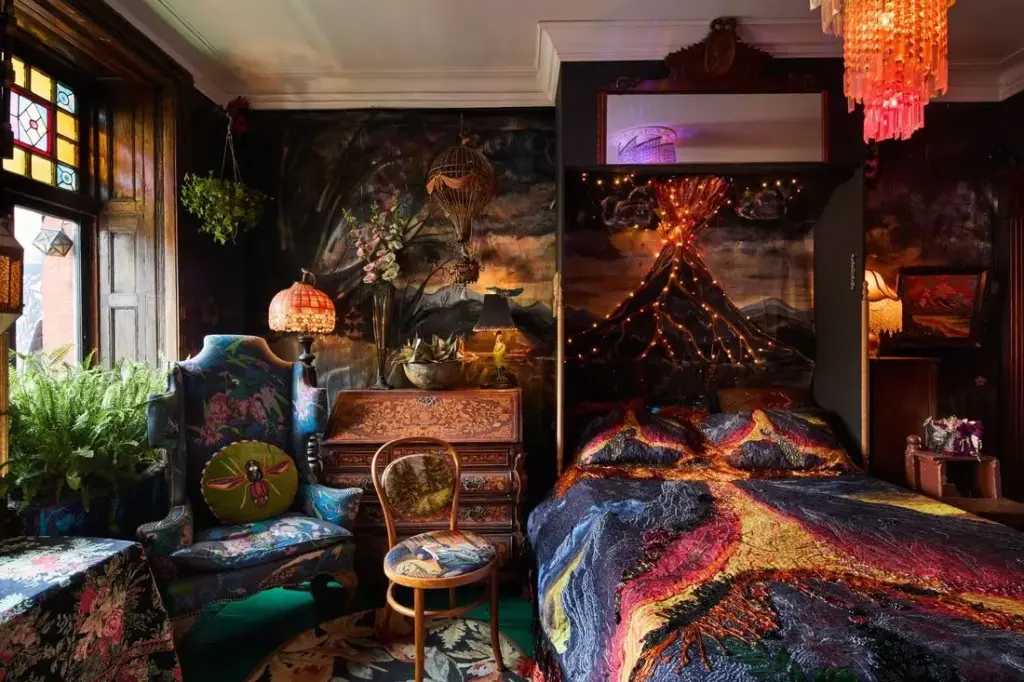
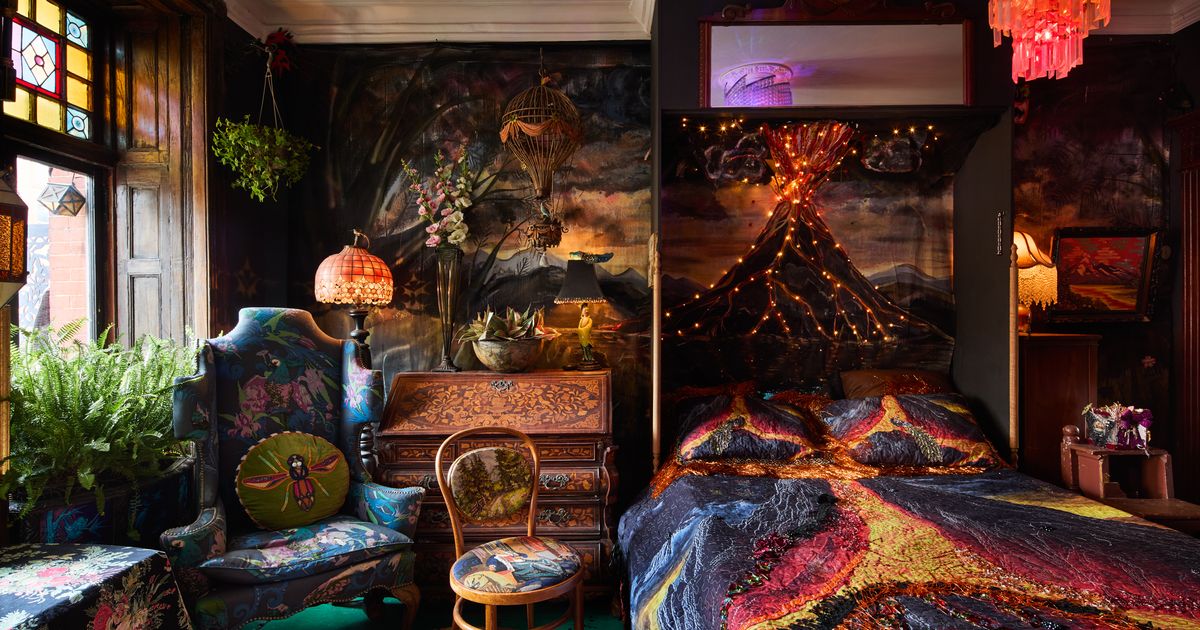
The interior details read as a masterclass in theatrical curation and vintage salvage. In what Willis calls the Volcano Room, a vibrant mural covers the wall directly behind his Murphy bed—a piece he originally painted for an Off-Broadway show about the Peruvian singer Yma Sumac. He designed the coordinating bedspread himself, while a nearby café chair came courtesy of Rebecca Romijn. "She finds embroideries on eBay and makes these chairs," Willis explains, noting that an inlaid desk in the same room was rescued from the City Opera Thrift Shop.

In the living and fireplace areas, the curation continues with an eclectic mix of international mementos and repurposed heirlooms. A lacquer chest hails from Japan, where Willis’s family lived for a period during the 1970s. Portraits collected from flea markets and antique shops have been given a dramatic drag makeover by Willis’s own hand, while a vintage chandelier has been retrofitted with colored lightbulbs. A 1960s elephant statue once belonged to his mother, standing near the apartment’s original mirror.
The bathroom and lounging spaces push the theatrical aesthetic even further. A Victorian wall unit serves as an unexpected door frame, while artwork sourced from the Chelsea Flea Market hangs nearby. The trim and oversized tassels on his bedding were procured from Hai Trim & Feathers in Manhattan’s Garment District. "It’s a fantasyland inside," Willis says of the richly textured environment.
That sense of fantasy extends to a main sofa that arrived draped in protective plastic. "This sofa was covered in plastic. When I took it off, I knew some old lady in heaven was having a fit. It felt almost sacrilegious to remove it," Willis admits. Accompanied by a marble-top coffee table from Goodwill and lamps and a chaise lounge found on eBay, the seating area draws frequent comparisons from visitors. "Someone said, ‘You know your apartment looks like Freud’s study?’ And I thought, Is that bad?"
Elsewhere in the studios, a newly finished portrait anchors what Willis refers to as his shrine—a piece completed just recently, tying into ongoing creative pursuits that include pitching a fountain project to Dollywood. The mantel nearby is a trompe-l’œil-painted piece from a thrift store, flanked by porcelain faces found at the Chelsea Flea, a screen from eBay, and a side chair acquired via Facebook Marketplace. In the bedroom, fabric from the Garment District covers the walls and lampshade, while an original radiator has been repurposed as a functional bedside table next to a nude painting gifted by a friend.
Through decades of sweeping neighborhood gentrification, building renovations, and shifting cultural tides, Steve Willis’s dual studios remain an eccentric, deeply personal time capsule. Preserving the physical remnants of the Hotel Chelsea’s storied past alongside a lifetime of accumulated theatrical treasures, his home stands as a testament to an era of New York bohemianism that continues to endure behind closed doors.