When whiskey enthusiasts hear the name Jefferson’s, their minds often drift immediately to the brand’s unconventional and highly publicized experiments. Over the years, the label has built a reputation for pushing the boundaries of traditional whiskey maturation. Aficionados frequently point to its daring practice of aging barrels of whiskey at sea aboard rolling container ships, exposing the spirit to constant motion, fluctuating temperatures, and salty maritime air. Others remember unique releases like last summer’s Founder’s Reserve, a remarkably complex 20-year-old bourbon that was surprisingly granted a finishing period in French Bordeaux wine casks—an adventurous step for a whiskey of such advanced age.
While these boundary-pushing expressions and ocean-aged varieties often steal the spotlight and generate lively debates among collectors, the foundational backbone of the brand has always relied on a more traditional approach. Jefferson’s core whiskey portfolio is less about taking high-risk gambles and more about the meticulous art of selecting and blending exceptionally high-quality barrels into consistent, approachable expressions. Now, the brand is shifting focus back to these everyday staples, announcing significant upgrades to its two primary bourbons in terms of both maturation age and bottling proof, alongside a comprehensive packaging redesign meant to unify the entire brand identity.
Founded in 1997 by the pioneering father-and-son duo Chet and Trey Zoeller, Jefferson’s has grown from a boutique concept into a staple of modern American whiskey. Both founders earned widespread respect in the industry, ultimately culminating in their joint induction into the Bourbon Hall of Fame a few years ago. Although the whiskey community suffered a profound loss when Chet Zoeller passed away in 2024, his son Trey continues to steer the ship, maintaining the brand’s creative vision. The company’s trajectory changed significantly in 2019 when beverage giant Pernod Ricard acquired Jefferson’s parent company, Castle Brands, providing the backing necessary for broader distribution and continued experimentation while preserving the brand’s core identity.
That identity is perhaps best embodied by the core lineup, which traditionally consists of the Very Small Batch Bourbon, Triple Rye, Ocean, and Jefferson’s Reserve. Recently, the latter of these expressions received a very substantial improvement upon a recipe that was already widely regarded as a reliable and high-performing whiskey. Jefferson’s Reserve has officially transitioned to carry an eight-year age statement, giving bourbon enthusiasts a clearer picture of the maturity resting inside the glass. Furthermore, the bottling proof has been elevated to 96, a noticeable increase from its previous 90.2 proof.

Achieving this new milestone required a deliberate and thoughtful shift in how the blending team approaches its inventory. Ale Ochoa, Jefferson’s master blender, elaborated on the meticulous process behind the change in a statement released by the brand. According to Ochoa, reaching this specific age statement meant diving deep into the company’s stock of older, more mature barrels and crafting the final blend with absolute intention. Aged for a minimum of eight years in charred American white oak barrels, the upgraded Jefferson’s Reserve is designed to deliver a robust sensory experience. The master blender notes that the whiskey opens with prominent upfront notes of dark fruit and creamy vanilla custard, which then gracefully transition into baking spice, seasoned oak, and toasted almond, ultimately carrying through to a long, warming, and spicy finish.
The flagship Jefferson’s Reserve is not the only expression receiving a meaningful adjustment. The brand’s entry-level workhorse, Jefferson’s Very Small Batch Bourbon, has also undergone a subtle yet impactful transformation. Its proof has been raised from 82.3 up to 88. While a jump of a few points might seem modest on paper, in the realm of whiskey blending, even a slight increase in proof can dramatically alter the mouthfeel, structural integrity, and flavor delivery of a spirit, allowing the underlying grain and barrel characteristics to shine through with greater clarity.
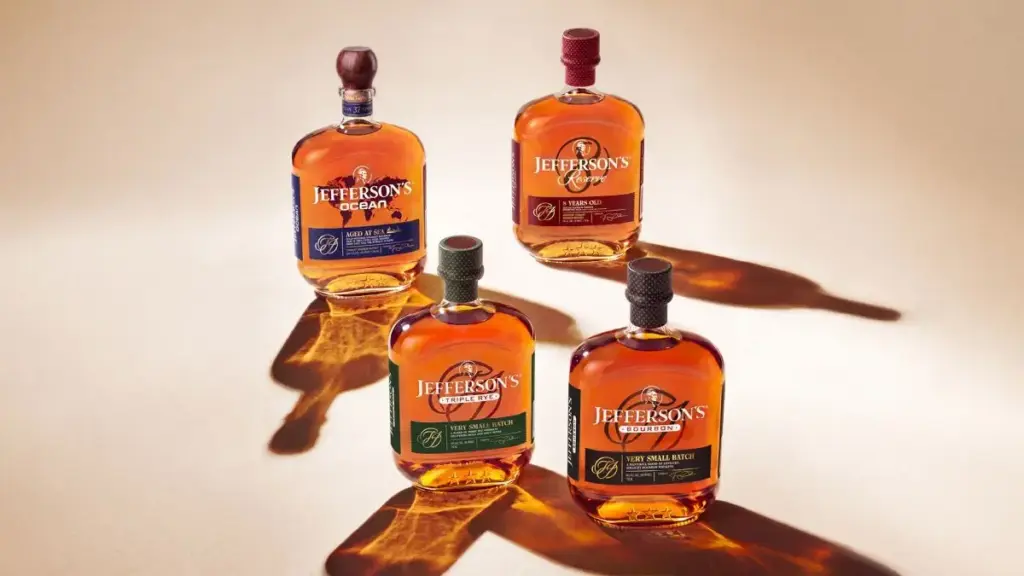
Alongside these liquid enhancements inside the bottles, Jefferson’s has also completely refreshed its external packaging. This aesthetic overhaul places the brand alongside other notable American whiskey producers, such as the Bardstown Bourbon Company, which have similarly updated their visual presentations over the past year or so to better align with contemporary design standards. Reactions from longtime fans and purists to a packaging refresh can notoriously vary across the spirits community, as collectors often hold a strong nostalgia for legacy labels. However, these new Jefferson’s bottles feature a design that has been carefully calibrated to feel clean, sophisticated, and largely inoffensive to traditionalists.
According to representatives for the brand, the new visual identity was specifically built to better reflect the true quality and character of the liquid housed inside. The redesign aims to create a stronger, more cohesive brand identity across all tiers of the portfolio, while simultaneously establishing a clearer navigation system for consumers attempting to explore the full range of Jefferson’s offerings on crowded retail shelves. In the current economic and market climate of the American whiskey industry—where production levels and market dynamics have faced shifting consumer demands—any thoughtful update that helps modernize a brand and boost retail engagement is viewed as a positive step forward.
For enthusiasts eager to taste the changes firsthand, the newly upgraded versions of Jefferson’s Very Small Batch Bourbon, Triple Rye, Reserve 8-Year-Old, and the signature Ocean Aged at Sea expressions are currently rolling out and can be found on liquor store shelves around the country. For those looking for alternative sizing options to fit different occasions, smaller 375-milliliter bottles, as well as larger 1-liter and 1.75-liter formats, are scheduled to become commercially available later this year.