Translation never truly arrives in Maia Ruth Lee’s solo exhibition, Double Vision, currently on view at the Tina Kim Gallery. Instead, within the gallery’s meticulously curated spaces, translation is presented not as a definitive endpoint or a bridge successfully crossed, but as a persistent condition to be physically embodied and critically probed.
The exhibition draws deeply from Lee’s personal history and family background. Her parents worked as Bible translators who relocated to Nepal, where they undertook the complex, monumental task of developing a written alphabet for the previously unwritten oral Sherpa language. Growing up immersed in this cross-cultural, linguistic endeavor profoundly shaped Lee’s artistic perspective. In Double Vision, she unfolds the complex, often fractured act of translation across a diverse array of mediums, treating language, memory, and physical movement as fluid entities that resist permanent fixing.
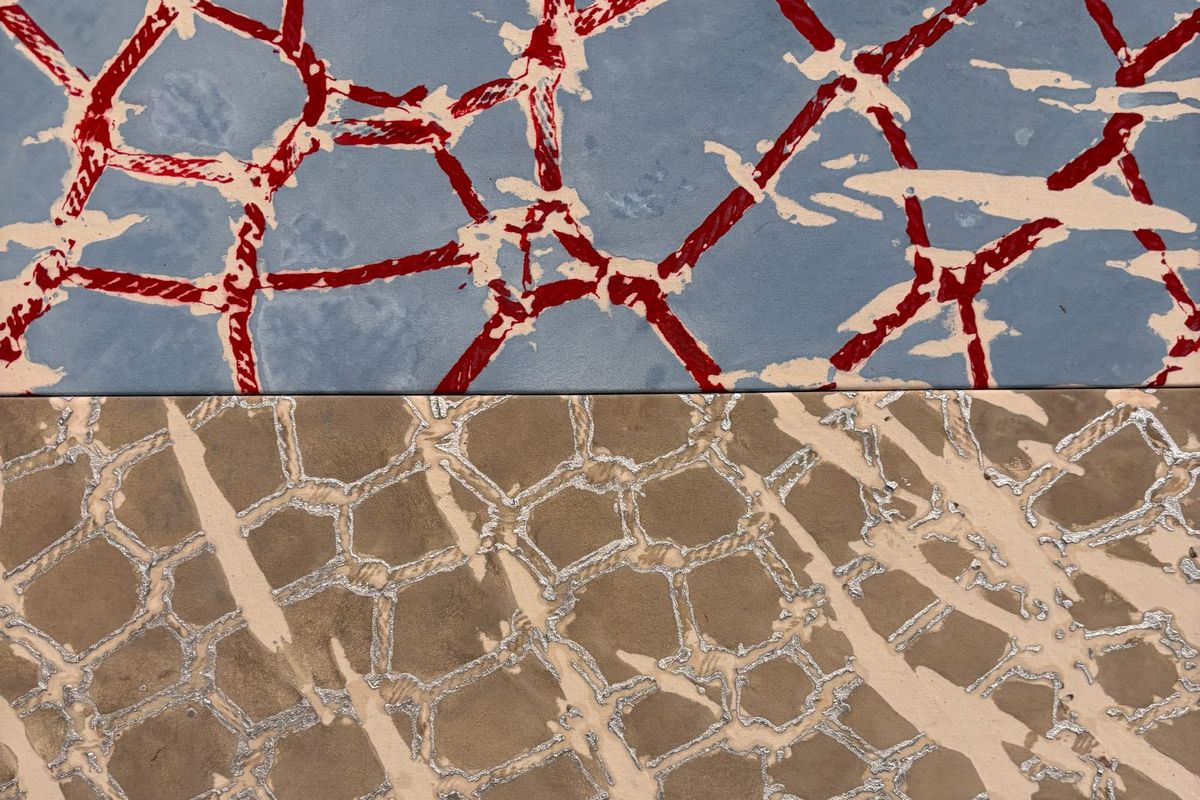
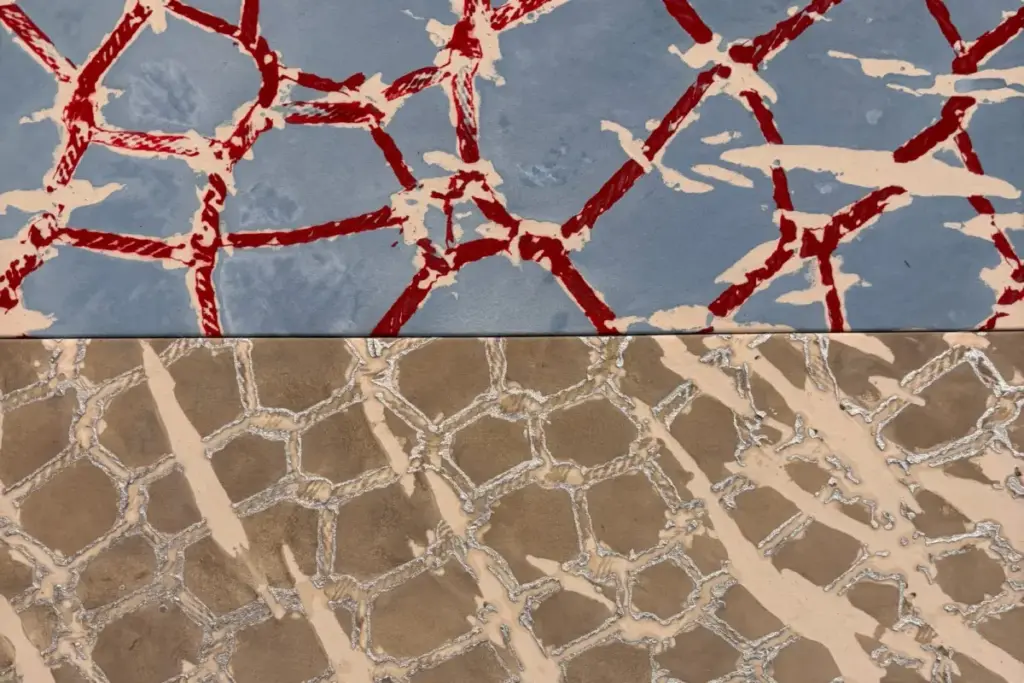
Throughout the exhibition, a distinct visual language recurs across canvas, latex, and steel, creating a dialogue between disparate materials and forms. This visual vocabulary features grid-like patterning directly inspired by the luggage and transit spaces of the Kathmandu airport, cryptic and illegible glyphs that resist straightforward decoding, and intimate images drawn from the artist’s family archive. These elements act as motifs of migration, but the motifs themselves literally and figuratively migrate across the gallery space, mutating and shifting as they take on new physical forms.
This dynamic transformation is particularly evident in how Lee handles physical and conceptual weight. Stacking, for instance, serves as a versatile structural device that evokes opposing emotional and psychological states depending on the context. In the modular canvases of the B.B. Tetris series, all created in 2026, stacking evokes a sense of playful geometry, interactivity, and structural experimentation. Viewers are invited to perceive the arrangement of the canvases through a lens of spatial game-play and structural fluidity.
However, this same act of stacking takes on an entirely different, heavier resonance in works like “Expandable Luggage,” also from 2026. In this piece, the rapidly growing, vertical height of the stacked and expandable forms suggests a belabored, arduous migration—one burdened by the physical and emotional weight of displacement, transit, and the accumulation of belongings over time. Within this framework, translation effectively acts as a migration of a kind. As things move from one space, culture, or language to another, some elements are carried across successfully, while others are inevitably left behind, lost in the hazardous space of the interval.

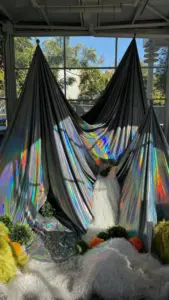
The exhibition layout reinforces this sense of transition and continuous movement. Installation views of the gallery, including Maia Ruth Lee’s video work #1 from 2026, capture the immersive quality of the show, where viewers are encouraged to navigate not just a collection of static objects, but an active environment defined by gaps, delays, and ongoing shifts in meaning. By refusing to offer easy resolutions or neat linguistic packages, Double Vision challenges audiences to sit with the discomfort and generative potential of the in-between, positioning translation as an enduring human state rather than a finished task.