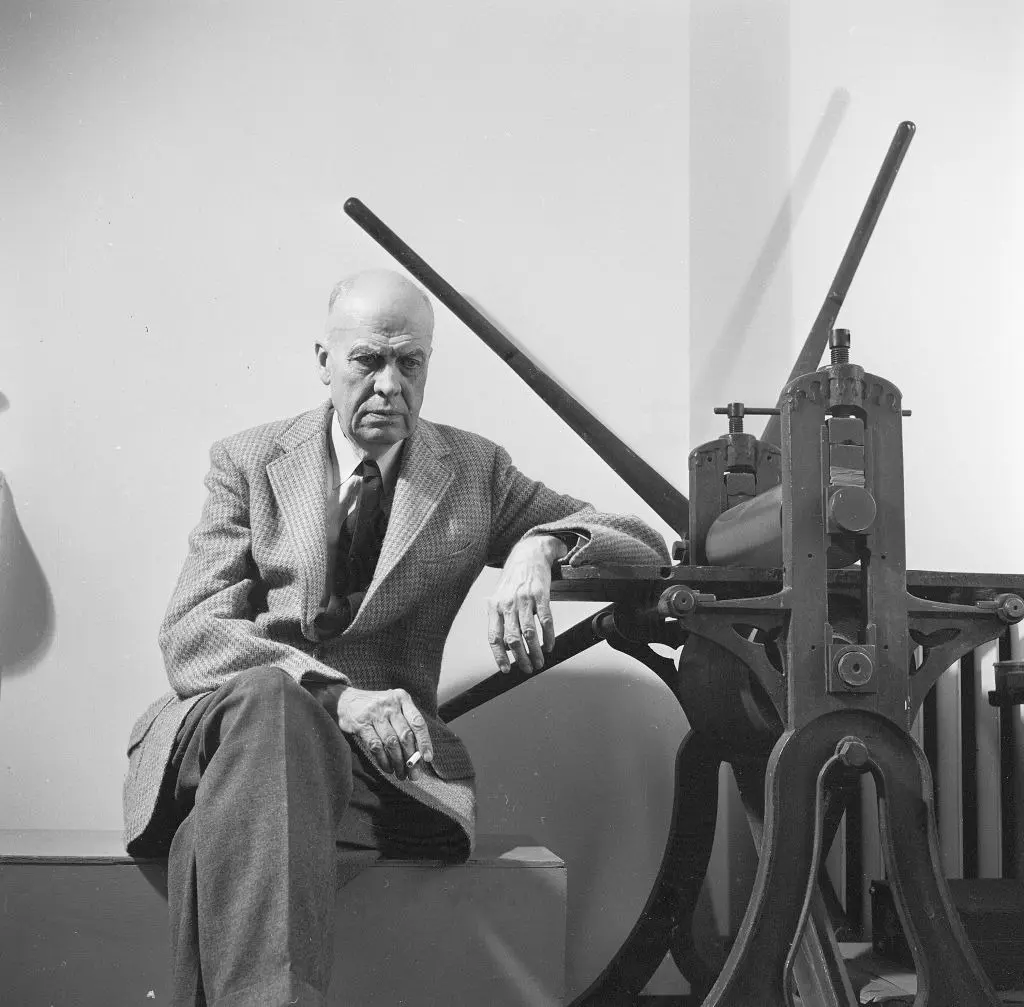
A compelling new biography on Edward Hopper has shed entirely new light on the legendary American realist painter’s formative years, revealing that his earliest known oil paintings are not original compositions at all, but rather copies of works by other artists.
According to an excerpt from Louis Shadwick’s forthcoming biography of the artist, published in The Art Newspaper, all six of the teenage oil paintings long attributed to Hopper’s nascent genius were painted while he was working in a makeshift studio inside his family home in Nyack, New York. Created before he formally attended art school in New York City, these works have historically been viewed by art historians as early windows into his developing, independent artistic vision. However, Shadwick’s meticulous research demonstrates that the future master of melancholy urban isolation began his oil painting journey by faithfully replicating instructional color plates found in late-19th-century periodicals.
The story of how these early works came to light dates back to the late 1960s, shortly after Hopper’s death. They were discovered in the dusty attic of the artist’s childhood home in Nyack by the Reverend Arthayer R. Sanborn, a Baptist minister who lived just down the street from the Hopper family. Sanborn had developed a close relationship with the household, eventually taking on the responsibility of caring for Hopper’s sister, Marion, and his wife, the fellow artist Josephine Nivison Hopper.
Following the deaths of the artist and his family members, Sanborn acquired a massive and historically significant trove of Hopper memorabilia. This collection included personal letters, rare photographs, detailed notebooks, and a wealth of early paintings and drawings salvaged from both the Nyack house and the couple’s long-time apartment in Greenwich Village. While parts of this sprawling archive eventually found a permanent home in public institutions—most notably the Whitney Museum of American Art, which holds a vast repository of Hopper’s mature works and preliminary sketches—Sanborn’s stewardship of the collection has occasionally been viewed with a degree of controversy regarding how items were cataloged and presented to the public.
As Shadwick details in his biography, Sanborn did more than simply preserve the teenage works; he inadvertently helped cement a misleading narrative regarding their origin. Assuming that the young Hopper had conceived of the compositions himself and drawn direct inspiration from the familiar surroundings of his hometown, Sanborn assigned new and evocative titles to the canvases.
For decades, art historians and enthusiasts accepted these titles at face value. One prominent example, titled Old Ice Pond at Nyack by Sanborn, was widely thought for generations to depict the local skating pond near the neighborhood where Hopper grew up. Another painting was similarly christened Rowboat on Hudson—or Rowboat in Rocky Cove, as it was also known—tying the imagery directly to the Hudson River landscape of Hopper’s youth.
Shadwick’s research, however, debunks these long-held assumptions. Both paintings turn out to be careful copies that a teenage Hopper made from instructional images printed as color plates in the publication Art Interchange. Specifically, Old Ice Pond at Nyack was copied directly from a painting by the artist Bruce Crane, titled A Winter Sunset, which appeared in the December 1890 issue of the magazine. Meanwhile, Rowboat on Hudson was traced back to a watercolor titled Lake View, created by an unidentified artist and published in the February 1891 edition.
The pattern of replication extends to the rest of the surviving group of early oils. Shadwick’s biography highlights several other examples, including Country Road, which was copied from A Landscape Study in Color by John Francis Murphy. Another canvas, simply titled Ships, was lifted from Marine View by Edward Moran, while Clipper Ship Being Towed by Tug was derived from Stormy Voyage by Fred Pansing.
Hopper executed all of these works in the late 1890s, when he was approximately 15 or 16 years old. Demonstrating the pride of a young hobbyist experimenting with a difficult medium for the first time, most of the canvases are signed with his full name or his initials, marking his early, tentative steps into the world of fine art.
Crucially, Shadwick emphasizes that these findings should not be interpreted as a scandal or an attempt at deception on the part of the young artist. There is no indication that Hopper was trying to pass the works off as his own original inventions for public exhibition or commercial gain. Rather, as Shadwick observes, the signatures on the canvases reflect a teenager’s youthful pride in mastering the difficult medium of oil paint—achievements accomplished in private, with no initial expectation that the pieces would ever be scrutinized by the public or art historians.
Far from being a sensationalized "gotcha" moment designed to diminish Hopper’s legendary stature, Shadwick’s discovery serves as a vital historical revision. It fundamentally reshapes our understanding of Hopper’s artistic evolution. The traditional narrative suggested that his exceptional talent for painting emerged almost spontaneously during adolescence without formal guidance, or that he was entirely unexposed to broader American art movements until he entered professional art school. Instead, the newly contextualized works show a dedicated teenager learning his craft the traditional way: by studying, copying, and mastering the techniques of established masters whose work circulated through the popular arts press of the Victorian era.