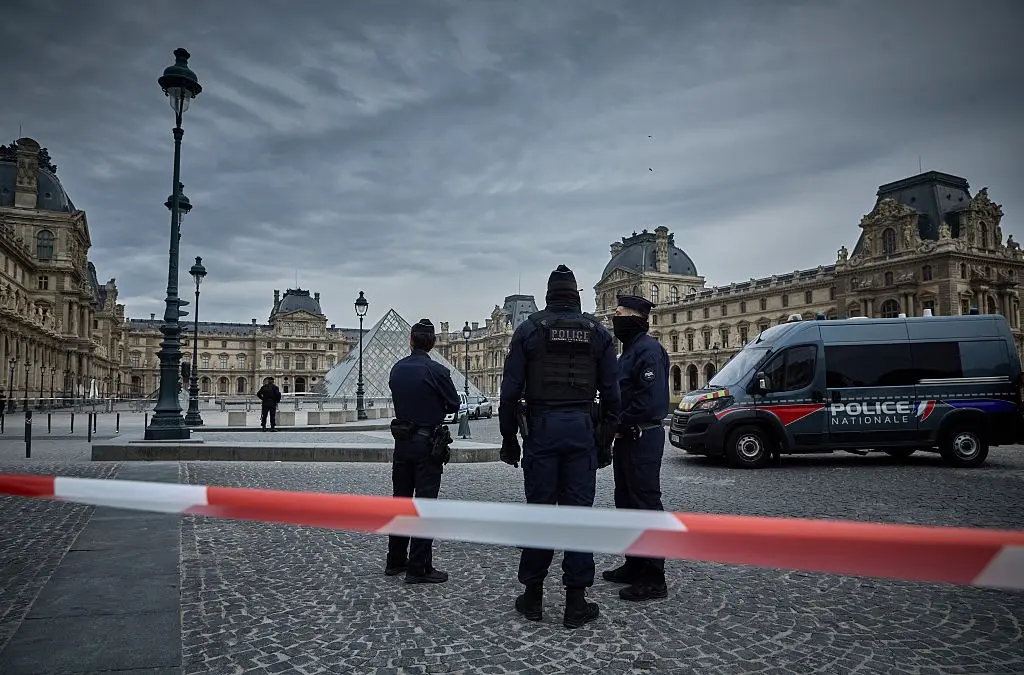
An alleged member of the four-person team that carried out a brazen daylight break-in at the Louvre last October, making off with irreplaceable crown jewels valued at roughly $100 million, will remain behind bars, the French publication Le Figaro reports. The Paris Court of Appeal ruled on Wednesday to deny a release request for 40-year-old Rachid H., who has been held in pre-trial detention since November 2025. The court’s decision underscores the gravity of the ongoing investigation into one of the most high-profile museum thefts in modern history, an operation that stunned law enforcement and cultural heritage experts alike with its cinematic precision and sheer audacity.
The heist itself unfolded with breathtaking speed on the morning of Sunday, October 19, 2025. Utilizing a truck-mounted motorized ladder, the gang of four executed a vertical assault on the world-famous museum, breaching a second-floor window to gain direct entry into the Louvre’s majestic Apollo Gallery. Once inside the historic halls, the perpetrators wasted no time, systematically smashing two display cases and seizing eight priceless pieces of imperial jewelry. Among the items targeted was a historic crown once owned by Empress Eugénie, which was accidentally dropped on the floor and left behind in their frantic haste as alarms began to blare throughout the sprawling cultural institution.
With security alerts sounding and authorities being notified, the crew executed a swift escape. Moving with practiced coordination, they fled the scene on two motorized scooters, weaving through Parisian traffic and vanishing before local police could respond to the initial alarms. Investigators later determined that the entire operation—from the initial breach of the second-floor window to the final getaway on two wheels—unfolded in roughly seven minutes, showcasing an alarming level of planning, reconnaissance, and timing.
In the months following the spectacular robbery, French law enforcement agencies have launched a massive, multi-jurisdictional manhunt to track down the culprits and recover the missing national treasures. While the stolen crown jewels have yet to be recovered, police have made notable strides in identifying and apprehending members of the alleged criminal network. The initial breakthrough came within a month of the heist, leading to the arrest of the first two primary suspects: 40-year-old Abdoulaye N., an unlicensed taxi driver with a prior record of robbery convictions who had gained a degree of local notoriety online for his motocross stunts; and Ghelamallah A., a 36-year-old unemployed Algerian national. Both men have since admitted to their involvement in the audacious break-in, though investigators note that their cooperative statements and courtroom testimonies have ultimately introduced as many complications as they have resolved.
During court appearances in June, the two detained men offered a convoluted account of the crime to investigating magistrates, claiming they had been recruited for the job just days before October 19 by an anonymous sponsor whose identity they steadfastly refused to disclose. According to their testimony, the principal accomplice who issued their orders and coordinated the logistics remains completely at large. Furthermore, the two suspects insisted that other men subsequently arrested by police—including Rachid H.—had nothing whatsoever to do with the planning or execution of the crime. In an attempt to deflect responsibility or perhaps protect co-conspirators, they claimed that the purported mastermind had actually accompanied the robbers directly into the Louvre during the break-in and continues to evade law enforcement custody.
Rachid H. was originally apprehended and placed under formal investigation on suspicion of acting as a critical logistical link for the crew, specifically for allegedly providing the robbers with the keys to a secure parking facility located in Aubervilliers. During questioning in January, reports from the Agence France-Presse indicated that Rachid H. partially acknowledged having handed over the keys to "two people," while staunchly maintaining that he was entirely ignorant of the fact that the keys would be used to facilitate a multi-million-dollar museum heist. His defense team has aggressively pushed back against the state’s detention of their client, pointing out critical forensic gaps in the prosecution’s case. Specifically, defense lawyers have emphasized that Rachid H.’s fingerprints were discovered neither on the motorized truck used to breach the Apollo Gallery window nor within the Aubervilliers parking lot where the robbers allegedly transferred the stolen jewels to an unidentified individual.
Despite these defense arguments, the Paris Court of Appeal determined that continued pre-trial detention remains necessary as magistrates continue to probe the wider network responsible for the theft. As the investigation presses forward, French authorities continue their international appeal for information regarding the whereabouts of the eight missing crown jewels, while the search for the remaining suspects and the alleged mastermind shows no signs of slowing down.