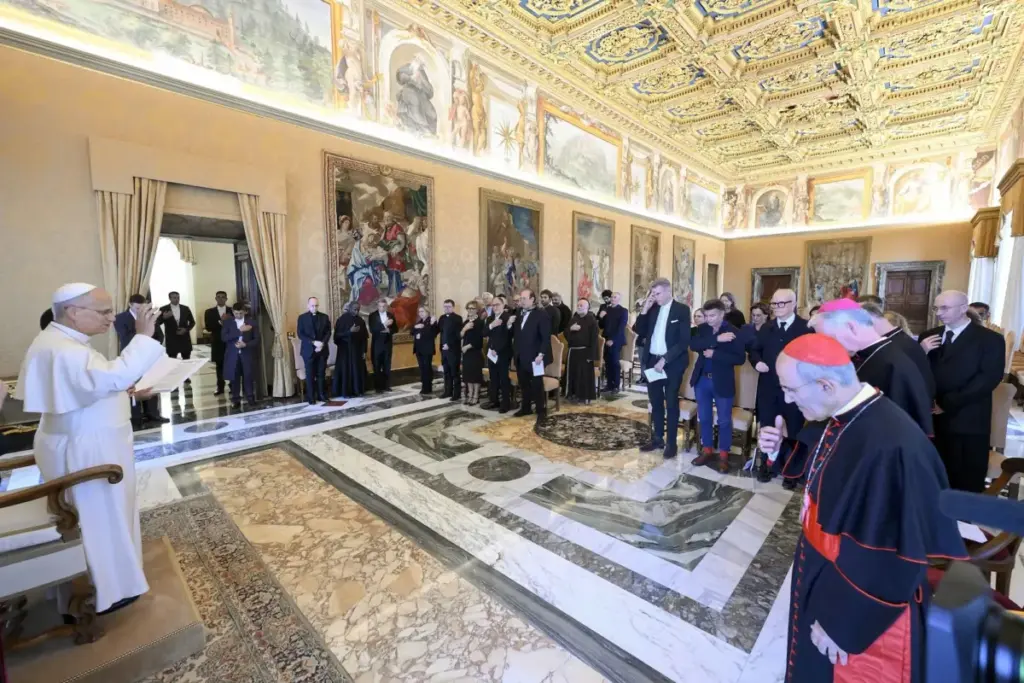
VATICAN CITY — In a sweeping address delivered at the Vatican’s Apostolic Palace on Friday, Pope Leo made a passionate plea to a gathering of international artists and curators, declaring that the Catholic Church urgently needs their creative vision to navigate the cultural challenges of the digital age. Speaking against the backdrop of rapid technological shifts, the pontiff positioned authentic human art as a vital counterweight to the rise of advanced artificial intelligence, arguing that creative works preserve an irreplaceable spiritual spark that algorithms can never replicate.
The pope’s remarks come at a critical juncture in the global conversation surrounding artificial intelligence. The address arrived just days after prominent technology experts warned of existential risks posed by frontier AI systems over the coming decade. Furthermore, the Vatican gathering followed a high-profile meeting in Washington, D.C., where U.S. President Donald Trump convened leading architects of frontier AI models at the White House to secure voluntary commitments regarding industry self-regulation.
Addressing the cultural delegation inside the historic Apostolic Palace, Pope Leo emphasized that the mission of the Church relies heavily on the cultural contributions of artists. The audience was gathered for the inauguration of a new Vatican exhibition titled “The Art of Possibility: Weaving Together,” which was organized under the auspices of the Vatican’s Dicastery for Culture and Education.
“This is especially true in this age of artificial intelligence, in which we urgently need to distinguish human art from what is produced by machines,” Pope Leo told the assembled creators.
Elaborating on the philosophical and theological implications of machine-generated media, the pontiff pointed to a profound division between human creativity and technological output. He underscored that the distinction is not merely aesthetic, but fundamentally ontological.
“There is an ontological difference—even before an aesthetic one—between art and what a machine can generate through statistical calculation based on millions of images created by others,” the pontiff said. Quoting extensively from his encyclical letter published earlier this year in May, titled Magnifica Humanitas: On Safeguarding the Human Person in the Time of Artificial Intelligence, Pope Leo stressed that algorithms inherently lack the intangible essence of human experience. He reiterated the sentiment of the encyclical, noting that “authentic culture and art preserve this spark.”
The papal address drew upon historical precedent within the modern Church. Pope Leo cited his predecessor, Pope Paul VI, who famously appealed to the artistic community during a historic gathering in 1964 by declaring, “We need you.” Expanding upon Paul VI’s vision, Leo argued that the core ministry of the Church is dedicated to making the world of the spirit inspiring and accessible to contemporary society.
“And in this task, which translates the invisible world into accessible, intelligible forms, you are masters,” the Pope told the curators and artists in attendance.
The pontiff reinforced his message to the wider public by sharing his thoughts on X, the social media platform owned by entrepreneur Elon Musk. Musk’s prominent role in the development of frontier artificial intelligence systems had earned him a seat at the White House roundtable hosted by President Trump just days prior. The synchronized social media post echoed the central themes of the Vatican address, ensuring that the papal warning reached a global digital audience.
During Friday’s address, Pope Leo contrasted the operational nature of modern digital tools with the contemplative depth of creative expression. He noted that contemporary society is inundated with rapid answers derived from automated systems that prioritize convenience and pre-existing preferences.
“We live in the age of search engines that offer us thousands of instantaneous answers,” Leo observed. “Yet, no matter how powerful they may be, they merely return what already exists and tend to give us what we already want.”
In contrast, the pontiff framed authentic art as an alternative mechanism for human inquiry and discovery. He suggested that artistic creation operates on a fundamentally different plane than automated data retrieval, serving as a catalyst for deeper introspection rather than passive consumption.
“Art is a different kind of ‘search engine,’” the Pope explained. “It does not proceed by indexing but by inquiry. Indeed, its inquiry is a focused attention that is not satisfied with the mere sum of facts, for it never ceases to dig deeper, seeking the thread that unites them.”
He added that creative works capable of resisting cultural homogenization possess the unique power to command human attention, inviting individuals to pause in front of objects that defy commodification. Such art, the pontiff argued, functions as a powerful instrument for cultural and spiritual regeneration in a mechanized world.
Concluding his address, Pope Leo offered words of encouragement and solidarity to the cultural leaders gathered at the Vatican, affirming the institutional support of the Church for their ongoing creative endeavors.
“Dear artists, dear curators, know that the Church looks upon you with esteem, gratitude and hope; that she needs you, and that she wishes to walk alongside you, so that together we may safeguard the grandeur of humanity entrusted to us,” the Pope concluded. “May God bless all of you and your work!”