Beth Rudin DeWoody, the celebrated art collector, philanthropist, and real estate heiress known for amassing a staggering collection of roughly 10,000 works of art, has once again placed her longtime home on Manhattan’s Upper East Side on the market. Listed for $12 million—the exact same price she asked when she last attempted to sell the property in 2018—the sprawling 5,000-square-foot apartment offers a rare glimpse into a life deeply immersed in contemporary art and New York City history.
For DeWoody, acquiring things has always been a way of life. Over the decades, she has bought everything from a Benny Andrews drawing to a miniature poodle, often on impulse. Her collecting habits extend far beyond canvas and sculpture into the realm of real estate. In the early 2000s, she acquired three homes on adjacent lots along the Intracoastal canal in Florida. More recently, she grabbed a duplex in the historic Los Angeles co-op building once home to filmmaker Billy Wilder, a property situated just above another unit she already owned. As she famously remarked to Artnet, explaining the relentless pace of her acquisitions, it is hard for her not to buy, even when she runs out of money.
Yet maintaining a massive, highly staffed footprint across multiple states comes with steep financial realities. It becomes difficult to justify spending $13,000 a month in cooperative maintenance fees for a 5,000-square-foot pied-à-terre in New York City when your daily life and primary centers of gravity are firmly rooted in Los Angeles and Florida. This calculus likely informed her decision to part ways with Apartment 4G at 10 Gracie Square, a home she has owned and curated since 1987.
Nestled on the fourth floor of a distinguished 1929 doorman co-op building located at the far eastern end of 84th Street in Yorkville, the apartment sits within an architectural landmark seemingly tailor-made for high-profile residents seeking privacy from the public eye. The building features a private, covered driveway that cuts completely beneath the structure, running all the way through to 83rd Street and leading straight to three separate elevator lobbies. Over the decades, the prestigious address has drawn numerous notables. The Obamas were once rumored to be eyeing a home in the building, legendary society figure Brooke Astor lived there, and a young Anderson Cooper was raised upstairs by his mother, Gloria Vanderbilt.
When DeWoody first moved into the building in 1987, she was a mother with two young children. She enlisted the architect Alan Wanzenberg—who had previously worked for famed architect I.M. Pei—to execute a comprehensive renovation. While Wanzenberg typically favors classic, restrained interior pieces, DeWoody’s personal aesthetic is radically eclectic. Observers of her properties have frequently noted the striking divergence of her style; The Wall Street Journal once memorably compared her Florida compound to a Tim Burton film brought to life, citing topiaries meticulously trimmed into the shapes of poodles and chess pieces.

DeWoody’s background is deeply rooted in the traditional aristocracy of the Upper East Side. She was raised just a block away in a building managed by her father, the prominent real estate executive and civic leader Lew Rudin. It was only after her marriage to the artist James DeWoody that she settled downtown in Tribeca, immersing herself fully in the avant-garde art world and developing a lifelong passion for unconventional, contemporary works.
Her Gracie Square apartment functions as a fascinating architectural and visual intersection of these two distinct worlds—as if a sprawling, sun-drenched waterfront Miami mansion had been carefully compressed into a classic pre-war New York space defined by multi-paned windows and traditional herringbone floors.
In a grand 34-foot-long entrance gallery that serves primarily as a dramatic introduction to the home rather than a functional living space, those classic wood floors are painted a luminous creamy white. That bright, neutral paint extends seamlessly across the floors of the adjacent 32-foot-long living room, whose expansive windows capture sweeping vistas looking east over the East River and north toward the lush greenery of Carl Schurz Park.
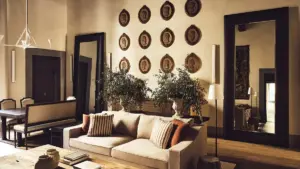
Inside the expansive living room, the atmosphere is electric with personality. The space accommodates zebra-print chairs, a grand piano topped with a miniature geodesic dome, a tiny gold-plated piece of construction equipment resting on a mantelpiece, and a striking figurative sculpture depicting a woman with cascading coils of Medusa-like black hair. Elsewhere in the apartment, a Charles Lutz Brillo box functions cleverly as a side table in a room staged to resemble a home office. The density of the art collection is so profound that framed pieces literally overlay the built-in bookshelves in the library. A Tony Matelli sculpture of an ancient goddess delicately balancing slices of honeydew melon marks one end of the long entryway, where a staircase winds upward toward four bedrooms—two designated for family and two formally marked for staff.
When DeWoody first listed the property in late 2018, she informed The Wall Street Journal that her motivation was a desire to spend more time on the West Coast closer to her children, the designer Carlton DeWoody and the curator Kyle DeWoody. However, because her children have long maintained bicoastal lives, the decision to sell now may also stem from a pragmatic desire for liquidity. DeWoody has always been candid about the financial mechanics of her collecting habits. She famously noted in an interview that a well-timed sale of a Matthew Wong painting successfully paid for her divorce. Similarly, the 2017 sale of her historic Stanford White-designed home in Southampton for $3.4 million provided essential funding for the establishment and renovation of The Bunker Artspace, her private contemporary art museum in West Palm Beach, which opened that same year. Aside from these occasional strategic transactions, she has acknowledged that parting with properties goes against her natural inclinations. As she told Apollo magazine, she generally dislikes selling, but occasionally finds herself compelled to do so simply because she runs out of money from buying art.
The cooperative apartment spans roughly 5,000 square feet, comprising four bedrooms and five bathrooms, complemented by four wood-burning fireplaces, a 32-foot-long entrance gallery, and magnificent, unobstructed views of the river and the cityscape. The monthly maintenance fee stands at $12,778. Within a convenient ten-minute walking radius lie neighborhood institutions such as Carl Schurz Park, Nica Trattoria, and The Five Lamps. The residence is currently co-listed by Martha Kramer and Mary L. Fitzgibbons of Brown Harris Stevens.