Good morning!
As cultural institutions worldwide grapple with the persistent threat of theft and the logistical challenges of protecting priceless artifacts, the art world has been shaken by yet another brazen heist in France. Regional museums, often lacking the multi-layered security infrastructure of metropolitan giants like the Louvre or the Musée d’Orsay, continue to find themselves vulnerable to sophisticated criminal operations. This latest incident, alongside high-profile fossil auctions, gallery shifts, and centuries-old manuscript discoveries, underscores the dynamic and sometimes volatile nature of the global art and culture beat.
The Headlines
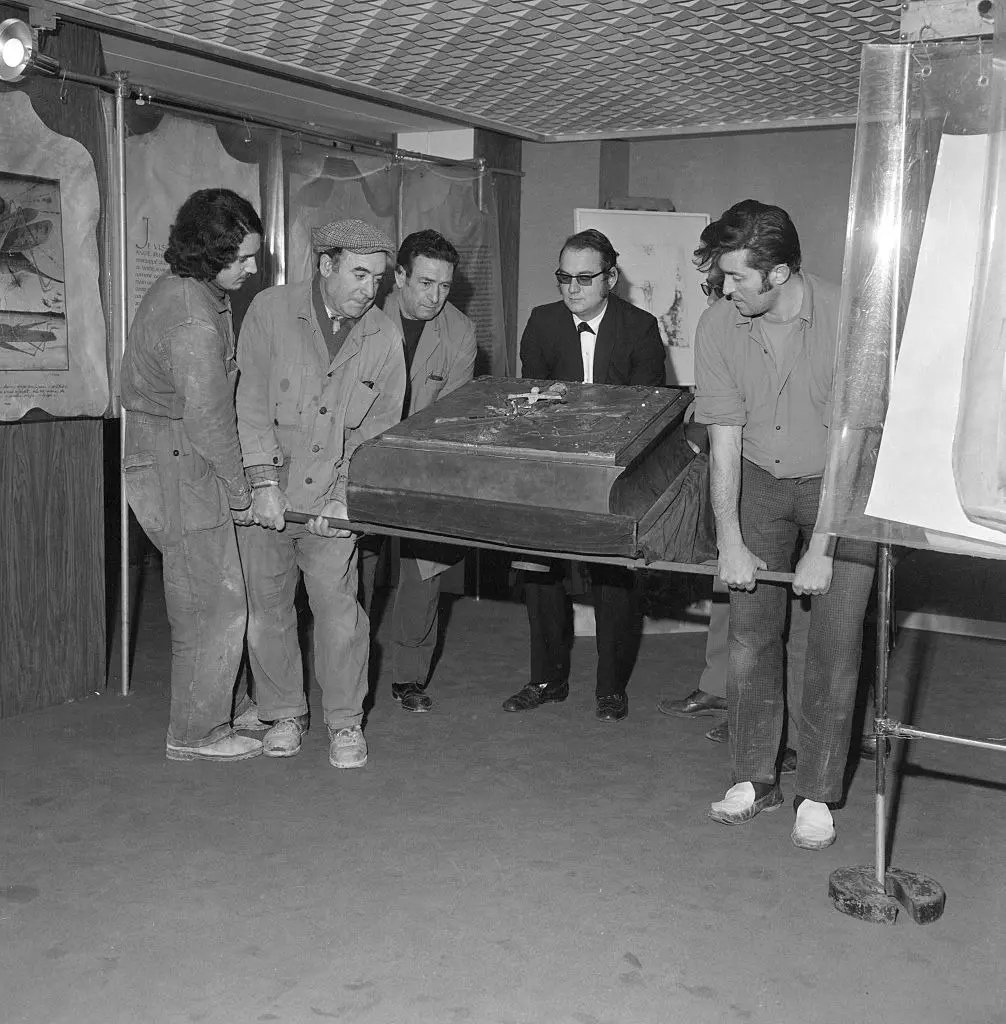
DALI DISAPPEARING ACT. Yet another French museum has fallen victim to a brazen and devastating theft. A massive, 330-pound book cover designed by surrealist master Salvador Dalí—crafted from bronze and encrusted with precious stones, seashells, and trademark Dalinian touches like cutlery—was stolen overnight on Sunday. The crime took place at a small, private contemporary art museum located in the town of Issoire, situated in the center of France, as reported by the venerable French daily Le Monde.
The targeted book, historically known as the Livre de l’Apocalypse, or the Book of Revelation, was originally conceived as an ambitious collective art project back in 1958. It was spearheaded by the French art publisher Joseph Foret in close collaboration with fourteen distinct modern artists and writers of the era. The illustrious roster of contributors who lent their talents to the broader project alongside Dalí included such luminaries as Jean Cocteau, Bernard Buffet, and Jean Giono.
As investigations unfold, local law enforcement officials admitted they still do not know precisely how the heavy, unwieldy book cover was successfully removed from the premises. The mayor of Issoire, Bertrand Barraud, expressed profound dismay over the incident, characterizing the masterwork as "the work of a lifetime" whose intrinsic value and ultimate loss are quite simply "inestimable."
Fortunately, the interior of the publication fared better during the overnight intrusion. The 150 large sheets of parchment that comprise the text blocks of the book were stored separately from the elaborate bronze cover and remain safely tucked away in secure storage. However, the emotional toll on those connected to the artwork has been severe. The owner of the piece, Christian Karoutzos, offered a bleak assessment in an interview with local radio following the discovery of the theft, stating dramatically that "they assassinated France last night; they assassinated French heritage."
OLD BONES. Moving from stolen surrealism to prehistoric fossils, Sotheby’s is once again bringing ancient skeletons to the auction block. This time, the auction house is featuring Jodi, a remarkably complete and fossilized Nanotyrannus specimen. Often described by researchers as a smaller, more agile cousin of the fearsome Tyrannosaurus Rex, Jodi is currently estimated to fetch between $6 million and $9 million when the auction hammer finally falls on October 27 in New York, according to reporting by Artnet News.
This upcoming sale actually marks Jodi’s second major appearance on the international market. The fossil was previously presented at Frieze London in 2023, though it was incorrectly identified at the time as a juvenile T. rex and carried an ambitious price tag of $20 million. The reclassification comes after a rigorous, long-running scientific debate that ultimately led researchers to identify Jodi as a distinct new species a year ago.
Sotheby’s has enjoyed considerable success with prehistoric reptiles lately. Back in July, the auction house notably sold Gus, a genuine T. rex specimen, for a staggering $50.1 million. Given the robust market demand for high-end natural history specimens, the house’s continued investment in dinosaur fossils appears to be a calculated and lucrative trend.
Discussing the shifting classifications and the market for such rare artifacts, Cassandra Hatton, the head of science and natural history at Sotheby’s, emphasized the educational dimension of these high-stakes sales. "It’s a really good example of how paleontology is an evolving science and how specimens like this can answer questions about how things worked," Hatton observed.
The Digest
In the commercial gallery sector, the UK-based, Grenada-born painter Denzil Forrester has officially joined the roster at Thaddaeus Ropac gallery. The move follows the recent closing of his former gallery representation, Stephen Friedman, marking a significant new chapter for the acclaimed contemporary artist known for his vibrant, rhythm-infused canvases that capture the energy of London’s dub reggae and club scenes.
In the realm of institutional philanthropy, the Phoenix Art Museum has received a major financial boost. Philanthropist Sukumar Nagendran has donated $5 million toward the expansion of the museum’s Sri Lankan and South Asian art galleries. In addition to physical expansion, the generous gift will directly support future acquisitions, scholarly research, and public programming initiatives aimed at deepening community engagement with South Asian artistic traditions.
Real estate news also intersects with the upper echelons of the art world, as prominent art collector Beth Rudin De Woody has listed her expansive, 5,000-square-foot Upper East Side co-op. Built in 1929, the sprawling residence has been put on the market for $12 million. This marks the second time the prominent patron has attempted to sell the property since 2018, drawing considerable interest from architecture and real estate observers alike.
Looking ahead to the international biennial circuit, the Lagos Biennial has announced its roster of participating artists for its upcoming 2026 exhibition. Titled "The Museum of Things Unseen," the forthcoming showcase will feature works and archival presentations by Ade Adekola, Ala Praxis, Caitlyn Min-ji Au, CAMP, Ha Bik Chuen, Jacob Höfle, the Lagos Studio Archives, Olukemi Lijadu, and numerous other contemporary practitioners exploring hidden histories and material cultures.
On the municipal funding front, the San Francisco Arts Commission (SFAC) has announced a massive distribution of financial support. The agency is awarding $25.26 million in funding, divided across 465 distinct grants directed toward local artists, arts organizations, non-profit groups, and foundational cultural institutions across the Bay Area.
The Kicker
SPELLBOUND. Fresh academic research suggests that what has long been described as the "world’s most mysterious manuscript"—an artifact of entirely unknown provenance crafted during the Middle Ages between 1404 and 1438—has been fundamentally misunderstood by generations of scholars, according to a report by The Guardian.
The Voynich manuscript, renowned for its dense pages filled with intricate botanical drawings, baffling astronomical diagrams, depictions of nude figures, and an unreadable cipher, has baffled cryptographers and historians for centuries. Over the years, amateur and professional cryptanalysts have theorized that the text might reference a lost human language, function as an elaborate musical score, or even have been authored by Renaissance polymath Leonardo da Vinci as a youthful exercise.
However, a team of researchers now argues that the primary obstacle to understanding the manuscript is not its enigmatic script, but rather the fact that its pages are severely jumbled. According to a recent article published in the academic journal Digital Medievalist, the original parchment gatherings of the manuscript were incorrectly bound during historical restorations. The researchers assert that the pages should have been stacked like folded cards rather than nested inside one another in traditional signature fashion.
Lisa Fagin Davis, co-author of the peer-reviewed study, suggested that these findings fundamentally alter our understanding of how the book was produced and used. "There are a lot of people who wanted the Voynich to have been created by one mad genius working in their attic in medieval London," Fagin Davis noted. "In fact, the evidence suggests we’re talking about a more communal object, perhaps a set of booklets through which information was passed down from one generation to the next—the ‘lone genius’ idea is kind of out of the door."