October occupies a unique position in the calendar, standing firmly in the center of the year’s second transitory season. It is a period that signals the inevitable descent into the darker half of the year, a time when the natural world undergoes a profound metamorphosis. The landscape is draped in an autumnal palette of ochre, umber, sienna, and cadmium, reflecting the decay and dormant potential of the earth. As the days grow shorter and the temperatures dip, the world retreats indoors, often accompanied by the steady, melancholic rhythm of a coldened drizzle against the windowpane. Outside, the myriad falling leaves spiral toward the damp, cooling ground, marking the passage of time with silent finality.
This seasonal shift does not merely alter the landscape; it stirs something within the human psyche. The imagination begins to smolder, igniting a creative restlessness that often manifests in a somber, contemplative mood. There is a universal tendency, perhaps intensified by the approaching festivities of Samhain, to revel in the funereal tones of the season. Much like moths drawn to the flickering warmth of a candle flame, we find ourselves intrinsically pulled toward the darker side of artistic expression during these months, seeking to externalize the mysteries that dwell in the periphery of our consciousness.
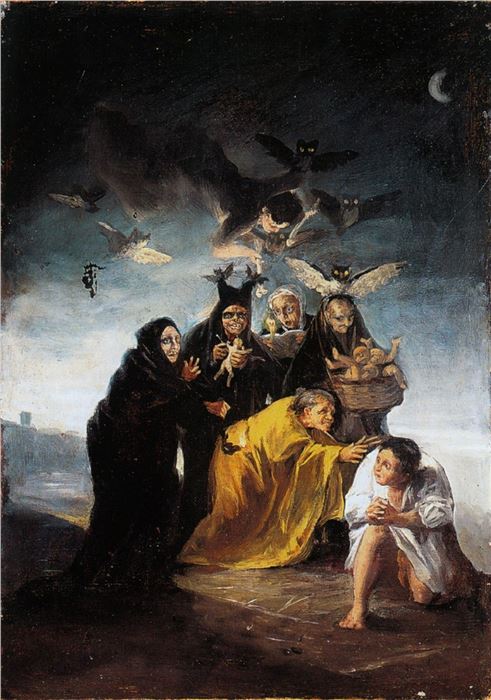
Among the masters of this dark aesthetic, Francisco Goya stands as a towering figure. His work, The Incantation (El conjuro), painted between 1797 and 1798, serves as a quintessential example of the artist’s fascination with the occult. In the painting, currently housed in the Lázaro Galdiano Museum in Madrid, Goya depicts an overcast, oppressive sky under which a parliament of owls keeps watch. Beneath them, a coven of witches congregates on a desolate, windswept clifftop, engaged in a scene of mirthful malevolence. An innocent figure cowers at their feet in a state of futile supplication, highlighting the vulnerability of the human spirit in the face of ancient, inexplicable forces.
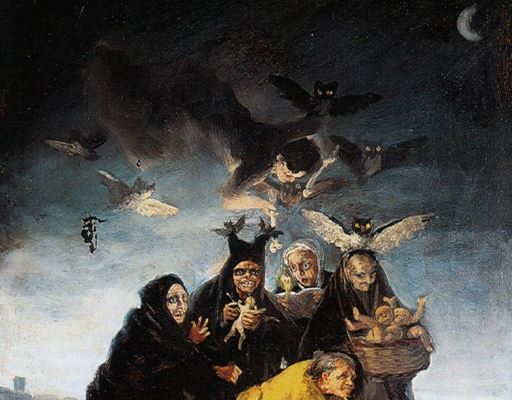
Each of the six figures in the hexad plays a distinct and disturbing role in the ritual. One witch chants from the weathered pages of a grimoire; another clutches a basket filled with squirming infants; a third, distinguished by the pair of bats adorning her hood, intently sticks pins into a doll. A fourth figure gesticulates wildly as she utters the incantation, while the elder of the group—draped in a golden cloak and appearing sightless—stretches her misshapen, claw-like hands toward the unwilling sacrifice. Most haunting, perhaps, is the sixth figure, captured on nocturnal wing, seemingly caught in a mid-transformation from bird to sorceress. She holds a pair of bones in her pallid hands, acting as the percussionist for this perverse, unholy carol.
El conjuro is one of six works centered on the theme of witchcraft that were purchased by the Dukes of Osuna in the summer of 1798. These pieces were commissioned for the Dukes’ newly constructed palace in the Madrilenian barrio of La Alameda. Art historians have long theorized that this specific series, which includes the famed Witches’ Sabbath, was created at the direct behest of the Duchess, whose patronage played a crucial role in Goya’s exploration of the supernatural and the grotesque.
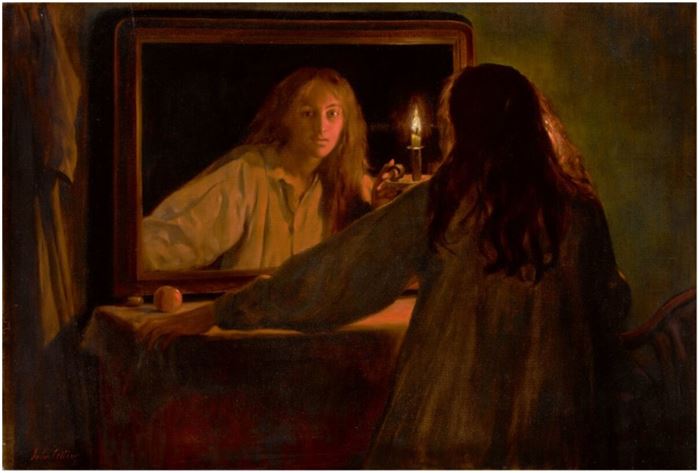
The turn of the century brought with it a different, yet equally compelling, engagement with the occult. In John Collier’s 1895 oil painting, All Hallowe’en, the viewer is invited into a more domestic, though no less eerie, setting. A young woman, clad only in a nightshirt, sits with a candle burning low in its holder, staring at her wide-eyed reflection in a mirror. Her disheveled hair suggests she has been abruptly roused from sleep, perhaps by a haunting dream or an inexplicable sound echoing through the quiet house. However, her actions are deliberate; she is engaged in the practice of mirror gazing, or catoptromancy.
An ancient form of divination that saw a resurgence in popularity during the Victorian era, catoptromancy involves staring into a reflective surface until the boundary between the observer and the seen begins to dissolve. The practitioner believes that by staring long enough, images that do not exist in the earthly realm will manifest within the glass—ghostly echoes that provide glimpses of the future or the unseen. While All Hallowe’en lacks the voluptuousness often associated with Collier’s more celebrated portraits, it remains an evocative piece that captures the specific, chilling atmosphere of late October, offering a window into the mind of the aspiring occultist of the nineteenth century.
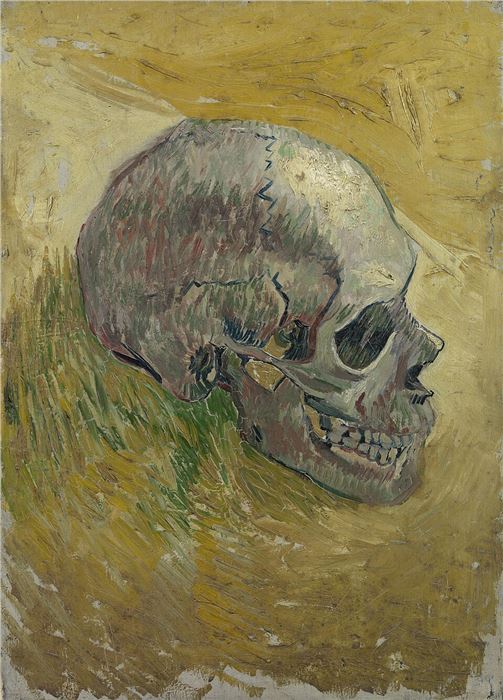
Moving from the human to the existential, Vincent van Gogh’s Skull (1887) provides a stark, minimalist meditation on the inevitability of death. The painting features a lonely skull set against a swirling, vibrant backdrop of ochre, viridian, and giallo di Napoli. It is a classic memento mori, a reminder that mortality is a constant, underlying thread of human existence. Though not among his most iconic works, it is a masterclass in composition and texture. The presence of fine craquelure around the jawbone offers a glimpse into the painting’s history; Van Gogh painted this study over an earlier work, utilizing a slow-drying zinc white as a base. In a poetic irony, the chemical instability of the paint has mirrored the subject matter: death, in its own slow, persistent fashion, eventually reclaims all things.
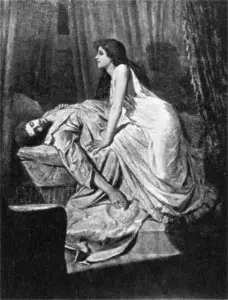
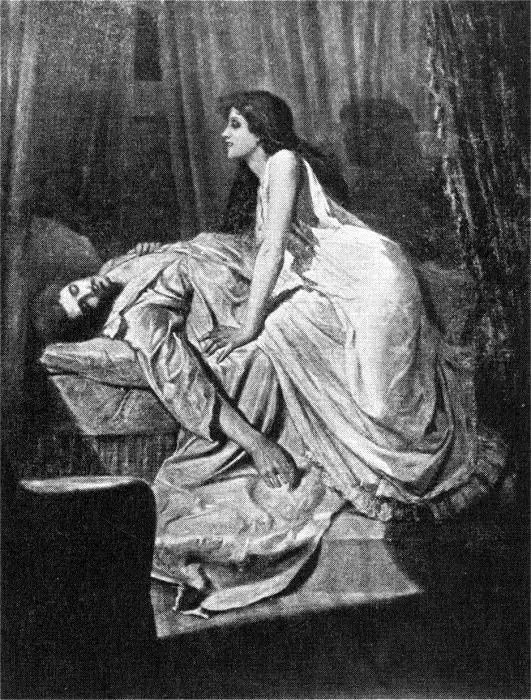
The exploration of the dark side of human desire found perhaps its most dramatic and controversial expression in Philip Burne-Jones’s 1897 work, The Vampire. In the painting, a vampiress looms over an unconscious man, her eyes three-quarters closed in a expression of satiation, a faint, predatory smile playing upon her lips. The scene is one of post-prandial bliss following the prick of razor-sharp teeth and the release of blood.
The history surrounding this painting is as compelling as the imagery itself. Created by the son of the renowned Pre-Raphaelite painter Edward Burne-Jones, the work became the direct inspiration for a poem of the same name by his cousin, Rudyard Kipling. Kipling’s poem was prominently displayed alongside the painting in the exhibition catalog for the tenth summer exhibition at the New Gallery in London, mere weeks before the publication of Bram Stoker’s Dracula.
The Vampire ignited a firestorm of public interest, fueled by more than just its themes of sensuality and violence. Philip Burne-Jones had been deeply infatuated with the famous stage actress Mrs. Patrick Campbell. Despite his attempts to win her affection with lavish gifts—including furs and fine jewelry—his advances were rejected. In an act of artistic retaliation, Burne-Jones modeled the features of the titular vampire on his unrequited love.
Beyond the personal drama, the painting remains a technically proficient work. The way the bedsheets cascade, blending the unwilling victim’s nightshirt with the gown of his captor, creates a visual unity that emphasizes the parasitic nature of the relationship. The contrast between the limp, defeated posture of the man and the tense, predatory grip of the vampiress creates a profound sense of unease. The subtle manipulation of light and shadow introduces an atmosphere of danger that might escape the casual observer at first, but which eventually draws the viewer into a space of uncomfortable intimacy. Unfortunately, the original canvas has been lost to time, and its current whereabouts remain a mystery.
Autumn, in all its fleeting intensity, often feels as though it is dying from the moment it begins. Yet, its essence is continually captured by the creative impulse—the spiraling brushstrokes on canvas, the frantic movement of graphite against paper, and the precise shutter-click of a camera in frost-chilled hands. Art provides a sanctuary for these transitory moments, allowing us to steal time away from the inevitable march of the seasons and entomb it within a chosen medium. Through the act of creation, the ephemeral is preserved, and the soul of the season is kept intact, waiting for the next October to stir it once more.