Born in the shadow of a brutal civil conflict, Guatemalan artist Regina José Galindo has spent over two decades transforming her own body into a site of resistance. By utilizing performance art as a visceral language, she exposes the structural violence—particularly against women—that remains etched into the social and political fabric of Latin America. For Galindo, the body is not merely an object of aesthetic contemplation; it is a political territory where the traumas of history and the realities of modern injustice collide.
As the feminist artist Judy Chicago once remarked, "I do not think art can change the world. I think art can educate, inspire, empower people to act." This sentiment serves as the heartbeat of Galindo’s practice. She operates on the understanding that every action, from the mundane movements of daily life to the deliberate, staged spectacles of performance, carries the potential to communicate deep-seated truths and ignite the momentum for systemic change.
Born in Guatemala City in 1974, Galindo emerged into a nation defined by its turbulent history. Her artistic trajectory has garnered international acclaim, including the prestigious Golden Lion for Best Young Artist at the 51st Venice Biennale in 2005 and the Prince Claus Award in 2011. Today, her work is a staple of global contemporary art discourse, with exhibitions spanning across Europe, the Americas, and the United Arab Emirates. Yet, despite her international success, her feet remain firmly planted in the realities of her homeland.

A Creator Shaped by the Scars of Civil War
To understand Galindo’s work, one must understand the environment that forged it. She was born during the Guatemalan Civil War (1960–1996), a devastating conflict that tore the country apart. The roots of this war were deeply entangled with the struggle for land rights and the exploitation of labor. Following a period of reformist, left-leaning governance in the 1940s and early 1950s, a 1954 U.S.-backed coup d’état dismantled these efforts, installing a series of military regimes that prioritized elite interests over the welfare of the citizenry.
The ensuing decades were marked by extreme repression. The government, in its effort to eradicate perceived political opponents, unleashed a wave of violence that resulted in between 40,000 and 200,000 deaths or disappearances. The most vulnerable populations—peasants and Indigenous Maya communities—bore the brunt of these atrocities. Galindo’s early life was lived within this climate of fear and state-sanctioned erasure. It is from this crucible that her obsession with themes of disappearance, repression, and bodily autonomy originates.
In contemporary Guatemala, these historical patterns have mutated into a crisis of gender-based violence. Statistics remain harrowing; an estimated one in two women in the country will experience some form of gendered abuse in their lifetime. Between January and July 2026 alone, official government records documented 2,676 cases of sexual violence, a staggering 1,272 of which involved underage victims. For Galindo, art is not a departure from these statistics but a direct engagement with the bodies behind the numbers.
From Poetic Expression to Visceral Performance
Galindo’s creative evolution began with poetry and drawing, but she soon realized that the written word alone could not capture the intensity of her environment. Inspired by fellow artists like Nicaraguan performance artist Jessica Lagunas, who also emerged from a context of political volatility, Galindo turned toward body art.
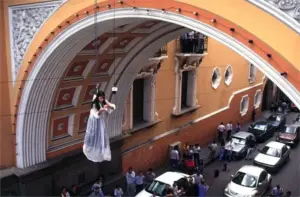
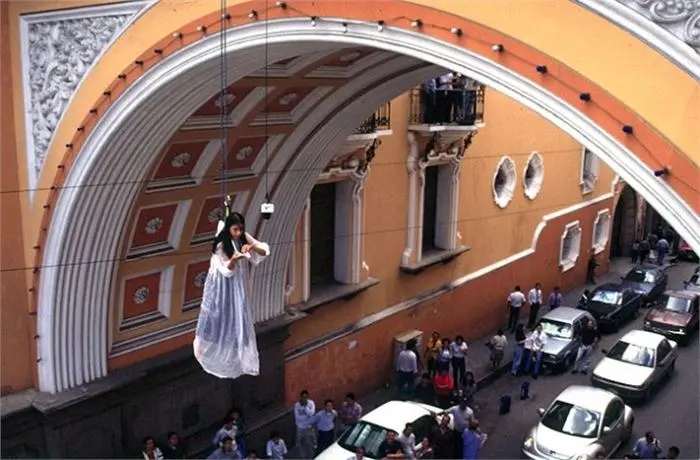
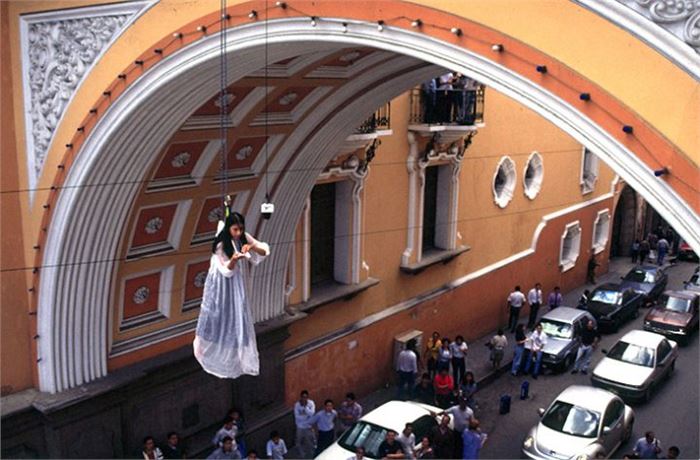
Her first major performance, Lo voy a gritar al viento (I’m Going to Shout It to the Wind), took place in 1999. Suspended from the arch of the historic Post Office Building in Guatemala City, she hung in a harness, dressed in a white gown that evoked the innocence of a child’s First Communion. While suspended, she recited poetry, using her vulnerability as a protest against the silence imposed by post-war society.
This early work set the stage for a career characterized by physical risk. In Himenoplastia (2004), Galindo underwent surgery to reconstruct her hymen. By documenting the medical procedure, she challenged the patriarchal obsession with "virginity" and the commodification of women’s reproductive health. The following year, in the controversial piece Perra (Bitch), she pushed her commitment to the breaking point. With a knife, she carved the word "perra"—a slur frequently found on the bodies of murdered women in Guatemala—into her own thigh. It was a harrowing act of solidarity, forcing the viewer to confront the physical degradation that characterizes the violence against women in her country.
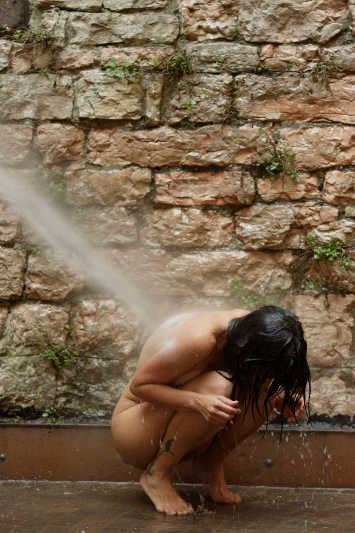
This commitment to the body as a primary medium echoes the traditions of pioneers like Marina Abramović, yet Galindo’s work is uniquely grounded in the specific socio-political history of Guatemala. In Limpieza social (2006), presented in Italy, she stood naked while being blasted with high-pressure water. The performance mimicked both the dispersal of protesters and the "cleaning" of prisoners. Through this act, she exposed how states performative "cleanse" their societies of "undesirables," whether they be political dissidents or the impoverished.
Confronting Global Spectacles of Injustice
Galindo’s focus has expanded beyond Guatemala to address the broader injustices faced by the global Latino community, particularly in the United States. Her work often highlights the dehumanization of migrants and the complicity of the public in these processes.
In America’s Family Prison (2008), she rented a model detention cell from a private-prison industry trade show and installed it within a gallery. For 24 hours, she lived inside the cage with her husband and their child, effectively turning their family life into a spectacle. By placing herself in the position of a detained migrant, she challenged the gallery-going public to witness the normalization of family incarceration. The performance functioned as a stark critique of a society that watches and profits from the suffering of those seeking refuge.
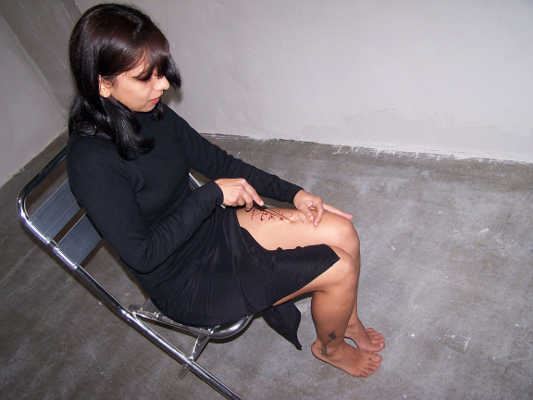
Her 2017 performance, Make America Great Again, staged in Los Angeles, took this critique of complicity even further. Galindo tied herself to a post while a professional dominatrix whipped her back each time a visitor dropped a coin into a jar. Every viewer who participated became an active agent in the violence, turning their spare change into a tool of oppression. It was a powerful, if uncomfortable, metaphor for the way society treats the migrant body—as something to be exploited, punished, and discarded for the sake of political rhetoric.
More recent works, such as La manada (2018) and Guatemala feminicida (2021), have continued this trajectory of political intensity. The former, a response to a high-profile rape case in Spain, features a group of men masturbating in front of a kneeling Galindo, capturing the collective nature of gender-based violence. The latter saw the artist dragging a modified Guatemalan flag—with the blue replaced by black—through the streets of Guatemala City, a mourning ritual for the countless women lost to femicide.
Regina José Galindo does not claim to offer a panacea for the world’s ills. She does not suggest that a single performance can stop a war, topple a regime, or end gender-based violence. However, her work serves as a vital mirror to our own complicity. By enduring pain, discomfort, and vulnerability in the public eye, she forces us to look at the realities we would otherwise choose to ignore. As she continues her practice in Guatemala City, her legacy remains one of unflinching courage, reminding us that art is not a passive experience, but a call to awareness and, ultimately, to action.