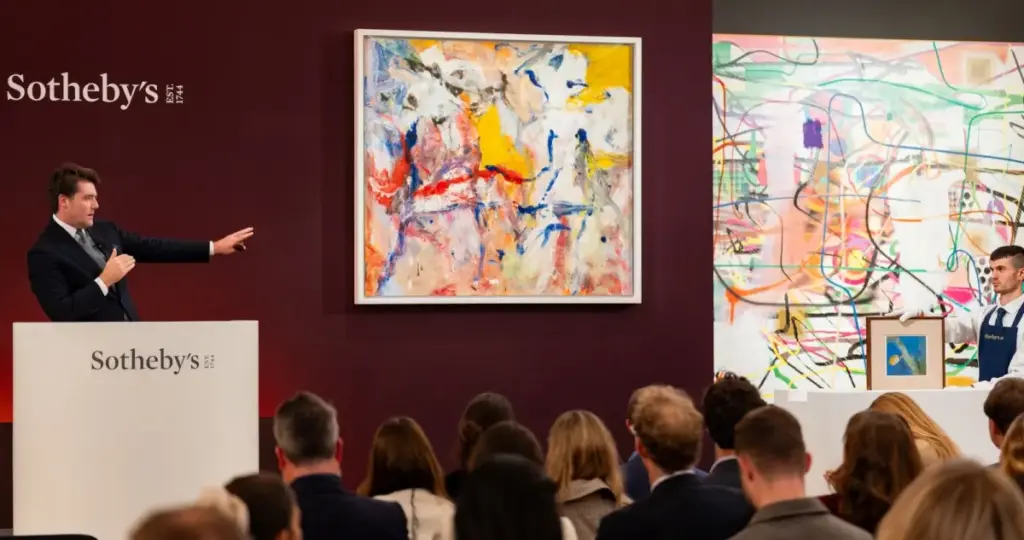
In a tense saleroom defined by moments of absolute silence and anxious pauses, Sotheby’s London conducted its contemporary art sale on Thursday evening. With all eyes locked on auctioneer Tom Eddison, the atmosphere at times bore a striking resemblance to a courtroom proceeding. Despite the palpable tension, the auction room was packed to capacity, carrying out a slow but steady sale that ultimately realized a total of £46.1 million, equivalent to approximately $61.1 million.
The evening’s top honor went to a vibrant Willem de Kooning abstraction, which fetched £9.8 million, or roughly $12.9 million. The overall event had carried a pre-sale expectation ranging between £41.7 million and £58.6 million, or about $55.3 million to $77.8 million. However, the hammer total before accounting for the auction house’s buyer’s fees came in at £36.9 million, landing just shy of the lower boundary of the predicted estimate range.
The auction itself was notably trim, lasting roughly an hour and comprising a curated selection of 34 lots. Of these offerings, 10 carried financial guarantees, securing a baseline of interest before the bidding commenced. However, the catalog faced a few hurdles prior to and during the event. Three high-profile works—originating from the hands of Damien Hirst, Anselm Kiefer, and Leon Kossoff—were formally withdrawn from the lineup before the sale began. Furthermore, works by several notable names, including Banksy, Georg Baselitz, Jadé Fadojutimi, Lucian Freud, Gerhard Richter, and Lynette Yiadom-Boakye, ultimately went unsold as the room failed to generate sufficient momentum.
For comparison, the equivalent contemporary art sale held by Sotheby’s London last year reached a total of £47.6 million, or roughly $63.3 million. That previous iteration was anchored by a major Francis Bacon canvas that alone commanded £13 million, translating to about $17.5 million.

Thursday’s Sotheby’s auction arrived precisely one night after a distinctly different scene at Christie’s, which hosted a relatively safe yet remarkably healthy evening of art sales. Across two distinct sessions, Christie’s brought in a staggering £218.6 million, or $289.4 million, more than doubling the total achieved during its equivalent sale the previous year.
The timing of these major auctions coincided with London’s bustling art fair week. Just a day prior to the Sotheby’s event, high-profile cultural figures and celebrities, including Tilda Swinton and Raf Simons, were spotted streaming into the exhibition halls of Frieze London. Amid the energy of the fair, numerous international commercial galleries reported robust and encouraging sales figures, indicating a bifurcated market where gallery foot traffic and private enthusiasm did not always translate cleanly into aggressive public auction bidding.
“I would say the market is very cautious,” noted Ivana Miloradovic, an independent art historian and consultant, speaking with ARTnews on the sidelines of the Sotheby’s sale. Reflecting on the steady rhythm of the evening, she observed that the majority of the lots presented “either underperformed or were at the lower end” of their anticipated valuations.
Despite the prevailing caution, several museum-caliber pieces managed to capture the room’s attention and command significant figures. The undisputed leader of the night was the aforementioned untitled abstract painting by Willem de Kooning, executed in 1977. Measuring five feet wide and carrying a pre-sale estimate of £8 million to £12 million—or roughly $10.6 million to $15.9 million—the canvas sold comfortably within its expected parameters. It hammered down at £8.2 million, bringing its final price with fees to £9.8 million ($12.9 million). The painting has a documented auction history, having previously passed through Sotheby’s New York saleroom in 2015, where it realized $6.1 million.

Coming in at second place for the evening was an expansive, eight-foot-wide canvas by Gerhard Richter titled Abstraktes Bild (1992). Estimated between £6 million and £8 million ($7.9 million to $10.6 million), the Richter hammered slightly below its conservative estimate at £5.4 million, ultimately realizing £6.7 million ($8.9 million) once fees were applied. The seller who parted with the work on Thursday originally acquired it at Christie’s London back in 2011, when they paid £3.6 million, which translated to about $5.7 million at the time.
The Richter was closely followed by an untitled, dark-hued abstract composition by Mark Rothko dating from 1969. Estimated at £3 million to £4 million ($4 million to $5.3 million), the Rothko hammered precisely at its low estimate, bringing in £3.8 million—just shy of $5 million—with buyer’s fees included. Its history on the secondary market dates back to 1992, when the current seller purchased the piece at Christie’s New York for a modest $264,000.
Additional works by Georg Baselitz, David Hockney, Albert Oehlen, and Andy Warhol successfully rounded out the top 10 tier of the evening. Notably, Baselitz, Hockney, and Warhol each had multiple pieces represented within this upper echelon of sales.
“British sales on British soil are always joyous,” Miloradovic remarked, drawing attention to the particularly rousing domestic demand for David Hockney’s 10th–22nd June 2021, Water Lilies in the Pond with Pots of Flowers (2021) and a 1978 work titled Butterfly Fish by Michael Andrews. “Everybody knows the artist, the gossip, and the history. It was a homey atmosphere.”

Indeed, one of the most unexpected and thrilling runaway successes of the evening was Michael Andrews’s Butterfly Fish. Depicting the marine animal of its title, the piece sparked an extended and competitive bidding war that eventually hammered at £550,000—dramatically eclipsing its high pre-sale estimate of just £120,000. Driven by fierce collector interest, the final price with fees reached £704,000, or approximately $933,117. This result established a brand-new auction high for a work on paper by the artist.
Although Andrews is today less widely recognized by the general public than his contemporaries within the legendary School of London, such as Francis Bacon and Lucian Freud, he was deeply revered by the artists of his generation. “Mike is so economical,” fellow painter Frank Auerbach once famously observed regarding Andrews’s rigorous approach. “He paints only masterpieces.”
Ottilie Windsor, Sotheby’s head of contemporary art in London, echoed Auerbach’s sentiments during a post-sale interview discussing the artist’s legacy and market scarcity. “The paintings that he did make were often bought as they were being made by a group of collectors who followed his work really closely,” Windsor told ARTnews. Those dedicated collectors have traditionally never needed to part with their holdings, she explained, resulting in a “very, very low supply of his work to the market; when they do come up, they really do very well.”
The broader auction also highlighted a mixed landscape for younger artists belonging to the under-50 demographic. Louis Fratino’s intimate painting Kissing Couple (2019) achieved a solid, within-estimate result of £320,000, or roughly $424,144. Similarly, Adrian Ghenie’s atmospheric canvas The Wall (2019) performed predictably, securing £640,000 ($848,288) to land comfortably within its expected valuation. (Fratino currently maintains a critically praised, sold-out solo exhibition at David Zwirner’s London gallery space.) Conversely, pieces by contemporary talents such as Jadé Fadojutimi and Lynette Yiadom-Boakye failed to find buyers, remaining unsold amid the evening’s selective purchasing climate.

Successfully navigating 28 lots across the finish line out of a 34-lot catalog still represented a victory for the auction house, Windsor argued as the evening concluded. “Any dealer at the Frieze fair would be thrilled to sell nearly 30 secondary market lots,” she noted.
While acknowledging that both genuine financial capital and deep-seated interest remain present within the contemporary art sphere, Windsor emphasized that the broader market continues to exercise a high degree of selectivity. It remains an environment that regularly keeps industry observers on their toes, continually surprising professionals with precisely what collectors are—and are not—looking to acquire.