For decades, the sprawling and visionary oeuvre of artist Dorothea Tanning has been viewed through a distinct, often limiting lens: that of her marriage to fellow Surrealist icon Max Ernst. A new biography, Dorothea Tanning: A Surrealist World by Alyce Mahon, attempts to challenge this persistent framing, making a passionate case for Tanning’s independence, artistic strength, and lasting significance in her own right. Yet, despite its sweeping ambition and meticulous research, the book ultimately struggles to break free from the very dynamic it seeks to dismantle, remaining frustratingly tethered to the shadow of her husband.
Mahon’s book offers a panoramic and deeply researched view of Tanning’s long life and multifaceted creative output. Rooting her biography firmly in the experience of womanhood, Mahon explores the immense cultural and professional pressures Tanning faced as a female artist navigating a male-dominated avant-garde movement. The author highlights how Tanning beat formidable odds to emerge as a standout creative force, producing a distinct body of work that spanned painting, sculpture, and literature.
Unfortunately, the project is weighed down by its own academic ambitions. Written by a professor of art history, A Surrealist World adopts an intensely intellectual tone clearly targeted toward fellow scholars. While it provides a comprehensive overview of Tanning’s trajectory, the narrative frequently fractures under the weight of its own dense analysis. The book is occasionally bogged down by a tedious cobbling together of historical reviews and critical reception of Tanning’s oeuvre, paired with a forced, overly defensive attempt to disentangle her legacy from Ernst’s. The resulting text is simultaneously lukewarm in its narrative pacing and fiercely protective of its subject.
To fully understand Tanning’s remarkable ascent, Mahon traces her story back to its quiet beginnings. Born to Swedish immigrant parents in Galesburg, Illinois—which Tanning famously described as a "small and sleepy town" where "nothing happens but the wallpaper"—she possessed a fierce ambition from an early age. Eager to escape the confines of her Midwestern upbringing, Tanning set her sights on bigger horizons, moving first to Chicago and eventually arriving in New York City in 1935.
Upon settling in Manhattan, Tanning immersed herself in the city’s bustling creative ecosystem. To support herself, she took on commercial art jobs, crafting striking advertisements for Macy’s and other major corporate clients. However, her artistic path shifted dramatically in 1936 after she attended the landmark Fantastic Art, Dada, Surrealism exhibition at the Museum of Modern Art. The display left her instantly and permanently enthralled with the tenets of Surrealism, sparking a lifelong dedication to exploring the uncanny, the subconscious, and the uncanny depths of the human psyche.

Tanning’s life soon took on its own surreal and migratory trajectory. In 1939, she traveled to Paris armed with a handwritten list of prominent European artists she hoped to meet. Instead of the vibrant cultural hub she anticipated, she discovered a Paris transformed into an eerie ghost town with the looming shadow of World War II on the horizon. Among the key figures on her list was Max Ernst, though their paths would not cross in Europe.
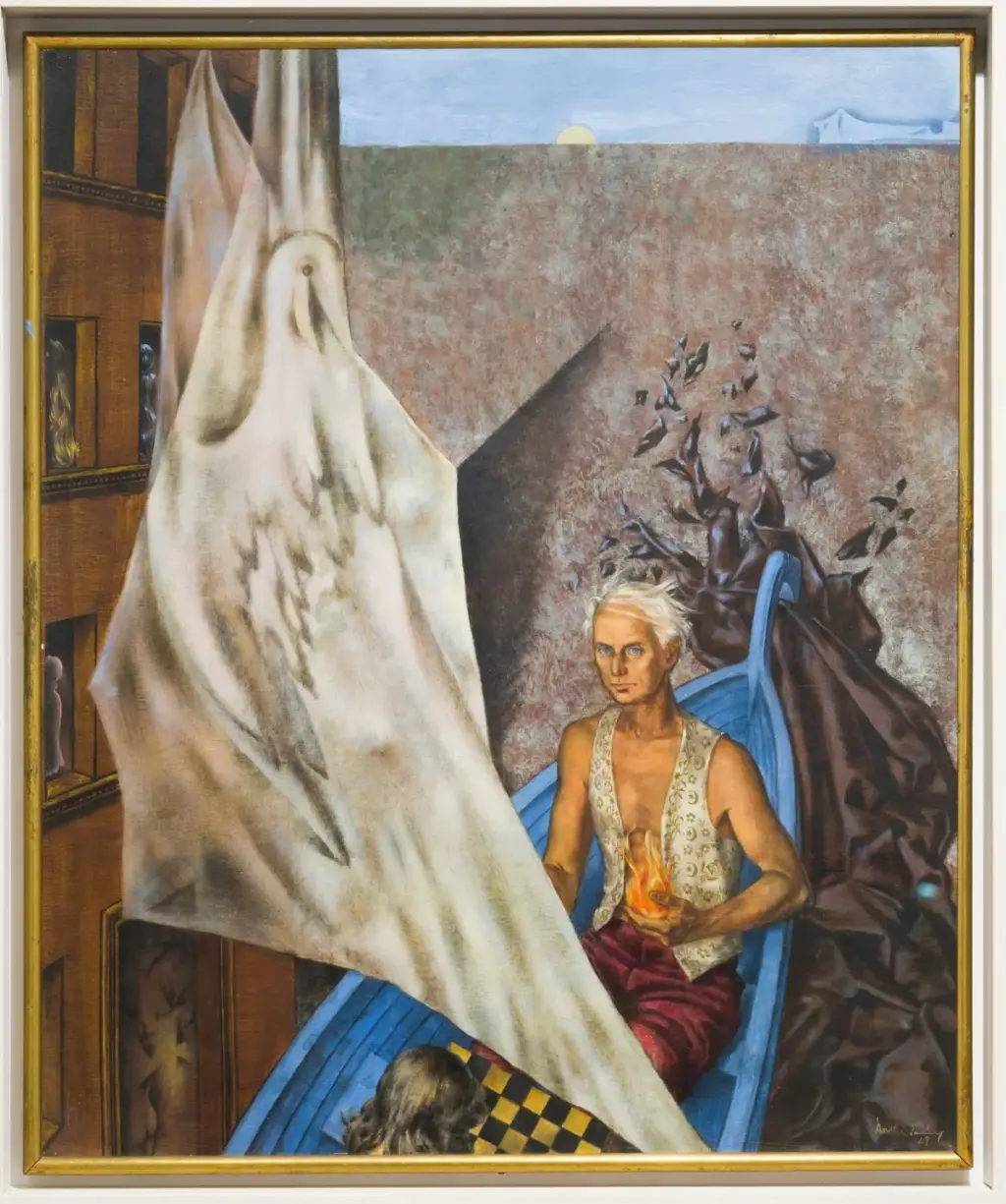
It was not until 1942, back in the safety of New York, that Tanning finally met Ernst. Their encounter sparked a powerful personal and creative partnership that would define decades of their lives, leading to their marriage in 1946. While this union placed Tanning at the very center of the international Surrealist circle—a dynamic captured in works like her 1947 painting Max in a Blue Boat—it also cemented a historical narrative that frequently overshadowed her independent contributions. Mahon’s biography strives to correct this imbalance, chronicling how Tanning continuously pushed past the boundaries of traditional Surrealism to forge a singular visual vocabulary, even as her life remained intimately intertwined with one of the movement’s most towering figures.