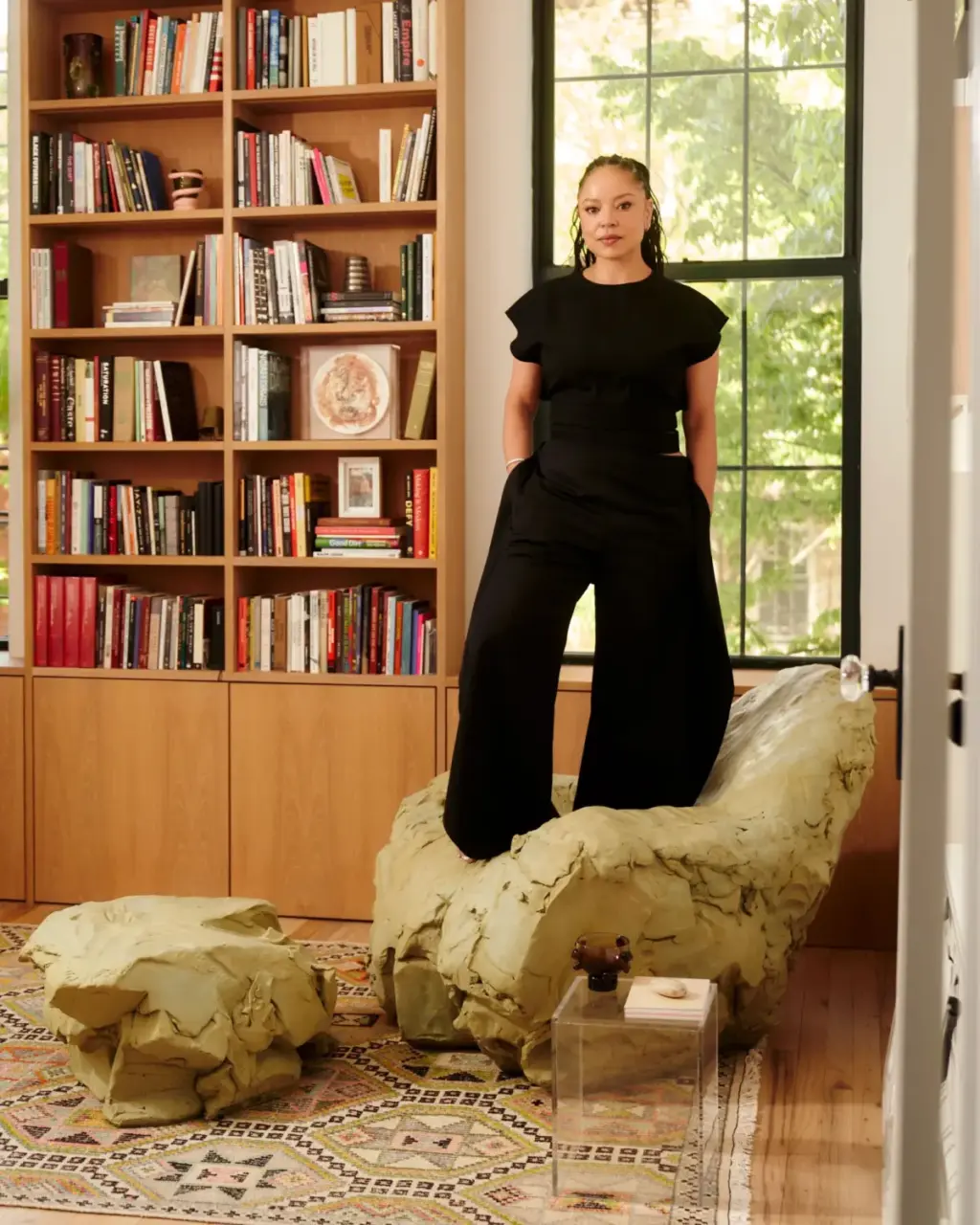
The mirrors arrived in Joeonna Bellorado-Samuels’s Clinton Hill apartment the way a particularly complex and demanding piece of contemporary artwork might enter a commercial gallery: through a series of unexpected hurdles. Because the building’s historic stairwell had been mismeasured, standard delivery methods proved impossible. The solution required erecting emergency scaffolding at the last minute to carefully haul roughly 10-foot panes of glass directly through a window overlooking the Brooklyn street.

“The neighbors were not used to that,” she recalls with a soft laugh. While the dramatic installation could have easily frustrated a less patient homeowner, the episode was successfully taken in stride. More importantly, it speaks directly to something essential and defining about Bellorado-Samuels’s living space: the entire residence is orchestrated around the deliberate, highly conscious experience of viewing.

As a senior director at the renowned Jack Shainman Gallery in New York City, Bellorado-Samuels has spent her professional life immersed in the upper echelons of the contemporary art world. Her career began at the Studio Museum in Harlem before she transitioned to working as an assistant to Claude Simard, the cofounder of Jack Shainman Gallery. Over the years, she has developed an acute appetite for artistic friction—a deliberate tension that informs her new domestic environment just as profoundly as it guides her professional trajectory.

This very same impulse is evident in her itinerant, conceptual gallery project, We Buy Gold, which cleverly plays on the overlapping themes of fine art and commercial trade. It also fuels her distinct distaste for conventional sofas, driving her instead to select chairs that are radically sculptural, funky, and visually arresting. Who could have imagined that the physical and psychological tension between remaining comfortably seated and nearly falling down could successfully dictate the layout and design of an entire modern living room?

Throughout the meticulously planned two-bedroom apartment, which Bellorado-Samuels renovated over the course of four years, conceptual vision consistently triumphs over conventional comfort. There are the towering mirrors, of course, which line a wall at one end of the open-plan living area, adding remarkable architectural dimension while dynamically reflecting the expansive room and changing light from the windows. In the secondary bedrooms, traditional storage space was intentionally sacrificed in favor of valuable wall real estate to accommodate more works of art. In Bellorado-Samuels’s own private bedroom, the television is discreetly stashed out of sight beneath the bed, allowing museum-quality works by artists such as Barkley Hendricks, Sadie Barnette, and Charisse Perlina Weston to take absolute pride of place. Meanwhile, the second bedroom was entirely transformed to house a custom, floor-to-ceiling bookshelf—a massive undertaking that took ten months to develop in close collaboration with millworker Paul Finsterwald, an artisan she originally met through her gallery connections.

This deep-seated instinct to prioritize pieces carrying profound personal meaning and historical sentiment has roots stretching all the way back to San Francisco, where Bellorado-Samuels grew up. Her father, Joe Sam, was a dedicated political activist and celebrated artist who frequently incorporated found objects and discarded materials into his mixed-media works.

“We would go to the train tracks and collect things for his art that would end up on the kitchen table,” she remembers, reflecting on her creative upbringing. “There’s a certain practice of care you develop in just loving objects and the things that you live with. All you need is a little bit of restraint and you’re golden.”

Her intimate relationship with this specific Brooklyn apartment building began with another cherished childhood ritual, when she and her mother would spend weekend afternoons touring open houses together. The mother-daughter duo revived the nostalgic tradition one Mother’s Day as Bellorado-Samuels found herself actively on the hunt for a larger home that could accommodate her growing collection.

“I lined up a bunch of apartments to look at the weekend she came,” she explains. “This was one of them.”

The building itself offered a wealth of historical character that made it easy to fall in love. The front portion of the structure dates back to around 1850, while the rear addition was constructed around 1900. Originally operating as a women’s home, the rear portion of the property was built to serve as an infirmary. After sitting entirely vacant for years, the building eventually transitioned into the Bull Shippers Inn, a local establishment that gradually fell into severe disrepair, acquiring the eerie, atmospheric aura of a neighborhood haunted house. Eventually, the neglected property was acquired by developers, thoroughly renovated, and subdivided into 26 distinct residential apartments.

Bellorado-Samuels remains deeply drawn to the physical traces of those previous lives: the preserved original façade, a strange and mysterious little window that no one can quite explain, and even the imperfect, patched patchwork of the exposed brick walls that she otherwise might have chosen to cover.

“People who know brick tell me it’s a really terrible patch job, but I love how ragtag and random it is,” she notes with appreciation.

It is precisely this kind of idiosyncratic architecture that adds rich texture to the viewing experience inside her home. That interplay is what ultimately makes the apartment feel far less like a sterile, private art gallery and much more like a thoughtful, studied proposition for how to genuinely live alongside art. Bellorado-Samuels’s home does not simply fade quietly into the background behind her extensive collection; rather, it pushes back, amplifies, complicates, and occasionally inconveniences her daily routine in the most stimulating ways possible.

“I like that in this space you can see all kinds of different art,” she observes. “People think they can’t live with sculpture—I love living with sculpture. Do you just want paintings of flowers? That’s fine, but there are other things.”

Just remember, as her own harrowing delivery experience proved, to measure twice.






