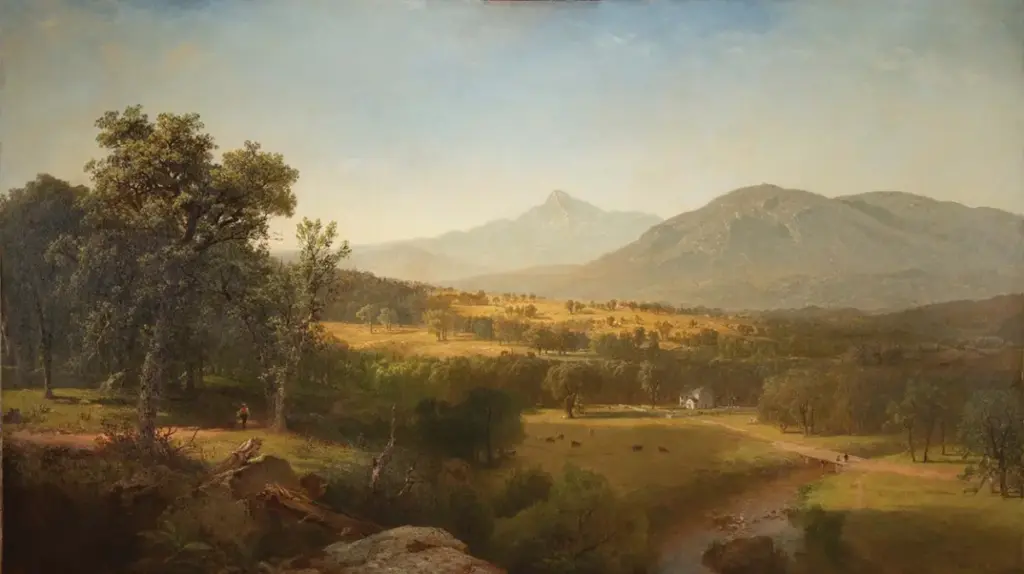
Glowing harmlessly on the walls of the Century Association on Manhattan’s West 43rd Street is a remarkable work by the 19th-century American artist John Frederick Kensett. The painting depicts Mount Chocorua, a striking peak rising in the White Mountains of New Hampshire. Today, in an era defined by affordable and easy travel to more exotic climes around the globe, this particular peak looms a bit less spectacularly than it did during the 19th century. Back then, Mount Chocorua occupied a towering place in the American cultural imagination, functioning as a kind of domestic Matterhorn. It was a landscape sung by national poets, meticulously captured on canvas by artists, and haunted, thrillingly, by a spooky local legend—the tale of an Indian chief named Chocorua who, according to lore, hurled a bitter curse at white settlers before throwing himself to his death from the mountain’s rocky summit.
John Frederick Kensett, the son of a British engraver who emigrated across the Atlantic to settle in New Haven, Connecticut, gazes out with rheumy, experienced eyes from the historical photographs and self-portraits that survive of him today. His body of work carries the unmistakable luminosity of the Hudson River School, that signature artistic quality capturing the transient, magical light of dawn or sunset. His palettes favor the warm tones of autumn rather than the blazing heat of high summer or the bleak, unforgiving chill of deep winter.
These canvases present to the viewer an undisturbed arcadia, a peaceful natural world seemingly inhabited by men and women who sleep restfully and arise each morning to purposeful, quiet labor. For anyone standing in the modern era and looking back from the chaotic, honking thoroughfares of Manhattan, such a vision beckons with an irresistible promise. It evokes images of lazy summer picnics, shaded front porches, and refreshing swims in cool mountain lakes. In short, it offers a window into a better, purer, and fundamentally happier age of American history.
Yet, if an observer takes even the tiniest step out of this idyllic scene—looking away from its gentle, rolling mountains, its neat wooden New England farmhouse, and its peaceful grazing flocks—they might suddenly be stopped cold by a jarring detail: the date inscribed on the heavy wooden frame, which reads 1864.
Placing that date into its historical context completely transforms the viewing experience. This serene, luminous landscape was painted precisely one year after the devastating Battle of Gettysburg and the issuance of the Emancipation Proclamation. It was created just one year before the ultimate conclusion of the conflict at Appomattox and the tragic assassination of President Abraham Lincoln. Furthermore, it was completed right in the midst of 1864—a catastrophic year that saw the slaughter of tens of thousands of American soldiers during the brutal Wilderness Campaign and the fiery destruction of Atlanta. Perhaps never before, and arguably never since, in the entire history of the United States had the grim, bloody reality of the nation been so profoundly distant from the gently golden, peaceful image captured on Kensett’s canvas.
Standing before the painting in our own dreadful and turbulent times, one cannot help but see the hand of an artist summoning the immense courage required to step away from the relentless, agonizing news of the day. Rather than documenting a country tearing itself apart in a horrifying fratricidal war, Kensett chose to create an image of a country that might yet emerge from the ashes of that conflict. He painted not necessarily the nation precisely as it was in its fractured present, but rather the nation that might yet be in a redeemed future.
Consequently, while a modern viewer can easily perceive everything that is physically missing from the picture’s peaceful borders—the systemic brutality of slavery, the tragic violence of westward expansion and indigenous displacement, and the immediate carnage of civil war—the painting begins to read less as a cowardly flight from the harsh realities of American history. Instead, it emerges as a powerful summons to ultimately overcome that history. It is an invitation to look outward, even through bloodshot, weary eyes, and to dare to envision a better, more harmonious world beyond the horizon.