Visitors stepping into the exhibition “Cassirer: Breakthrough of Impressionism” at Berlin’s prestigious Alte Nationalgalerie are greeted immediately by three striking women from across the turn of the 20th century. Edgar Degas’s captivating 1879 canvas Miss La La, Pierre-Auguste Renoir’s luminous 1867 portrait Lise with a Parasol, and Max Slevogt’s 1901 intimate depiction of the dealer’s own daughter, Suzanne Aimée Cassirer, set the stage for a profound historical exploration. Two of these paintings are French, one is German, and all three are inextricably linked to Paul Cassirer. As the dynamic Berlin art dealer largely credited with introducing Impressionism to Germany, Cassirer shaped public collections that still anchor the Nationalgalerie today while courageously championing German avant-garde artists who pushed the boundaries of modern development.
For generations, mainstream art history has often attempted to artificially separate the art market from the hallowed halls of the museum. This persistent fiction encourages viewers to treat esteemed collections of now-canonical masterpieces as though they existed entirely apart from the financial capital used to acquire them and the complex socioeconomic circumstances surrounding their sale. By contrast, this landmark exhibition and its accompanying catalog openly trace the intricate mechanisms by which art crossed national borders and exchanged hands in a rapidly modernizing Europe. The advent of Impressionism marked a definitive cultural shift away from traditional art academies and state-run collections as the supreme arbiters of artistic taste. Instead, private collectors and independent critics operating within a burgeoning free market took center stage, making visionary art dealers absolute essentials to the eventual triumph of the movement.
While his French colleague and counterpart Paul Durand-Ruel is a household name in art history textbooks, Paul Cassirer remains somewhat lesser-known globally, despite playing an identical role in Central Europe. Durand-Ruel himself once remarked that Cassirer was exclusively responsible for bringing the groundbreaking paintings of the French Impressionist group across the Rhine River and into the German consciousness around the turn of the 20th century.

The Clash of Cultures and the Rise of the Tiergarten Gallery
During the 19th century, French art predominated across Europe—a reality that proved to be both the supreme advantage and the ultimate controversy of Cassirer’s celebrated gallery. Operating during a period when the German state was actively working to promote a rigid, homogenous national artistic style, Cassirer audaciously funneled foreign, avant-garde paintings into both private collections and Berlin’s public institutions. Cassirer initially founded his enterprise as the Kunstsalon alongside his cousin Bruno in 1898. However, the partnership was short-lived; the cousins soon split, and by 1901, Paul Cassirer took over sole operations of the gallery.
Situated in Berlin’s fashionable and affluent Tiergarten district, Cassirer’s gallery space boasted a sumptuous interior masterfully designed by the renowned Art Nouveau architect Henry van de Velde. Within these elegant rooms, Cassirer chose to display paintings in what were then considered radical, relatively spare, single-row arrangements. This minimalist presentation stood in stark contrast to the dense, floor-to-ceiling, all-over salon-style hangs that remained wildly popular elsewhere at the time, allowing viewers to contemplate each individual brushstroke without visual clutter.
Monet, Manet, and the Business of Avant-Garde Art
In addition to Degas and Renoir, Cassirer exhibited works by Claude Monet, Édouard Manet, Paul Cézanne, and Vincent van Gogh, alongside non-French talents like Norwegian expressionist Edvard Munch. He pursued this ambitious programming out of a genuine love for modern art, but he was also a shrewd businessman operating for profit. A contemporary caricature of the gallerist famously and wittily quipped: “from Monet and Manet to money.”

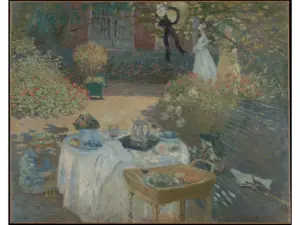
Trained rigorously in art history, Cassirer understood how to contextualize the movement for a skeptical public. He exhibited early Monet works, such as the 1866 canvas Jar of Peaches—also currently on view at the Alte Nationalgalerie—which brilliantly balances the strict visual restraint and containment of a glass fruit jar against an expressively marbled tabletop. By showing such early efforts alongside more radical contemporaneous milestones like Monet’s 1872 Impression, Sunrise, Cassirer successfully constructed a credible, digestible historical lineage for the movement that his wealthy patrons could comfortably follow. Even Manet’s historic scandalous masterpiece from 1863, Déjeuner sur l’herbe, found its way to the walls of the Kunstsalon, though at the time, it failed to find a buyer among cautious local collectors.
One of Cassirer’s most effective commercial and educational strategies was to repeatedly exhibit unsold works over extended periods, using familiarity as a tool to acclimate the conservative public to challenging new styles. This methodical persistence culminated in what was then the largest-ever exhibition dedicated to Vincent van Gogh in 1914, featuring a staggering 151 works. Interestingly, the current exhibition at the Nationalgalerie features only two van Gogh pieces, subtly highlighting the historical divide between what Cassirer passionately championed in his private gallery and what the German state was willing to officially acquire for its public holdings.
Van Gogh’s vibrant 1887 urban landscape Boulevard de Clichy, which Cassirer had previously exhibited in both 1905 and 1908, resonates powerfully with German Impressionist Curt Hermann’s Snow-Covered Roofs (1908/09), hung nearby in the current galleries. Both city scenes are flecked with vivid, pulsating color, serving as a compelling visual argument for the profound and lasting influence of French techniques on the development of German modern art.

Nationalistic Backlash and Historical Parallels
This mounting French influence, however, was viewed as an existential threat by a powerful cadre of conservative German artists and cultural authorities working tirelessly to defend a traditional nationalist vision. In 1911, landscape painter Carl Vinnen authored an infamous petition titled “Protest by German Artists” against the perceived cultural invasion of French art, gathering 140 signatures from sympathetic traditionalists. Cassirer swiftly fought back, participating in a formal “Reply to a Protest by German Artists” organized by a faction of artists who were far more sympathetic to internationalism, including modern pioneers Wassily Kandinsky and Franz Marc.
The political tensions surrounding these cultural battles had severe professional consequences. Three years prior to Vinnen’s protest, the visionary director of the Nationalgalerie, Hugo von Tschudi, was ousted from his position largely because of his daring acquisitions of French avant-garde art secured via Cassirer. At the time, Kaiser Wilhelm II held an increasingly tight, autocratic grasp on Germany’s national museum collections, preferring to promote narrow state nationalism over artistic innovation. This historical attempt to constrain public cultural institutions to strictly patriotic ends finds an uncomfortable and striking echo in the contemporary United States, where museum exhibitions and educational programming are increasingly subjected to intense political pressure from state priorities.
Paul Cassirer’s remarkable life ultimately ended in tragedy when he died by suicide amid stressful divorce proceedings. Yet, his monumental legacy for German art and museum culture remains vibrantly present today. It lives on not only through the breathtaking masterpieces gathered on the walls of the Alte Nationalgalerie, but also by demonstrating the enduring historical merit of transparency in the formation of public collections—and illuminating the spoken and unspoken motivations that continue to shape the art world.