BOGOTÁ — Doris Salcedo is widely celebrated for her moving, monumental “anti-monuments”—gigantic artworks and carefully crafted negative spaces that propose entirely new ways to commemorate historical atrocities. Throughout her decades-long career, the acclaimed Colombian sculptor has consistently trained her focus on the perspectives of victims, translating collective grief and political violence into physical form. Her best-known intervention, Shibboleth (2007), transformed the Tate Modern’s massive Turbine Hall through a single, scar-like crack in the concrete that forcefully rerouted foot traffic, evoking the jarring, painful disruption of borders and the human divisions they enforce.
Yet this penchant for working at a staggering, architectural scale developed through a profound personal transformation. At age 31, Salcedo was diagnosed with Stargardt disease, a rare genetic condition that progressively attacks central vision. Today, at 67, she is legally blind, possessing only peripheral sight. Before her vision began to shift, Salcedo created all of her sculptures entirely on her own. Reflecting on that solitary era during a visit to one of her studios in Bogotá, she recalled cherishing “the privacy of improvising and of working directly with the materiality.” As her condition progressed, however, she had to surrender that independence “little by little” and begin integrating assistants into her artistic process.
The Evolution of Collaborative Creation
Naturally, Salcedo mourned the loss of the spontaneity her solitude once afforded. Adjusting to a shared studio practice proved difficult, particularly because she had to sacrifice the quiet intimacy of her early methods. Working with a team required her to think in an entirely different manner.
“Before, I was improvising; I never had a prior drawing,” Salcedo explained.

Collaborating with a large support network meant she had to devise clear, meticulously planned blueprints that could be communicated effectively to others. “Things have to be absolutely defined,” she noted.
Slowly, however, she discovered that collective production unlocked new artistic horizons. Working collaboratively “gave me the possibility of making better pieces than the ones I was making by myself,” she reflected. “A collective statement is far more powerful than a lonely solo voice. It becomes like a chorus, and a really potent one.”
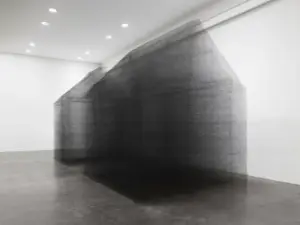
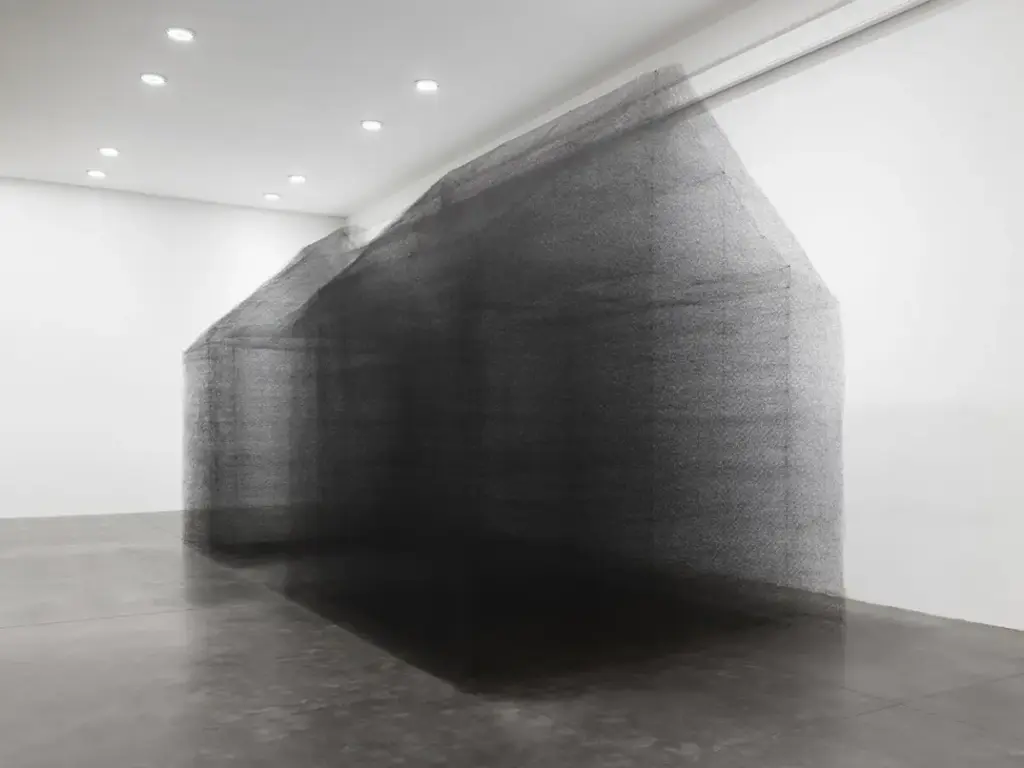
This month at White Cube Gallery in New York, Salcedo will premiere a major new sculpture that serves as the culmination of decades of collaborative practice—a work of immense physical magnitude that could never have been executed by a single pair of hands. Entirely woven from human hair, the installation features a full-sized house standing at nearly 30 feet tall. When visiting her Bogotá workspaces, observers could watch dozens of assistants carefully tying knots in individual strands of hair, a painstaking process resulting in a delicate pattern that resembles chicken wire or a chain-link fence.
Even with a massive team working across three separate studios, the construction process spanned three years. “To be thankful is not enough,” Salcedo said of the monumental collective effort, noting that the piece could easily have consumed two decades if attempted alone—time she simply does not have at this stage in her life.

Architecture, Memory, and Fragmentos
As Salcedo led visitors through her studio spaces—her own salt-and-pepper curls mirroring the looping locks lining the room—she noted that all of her workspaces were designed by the architect Carlos Granada. The two have maintained a close creative partnership for 25 years. Granada is also the architect behind Fragmentos, Salcedo’s landmark 2018 “anti-monument” commissioned by the Colombian government to commemorate the historic 2016 peace agreement.
Situated in the heart of Bogotá, Fragmentos initially appears to be a modest, single-floor modernist gallery. However, the space takes on immense emotional weight through its flooring: the textured tiles underfoot were forged from melted-down firearms previously surrendered by members of the FARC guerrilla group. Visitors walk directly across these neutralized instruments of fear and violence on tiles that Salcedo crafted in close partnership with 20 Colombian women who survived sexual violence during the internal armed conflict.
While the site regularly welcomes school groups and international visitors, it has also sparked complex critical debates. Some commentators have argued that its message is overly optimistic, given that thousands of fighters rejected the 2016 accord and various splinter factions remain active. For Salcedo, though, Fragmentos is designed as a dynamic, living space rather than a static memorial. She regularly invites kindred artists to exhibit within its walls.
During a recent visit, a crew was dismantling Hum II (2023), a site-specific sound installation by Hajrah Waheed that filled the open-air ruins with hauntingly hummed songs of resistance. The work draws its title from the Urdu word for “we”—Waheed’s mother tongue—and uses shared vocalizations to foster a deep sense of cross-cultural unity, even for listeners who do not understand the lyrics.

Salcedo’s workspaces share the high ceilings, glass brick walls, and floating staircases that characterize her architectural approach, providing ample light and open sightlines for her team. One of her primary studios mirrors the exact geometric silhouette of the hair house currently under construction: a triangle resting atop a square, reminiscent of a child’s simple drawing of a home. Inside, sections of the net-like hair gradient grow darker and denser toward the floor. Despite its fragile appearance, touching the material reveals a surprising combination of structural sturdiness and lightweight resilience.
Confronting Domicide and the Global Housing Crisis
The ambitious work-in-progress marries a complex physical process with a universally recognizable shape. The recurring motif of the house stems from deep theoretical and political concerns, hinted at by books resting on her studio desk—scanned so the artist can read them in large print—including Domicide: The Global Destruction of Home and Dreamhouse: Stories of Art and Shelter.
This is not Salcedo’s first exploration of the devastating human toll of the global housing crisis and displacement. Her acclaimed installation Uprooted (2020–22), featured at the 15th Sharjah Biennial where she met fellow prize-winner Waheed, repurposed 804 dead trees into an expansive, uninhabitable home stretching nearly 1,000 feet long. While Uprooted addressed the precarious plight of climate refugees, her newer hair sculpture confronts a more deliberate form of erasure: “domicide,” a term coined by scholars J. Douglas Porteous and Sandra E. Smith to describe the calculated, violent destruction of homes.
Pointing to ongoing conflicts in Ukraine, Gaza, Syria, and Sudan, Salcedo emphasized that mass forced displacement carries a cascading series of psychological and social losses. Victims are stripped not only of physical shelter, but also of community, privacy, basic hygiene, and safety, plunging them into chronic survival mode.

With House, Salcedo aims to underscore that while the dispossessed are profoundly vulnerable, they are also remarkably resilient. The meshy hair nets are flexible yet intensely strong, transforming an ephemeral biological material into a robust architectural framework. Drawing inspiration from the ways spiders spin webs from their own bodies, Salcedo links hair and home to suggest that human bodies and domestic spaces—much like dignity and shelter—are inextricably bound together.
Salcedo first explored working with human hair in her seminal series “Unland” (1995–98), which featured domestic tables cut apart and awkwardly conjoined, intricately stitched with hair gathered from local salons. For the sheer scale of House, however, she turned to online sourcing, exercising rigorous oversight to avoid the dark realities of the illicit human hair trade.
Labor, Materiality, and the Global South
Hair is not the only challenging material featured in her upcoming exhibition. On an upper floor of her studio, assistants wearing jeweler’s glasses and wielding X-Acto knives meticulously removed the starch from individual grains of rice. Nearby, a team of architects and engineers collaborated around a lofted computer station to map out the structural integrity of the sculpture.
“I’ve never had such a large team,” Salcedo remarked, noting that even a renowned engineer previously stepped away from the project, deeming the structural demands too complex.

Traditional sculptural materials like wood and bronze come with pre-designed tools and established techniques, but House demanded extensive trial and error. The studio had to fabricate entirely new instruments and methodologies. Assistants drilled microscopic holes into starchless rice grains before passing them to colleagues who threaded individual hairs through the openings. This intricate mesh was then molded around damaged household cookware—bowls, pots, and pans—to form Grains of Sorrow (2023–26), a poignant testament to the domestic life shattered by domicide.
For Salcedo, this intense physical labor is deeply conceptual. Employing roughly 150 women from rural regions of Colombia, where economic opportunities are scarce, ties her artistic practice directly to social support.
“My work has always been labor-intensive because in the Global South, labor is intensive,” she explained, contrasting it with industrialized economies.
Her methods offer a deliberate challenge to traditional art-historical narratives that often frame modernity as an exclusive Western achievement, ignoring the profound human suffering and labor that built the modern world. By merging European sculptural traditions with painstaking craftsmanship, she highlights how closely intertwined labor, history, and violence truly are.

When asked about the role of beauty in her work—a frequent point of critique from commentators who question the aestheticization of trauma—Salcedo remains steadfast.
“In all the violence and terror I’ve been researching all my life, I think the abject part belongs to the perpetrator,” she maintained, asserting that “beauty has a lot to do with dignity.”
For Salcedo, elegance serves as an ethical tool to compel viewers to truly look and engage. The horrors she investigates appear in the daily news cycle, yet audiences frequently scroll past without absorbing their weight. By pursuing extreme artistic lengths and uncompromising aesthetic power, Salcedo ensures that her audience cannot easily look away.