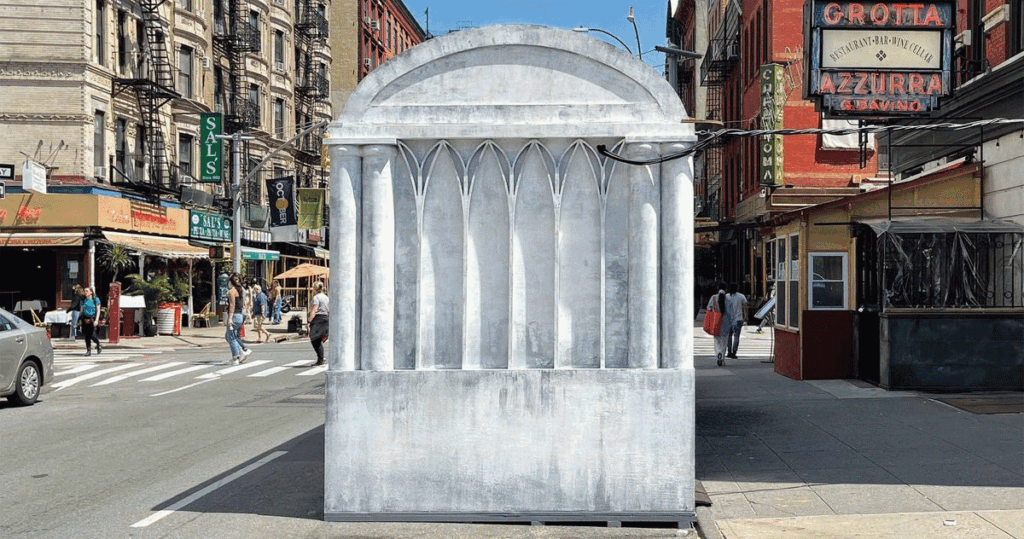
During the height of the COVID-19 pandemic, one of the few reliable rituals left for many New Yorkers was simply to walk. In the evenings, after logging countless hours of remote work from kitchen tables and makeshift desks, city residents would step outside to pace off 20, 40, or even 60 blocks. The goal was simple: to loosen up stiff joints, clear the head, and shake off a profound sense of cabin fever.
Graphic designer Penny Hardy shared that exact impulse. Trapped at home with her husband and daughter, the walls quickly began to close in. "My husband was at home, my daughter was at home, and I was like, ‘I am so not going to work at home,’" Hardy recalls. The moment the strictest public-health restrictions began to lift, she started walking the distance to her Chinatown office simply because she had to get out into the world.
Though she is not a professional photographer, Hardy decided to establish a creative daily routine to make the urban trek more engaging. She set a rule for herself: every morning, she would think of a theme, and she had to find three distinct photographs that captured that concept in completely different ways. For equipment, she relied on nothing more complex than the camera built into her smartphone.
What Hardy ended up documenting, almost by accident, was the woolly, barely regulated pioneering era of the curbside dining shed. That visual record has now been gathered into a compact new book titled Pandemic Architecture: NYC Dining Sheds 2020–2024, published by Blurring Books.
The collection serves as a poignant reminder that, in the beginning, there was absolutely no blueprint or template for what these roadside structures were supposed to look like. The earliest, most utilitarian iterations were built out of whatever materials could be scrounged up—typically raw plywood, flakeboard, and standard two-by-fours hastily banged together by struggling restaurateurs. From those humble origins, the materials, forms, and finishes quickly grew wild, eclectic, and wonderfully irregular.
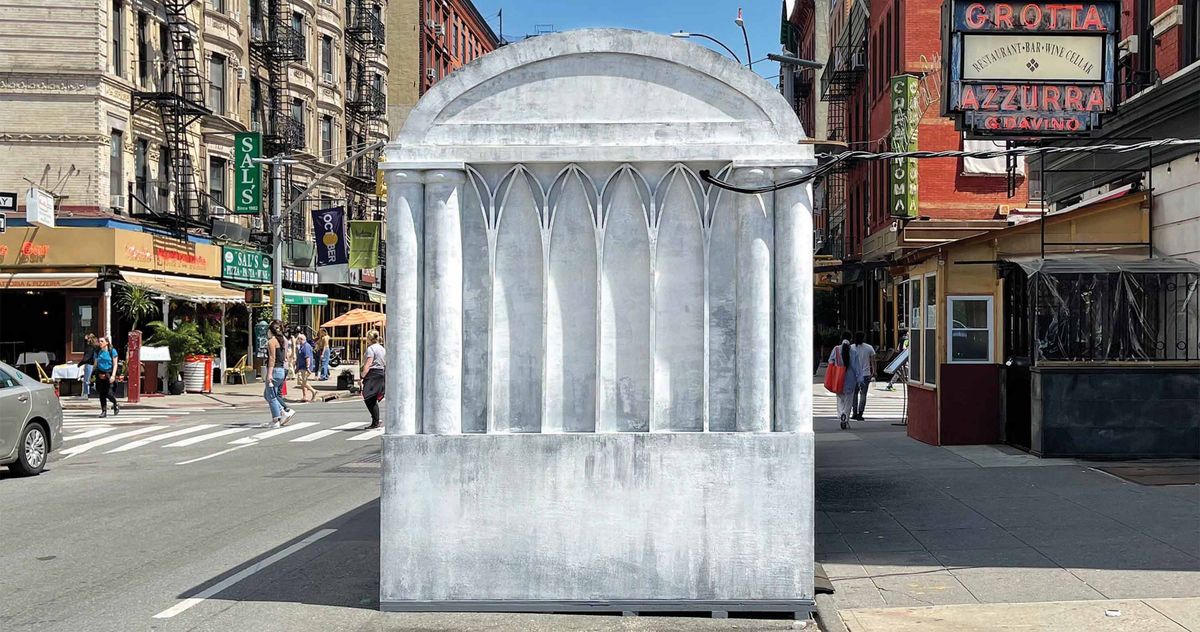
Operating window sashes, makeshift roofs made of palm fronds for a quasi-tropical vibe, and heavy plastic sheeting that made diners feel as though they were enjoying their morning mimosas inside a medical decontamination bubble all became common sights. In Little Italy, the remaining traces of Cannoli King featured a charmingly janky crown perched atop the roof, paired with a semicircular black-vinyl banquette tucked inside. These structures spanned a massive aesthetic spectrum, ranging from the somewhat grim to the awesomely odd. Crucially, no two sheds were ever alike.
Hardy was uniquely positioned to appreciate this vernacular architecture. Her professional studio specializes in branding for architecture firms, both of her late parents were working architects, and she is married to an architect as well. Her father, Hugh Hardy, was a renowned architect who specialized in the sensitive restoration of major historic cultural landmarks, such as Radio City Music Hall.
"I understand architecture," Hardy notes, "but hiring an architect is just not something most people can do. It’s a luxury. So I love this spirit of people being like, I can be an architect too."
The bizarre choices of texture, the delightful inconsistencies, and the raw strangeness of these makeshift structures represented an architectural freedom that the public would never see from professionals—supplying a completely different kind of aesthetic pleasure. It serves as a sort of inverse to Bernd and Hilla Becher’s renowned water-tower typology photographs, which sought to document the fine-grained differences among ostensibly similar utilitarian structures, linking consistency with variety. In the case of New York dining sheds, the family resemblances were faint at best. The only constants tying these undesigned designs together were the city curb line, running at roughly the same level, and Hardy’s disciplined choice to frame every structure tightly on the page. Removed from their chaotic street context, some of the more colorful sheds take on the quality of abstract paintings or mixed-media assemblages.
The book also acts as a historical document of an exceptionally evanescent type of urban building. By 2023, as restaurants successfully regained access to their indoor dining rooms and began to recover their financial footing, municipal authorities stepped in to tighten outdoor-dining regulations. The city restricted streeteries primarily to the warmer months, though the City Council later reversed course on year-round allowances. The Adams administration implemented a much firmer approval process and began pushing for standardized design guidelines, trading the splintery, anarchic free-for-all of the early pandemic for something more polished, structurally safer, and considerably less hospitable to urban pests.

Even though the physicality of the streetery has grown less eccentric and idiosyncratic, its overarching legacy has fundamentally shifted how New Yorkers understand public space and city life. Many residents discovered for the first time that reclaiming parking lanes for human use was an urban intervention well worth considering.
"Before, it was always like, Oh, I want to go to Paris and sit in one of those cafés on the street: How idyllic," Hardy says. "That was not something we did in New York. And post-COVID, the street is this communal social place that it was not before."
Ultimately, there is no need to mourn the passing of the weird, first-generation sheds. They were structurally engineered to endure a season or three at most, serving their immediate purpose before being retired like booster stages dropped into the sea. New Yorkers retained the most vital part of the experiment: a permanent transformation of the urban streetscape, complete with the neighborhood taco experience just steps from the curb.