The new Lucas Museum and LACMA’s David Geffen Galleries are much more than spectacular objects in a landscape.
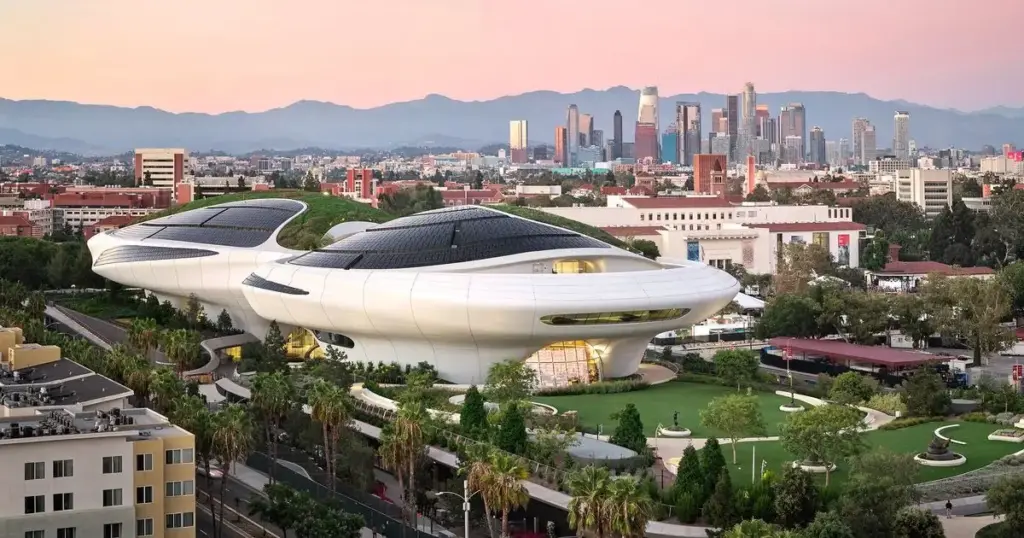
Within the span of just five months, the architectural landscape of Los Angeles has been fundamentally transformed by the arrival of two enormous, floating amoebas—one brooding and brutalist, the other ivory and intergalactic. The David Geffen Galleries at the Los Angeles County Museum of Art (LACMA), designed by the renowned Swiss architect Peter Zumthor, officially opened in April. It stands as a sprawling, serpentine concrete mass looming 30 feet above Wilshire Boulevard, supported by seven bulky, inhabited pavilions. Less than half a year later, the Lucas Museum of Narrative Art, designed by Ma Yansong of MAD Architects, is making its debut in Exposition Park. This sinuous, spaceship-like structure pinches, swells, bridges a public plaza, and touches down gently into a lush, 11-acre park featuring circuitous gardens, winding paths, and expansive event spaces designed by Studio-MLA.
Together, these meandering megastructures form the most dramatic and ambitious contribution to the city’s cultural landscape in more than a decade. Yet their twin arrivals also summon a familiar specter from the not-so-distant past: the blob, long dismissed as a hated symbol of globalist excess and architectural indulgence, might actually be back.
It is worth pausing to ask: didn’t the novelty of using powerful parametric modeling software to churn out crazy, avant-garde forms fade away years ago? Hadn’t a building type that initially looked like a liberating escape from the strictures of analog architecture ultimately hardened into a predictable, placeless formula? Furthermore, hasn’t the public been burned enough by the institution-crushing costs and relentless maintenance headaches required to keep an idiosyncratic museum running—not to mention the largely false promise that just a single iconic building could single-handedly revive a struggling city?
Apparently not. As it turns out, urban populations never truly stopped loving a good alien landing. The blob continues to satisfy a deep, enduring human attraction to organic shapes and visual spectacle, while naturally yielding incredible imagery for social media feeds. The critical difference now—or at least the underlying hope—is that contemporary parametric design has graduated from its historical role as a shallow status symbol to truly earn its keep. If the architectural blobs of the 1990s and early 2000s functioned primarily as arrogant exclamation points—such as Frank Gehry’s torquing Guggenheim Bilbao, Future Systems’ cratered Selfridges in Birmingham, or Peter Cook and Colin Fournier’s blue, nozzle-studded Kunsthaus Graz—today’s blobs operate more like spatial prepositions: over, across, and between. In theory, they have shifted from billboards to actual terrain, moving away from a posture of "look at me" toward an invitation of "hang out with me."
LACMA and the Lucas Museum, while vastly different in their architectural DNA and material expression, perform this communal task in remarkably similar ways. By hoisting their winding forms high above the ground, both designs manage to give precious space back to the city, often in unexpected and generative ways. LACMA features an intricate network of plazas and pathways threading all around the structure—some significantly more shaded and pleasant than others—that carve out intimate pockets to sit, socialize, circulate, and explore outdoor art while forging vital new connections to the adjacent La Brea Tar Pits and Hancock Park. Similarly, the Lucas Museum’s elevated mothership mass shapes and shelters a sinuous public court below, bringing the open-air ground level to life with its twisting, gridded form and a mesmerizing central oculus.
The fluid, non-rectilinear outlines of both museums boldly confound the traditional hierarchies that historically created spatial and cultural winners and losers in civic architecture. There is no obvious front or back, no dominant, intimidating façade, and no architectural ranking signaling which kinds of art or cultural artifacts are inherently more valuable than others. Instead, these sweeping forms allow for myriad unique visitor journeys that are clearly engineered to invite participation, meandering, and discovery. Strangely enough, these forms suit their Los Angeles context exceptionally well, their continuous twists and turns staying precisely in step with a cityscape that is itself ever-shifting.
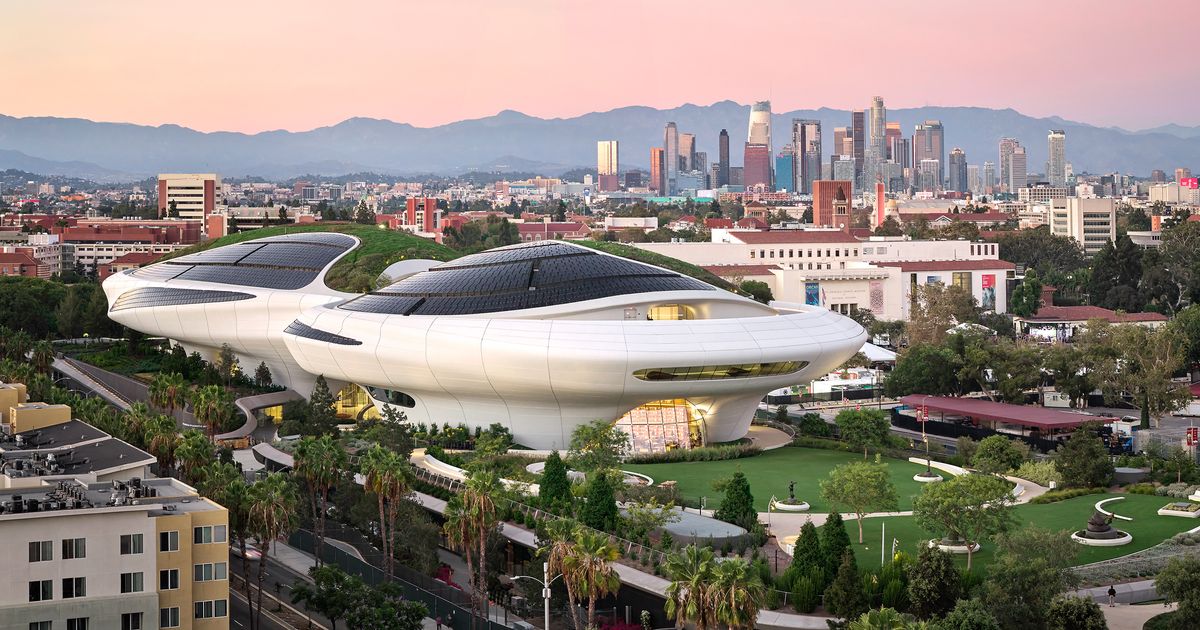
Unobstructed by towering high-rise buildings—a luxury that would be impossible in dense metropolitan cores like New York—their levitating forms also define the experiential quality of the city from above just as much as they do from below. At LACMA, panoramic expanses of glass frame the sprawling city, the ancient Tar Pits, the distant Hollywood Hills, and, most uniquely, Wilshire Boulevard itself, turning urban infrastructure into a dynamic, continuous companion to the artwork inside. At the Lucas Museum, the connection to the outside world is more episodic: carefully placed glass portals and wide terraces transport visitors around the site and out toward the broader city skyline, right before pulling them back into the museum’s immersive, artificial interior world.
These radical ideas are certainly not unique to Los Angeles. In fact, the Lucas Museum and LACMA are part of an encouraging new international crop of museums—blobs or otherwise—that are conceived first and foremost as landscapes themselves rather than mere containers dropped into a landscape. This paradigm shift is clearly visible at Philadelphia’s Calder Gardens, where Herzog & de Meuron and Piet Oudolf have created winding pathways that climb through dense meadows and native groves directly over submerged galleries. One sees a similar philosophy at Crystal Bridges in Bentonville, Arkansas, where Moshe Safdie has strung gallery pavilions delicately across tranquil ponds and through dense ravines. In Chicago, Tod Williams and Billie Tsien’s Obama Presidential Center is wrapped by an expansive campus of green-engulfed buildings, rolling meadows, and sunken courtyards, while in Helsinki, JKMM Architects chose to bury the Amos Rex Museum galleries entirely beneath Lasipalatsi Square, allowing their dramatic domed ceilings and skylights to swell upward into an undulating public playground.
It has been clear for some time that major cultural institutions can no longer justify exceptionally ambitious building projects, nor can they casually claim public land and financial subsidies simply on the grounds that they house precious objects. Facing intense resource competition and battling the omnipresent distraction of personal screens, contemporary museums are actively attempting to shed their historical cloaks of elitism and privilege, striving instead to offer new avenues of public belonging. Many institutions attempt this through curated programming alone, but others recognize that true transformation must be baked into the architecture itself.
At LACMA, that critical test of the museum as a genuinely public and civic space has already begun. Beneath the soaring galleries, ordinary people can be seen sitting at tables and chairs casually scattered across the sprawling plazas—many of whom may never actually step foot inside the museum galleries proper. These open-air spaces are being utilized much more frequently, and far more casually, than many architectural critics originally expected. During recent visits, distant corners once feared to be dead zones near the tar pits were instead crowded with families eating snacks, couples sharing drinks, and local art students sketching the surroundings.
A parallel negotiation will soon begin at the Lucas Museum, which opens its doors to the public on September 22. Its newly minted park and sheltered undercroft spaces will inevitably attract spontaneous uses that its designers and institutional administrators never anticipated or planned for—much like how OMA’s Casa da Música in Porto eventually transformed into a de facto skate park for local youth.
Still, these massive cultural projects are already exposing the inherent limitations of what private institutions are genuinely willing to risk for the public realm. At LACMA, a sharp, green-spiked security fence hems in the communal grounds, while a notoriously pricey admission fee and a costly upscale Erewhon café threaten to undermine its broader populist aspirations. At the Lucas Museum, significant portions of the surrounding park meet the city behind restrictive fences, and its elevated rooftop gardens and scenic balconies are generally restricted to special ticketed events or patrons of its high-end dining facilities.
Despite these regulatory and economic limitations, there remains profound promise in these floating architectural amoebas. Los Angeles possesses no shortage of iconic monuments, but it has historically suffered from a severe deficit of true civic centers—the kinds of egalitarian public spaces where vastly different groups of people can casually share space, linger, and relax without a commercial mandate. Reaching that ideal will require both museums to think far beyond the narrow needs of traditional museum donors and ticket-buying visitors. These spaces will not magically become authentic public domains simply because their monumental roofs provide strategic shade and their landscaped grounds look inviting in promotional photographs. The public itself must be actively welcomed and present to fully realize the potential of these spaces, and for that to happen, the host institutions must demonstrate a genuine willingness to show flexibility and civic initiative. The architectural blob is back, yes, but it is finally—hopefully—coming back down to Earth.