Portraiture has long served as the primary nexus where the rigorous discipline of art history meets the fluid demands of the global market. Unlike abstract works, which invite subjective interpretation, or landscapes, which often serve as aesthetic environments, a portrait—whether a face, a figure, or an entire world built around a sitter—demands a different kind of engagement. It asks to be lived with. It is an intimate invitation to share space with a surrogate presence, a silent observer that captures the essence of a moment or a personality. This week, we examine this enduring genre through a curated selection of works from five partner galleries, tracing a trajectory that spans from the vibrant streets of Havana to the contemplative studios of Seoul. When viewed collectively, these works illustrate a profound shift in contemporary art: the movement away from strict, photographic likeness toward the realms of symbolism, allegory, and the articulation of place.
This group of works also serves as a clear map for collectors navigating the accessible end of the gallery-sourced market. With pricing ranging from approximately $782 (EUR 782) for an oil painting by Anna Song to $8,500 for a limited-edition print by Pierre Sernet, these pieces highlight the diversity of the current market. Notably, three of the five works were produced within the last three years, underscoring a vibrant, active contemporary scene where artists are responding to the immediate pressures and inspirations of the present day.
The Symbolic Power of the Havana School
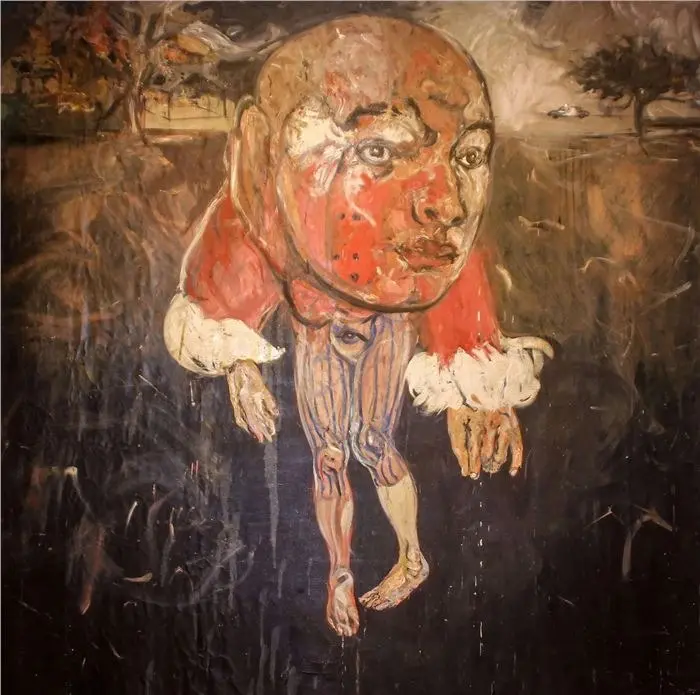
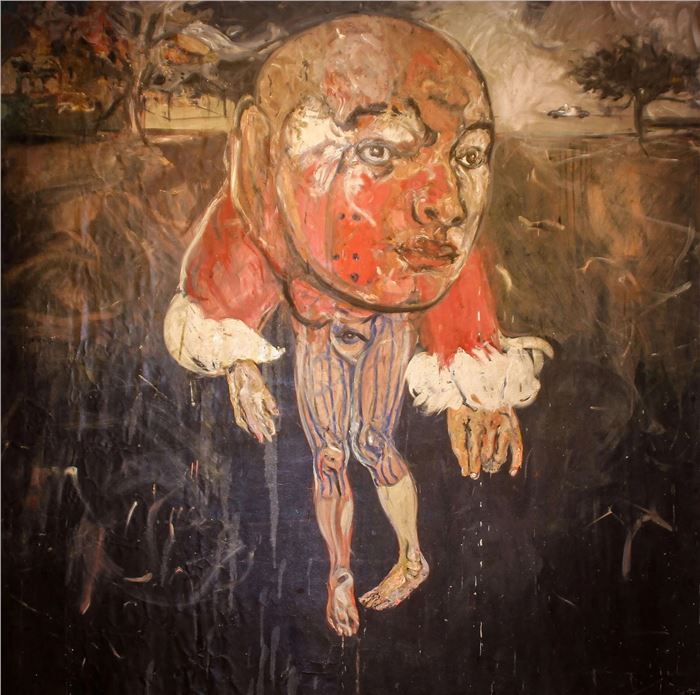
Represented by the Zapata Gallery, Havana-born painter Carlos Quintana has cultivated an international reputation since the mid-1980s. Quintana is known for a figurative language that prioritizes emotional resonance over mere visual accuracy. In his hands, the portrait is never just a likeness; his subjects are often charged with the complex symbolism of Cuban urban existence and the spiritual depth of local traditions. His faces function as vessels—masks that obscure the individual to reveal something more universal.
His latest untitled canvas is a masterclass in this philosophy. Distilling his approach to its absolute essentials, the work features a man’s face rendered in saturated, urgent red, isolated against a stark, light-absorbing black background. The intensity of the gaze suggests a votive image rather than the relaxed atmosphere of a traditional commissioned portrait. The work’s scale—a monumental 194.3 by 194.3 cm—makes it a wall-defining statement. For collectors, the size and the raw, confrontational nature of the work position it as a significant acquisition. Given that the piece is currently shipping from Miami, those interested are encouraged to engage in direct dialogue with the gallery to discuss its provenance and the logistical nuances of handling such a commanding canvas.
Yoruba Cosmology and Contemporary Devotion
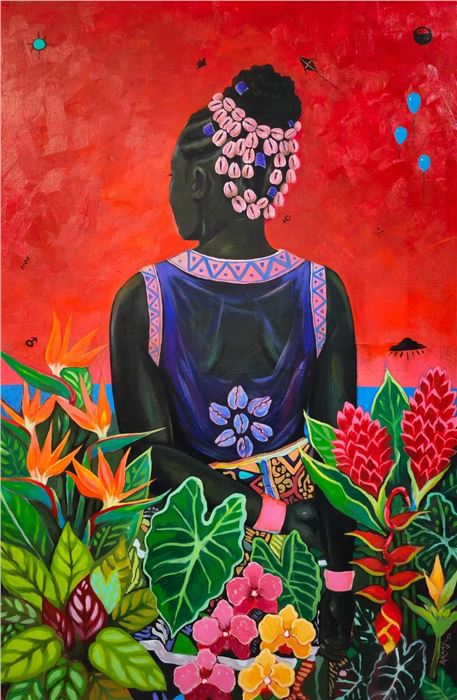
Moving from the urban intensity of Havana to the spiritual richness of the Yoruba tradition, we find the work of Akanji Bolaji, represented by the EAA Gallery in Lagos. Bolaji’s most recent canvas, Orisa: Goddess of fertility, love, and sweet waters, is a striking exploration of contemporary portraiture through the lens of ancient cosmology. The title invokes Osun, the orisha celebrated for her mastery over fertility and fresh water.
Bolaji depicts the figure in profile, a choice that emphasizes her role as an icon or deity. She is enveloped by dense, intricate tropical flora that stands in vivid contrast to a blazing, monochromatic red ground. The painting is both a devotional image and a modern celebration of Black beauty, executed with the flat, decorative confidence that has become a hallmark of Bolaji’s recent output. Priced at $1,200, the work comes with a certificate of authenticity, ensuring its status as a verified piece of contemporary African art. The EAA Gallery continues to showcase the breadth of Bolaji’s vision, with other works currently available at price points ranging from $1,000 to $2,150, offering collectors a unique opportunity to invest in a rising talent whose work bridges the gap between historical heritage and contemporary aesthetic inquiry.
Narrative Layers in the Work of Anna Song
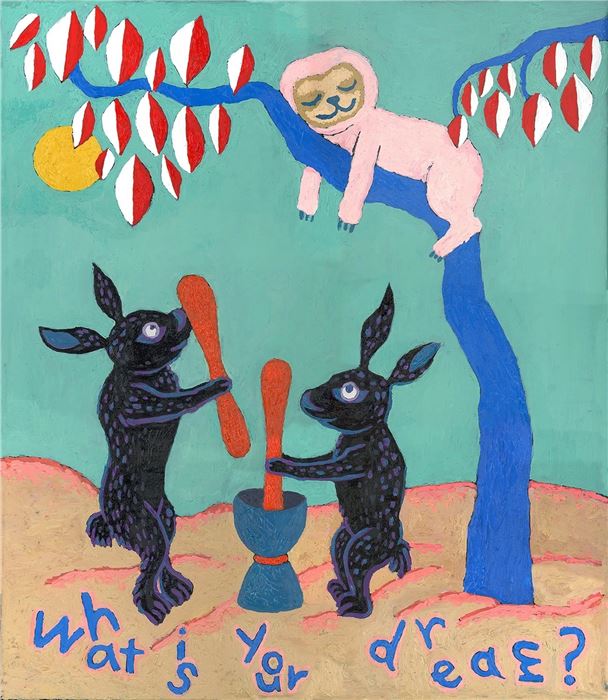
In Seoul, painter and celebrated picture-book author Anna Song approaches the concept of the portrait through a whimsical, narrative-driven lens. Born in 1984, Song’s artistic journey is inextricably linked to her literary background; she earned the prestigious Korean Andersen Award for excellence in published art in 2007 and gained further acclaim for her 2009 book, Dada’s Chair.
Her canvases are extensions of these storytelling roots. In What’s Your Dream?, a 2024 oil painting, Song casts a group of animals—two black rabbits and a monkey—as the sitters. By placing them in a dreamlike tree setting, she creates a group portrait that functions as a psychological mirror. These animals serve as proxies for the inner lives of the human viewer, inviting them to project their own dreams and anxieties onto the canvas. Song’s recent accolades, including an Excellence Award in the Wepple Gallery Gyomyo Year Competition in early 2023, signal her growing influence in the South Korean art scene. The work is currently offered through the Galerie Bruno Massa—an institution with a nomadic history that has moved from Paris to Seoul and eventually to its current home in Tbilisi—at a price of approximately $910. This affordability makes Song’s work an inviting entry point for new collectors interested in narrative-heavy contemporary painting.
The Art of Pairing: Sernet and the Global Landscape
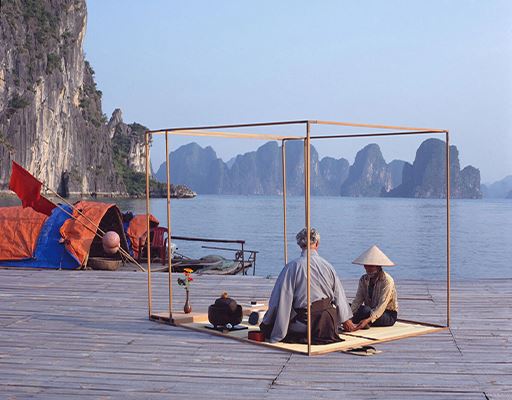
At the Arco Gallery in New York, the portrait is treated as an act of connection. Pierre Sernet’s One series is a sustained investigation into the nature of pairing. In his photograph One — Dinh, Halong Bay, Vietnam (2006), Sernet captures two figures side-by-side, perfectly integrated into the landscape of a wooden dock in Vietnam. The composition serves as a dialogue between the individual and their environment, where the setting is not merely a backdrop but an essential component of the sitter’s identity.
The series is a globe-spanning project, with Sernet capturing subjects in Hawaii, India, and China, among other locations. Each image is a testament to kinship across cultures, challenging the viewer to look past the individual face and consider the context of the human experience. Priced at $8,500, the giclée pigment print on archival paper reflects a consistent value across Sernet’s acclaimed series. It is a work for the collector who values the intersection of travel, sociology, and traditional portraiture.
The Quiet Intimacy of the Human Scale
Rounding out this selection is the work of Kelly James, represented by the Stefani Art Gallery in Salem, Oregon. James, a photographer who works with the patience and intentionality of a classical painter, presents a more intimate view of the human condition. Her 2025 print, Wifrida, captures an older woman seated before a flat, blue wall. The image is unhurried, direct, and profoundly human.
There is a deliberate simplicity to the composition; the sitter’s posture and the minimalist field of color behind her carry the entire emotional weight of the image. Measuring 41.9 by 40.6 cm, Wifrida provides a quiet, human-scaled counterpoint to the more expansive, symbolic paintings in this collection. As the Stefani Art Gallery continues to expand its reach through partnerships like those with MutualArt, works such as this offer collectors a chance to acquire a piece of high-quality contemporary photography that prioritizes emotional honesty over spectacle.
Collectively, these five works demonstrate how the genre of the portrait has evolved beyond the mere faithful recording of physical features. Across the diverse mediums of painting and photography, these artists share a core conviction: that the figure is a container for something far more complex than just a likeness. Whether through the bold, mask-like faces of Carlos Quintana, the spiritual, nature-infused deity of Akanji Bolaji, the dreamlike animal surrogates of Anna Song, the cross-cultural pairings of Pierre Sernet, or the quiet, unvarnished humanity of Kelly James, these artists are using the portrait to interrogate memory, identity, and the spaces we inhabit.
For the modern collector, the market offers a wide spectrum of options, with prices varying as much as the artistic approaches. Each of these works is backed by a gallery that is ready to provide detailed insights into condition, provenance, and the logistics of acquisition. For those interested in exploring these pieces further, direct inquiry through the respective partner galleries remains the most effective path to understanding availability and securing a piece of contemporary art that speaks to the complexities of the human experience. As the market continues to shift toward more narrative and symbolic forms of figuration, these artists stand at the forefront, defining the visual language of our time.