Portraiture has long served as the primary nexus where the worlds of art history and the commercial market collide. Unlike other genres that might prioritize abstraction or conceptual play, the portrait—whether it depicts a face, a human figure, or the environment of a sitter—demands a different kind of engagement. To acquire a portrait is, in many ways, to invite a presence into one’s private space; it is art meant to be lived with, rather than merely admired from a distance. In the current market, the most resonant works of contemporary figuration are those that move beyond the strict, faithful recording of a likeness, instead utilizing the human form as a vessel for symbol, allegory, and a deeper exploration of place.
This week, we examine a collection of six primary works sourced through our network of partner galleries, tracing a creative thread that spans from the vibrant urban streets of Havana to the quiet, introspective studios of Seoul. Read together, these pieces map the accessible end of the gallery-sourced art market with remarkable clarity, offering collectors a window into how artists are currently wrestling with the concepts of identity and memory. With price points ranging from approximately USD$782 for an intimate oil painting to USD$8,500 for a significant archival print, these works demonstrate that high-quality, thought-provoking contemporary art remains attainable for a wide spectrum of collectors. Furthermore, the fact that half of this selection was produced within the last three years underscores a market that is increasingly focused on the immediate, living pulse of contemporary production.
The Symbolic Power of the Havana Canvas
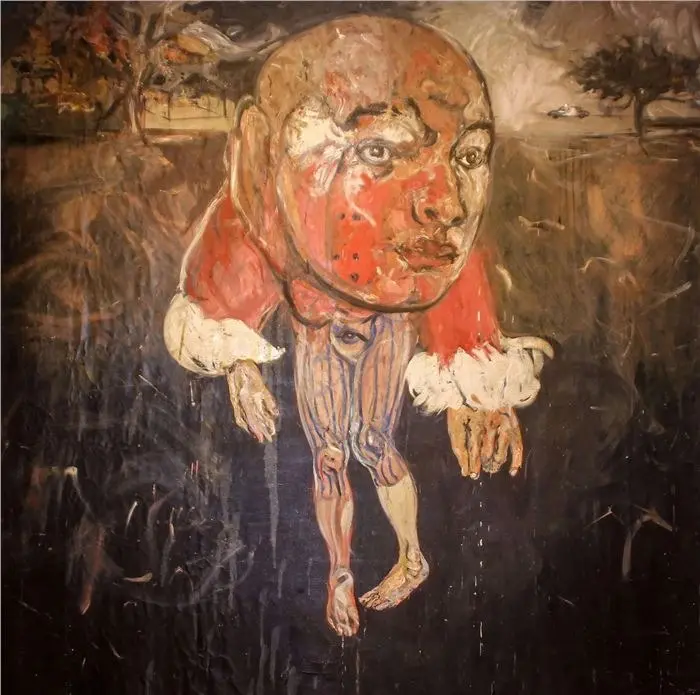
Represented by the Zapata Gallery, the Havana-born painter Carlos Quintana has been a fixture of the international art circuit since the mid-1980s. Over the course of his long career, Quintana has meticulously constructed a figurative language where the portrait is never intended to be a mere photographic record. Instead, his subjects arrive on the canvas charged with the intense, often mystical symbolism of Cuban urban and spiritual life. His figures frequently read more as masks, totems, or vessels for historical memory than as individuals in the traditional sense.

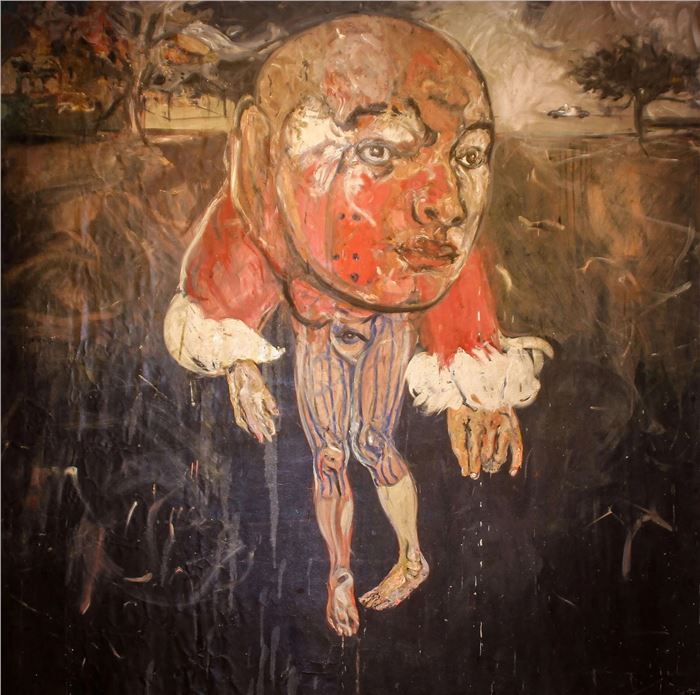
His latest untitled canvas serves as a distillation of this long-standing approach, stripping away extraneous detail to reach the absolute essentials of his practice. The work depicts a man’s face rendered in deeply saturated, visceral red, isolated starkly against a pitch-black ground. The composition possesses the haunting intensity of a votive image—a piece of devotional art intended for spiritual focus—rather than the placid, polished nature of a commissioned portrait.
The sheer scale of this piece is what sets it apart within this curated selection. Measuring 194.3 by 194.3 centimeters (approximately 76.5 by 76.5 inches), the square canvas functions as a wall-defining, architectural statement. As the work is currently shipping from Miami, it offers a rare opportunity for collectors to acquire a major, large-scale Cuban figurative piece. Given that pricing for such a monumental work is available upon request, it serves as an invitation for a direct dialogue between the collector and the Zapata Gallery, a necessary first step for those looking to anchor a collection with a piece of such significant gravity.
Yoruba Cosmology and Contemporary Figuration
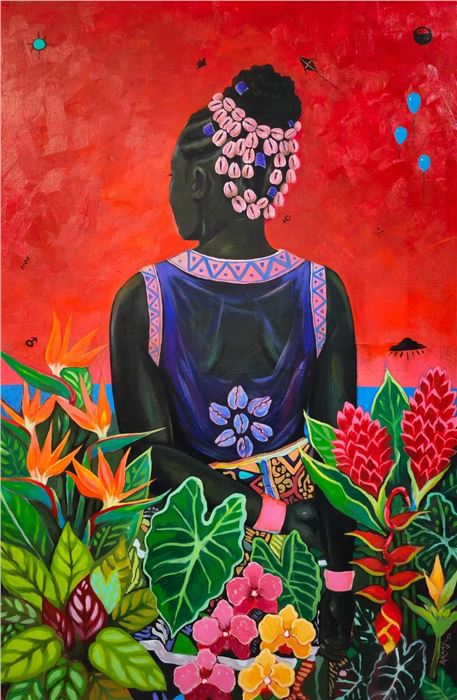
Turning from the Caribbean to the creative hubs of Lagos, we encounter the work of Akanji Bolaji, whose new canvas, Orisa: Goddess of fertility, love, and sweet waters, represents a fascinating turn toward the rich, complex narratives of Yoruba cosmology. Offered through EAA Gallery, the piece directly invokes the orisha known widely as Osun, the deity associated with fertility, love, and the life-giving properties of fresh water.
In this rendering, Bolaji presents the goddess as a seated figure, shown in profile and enveloped by a dense, lush backdrop of tropical flora. The background is a searing, blazing red, which serves to heighten the central figure’s presence. The final composition is a hybrid: it acts as both a devotional image and a contemporary portrait of Black beauty. Bolaji executes this with a flat, decorative confidence that has become a hallmark of his recent output, proving that traditional mythological subjects can feel entirely relevant and urgent in a contemporary context.
The canvas is currently listed at USD$1,200 and is accompanied by a certificate of authenticity from the gallery. For those intrigued by Bolaji’s specific aesthetic, EAA Gallery maintains a broader inventory of his paintings, with prices ranging from USD$1,000 to USD$2,150, providing an entry point for collectors at various stages of their journey.
Narrative Threads and the Inner Life
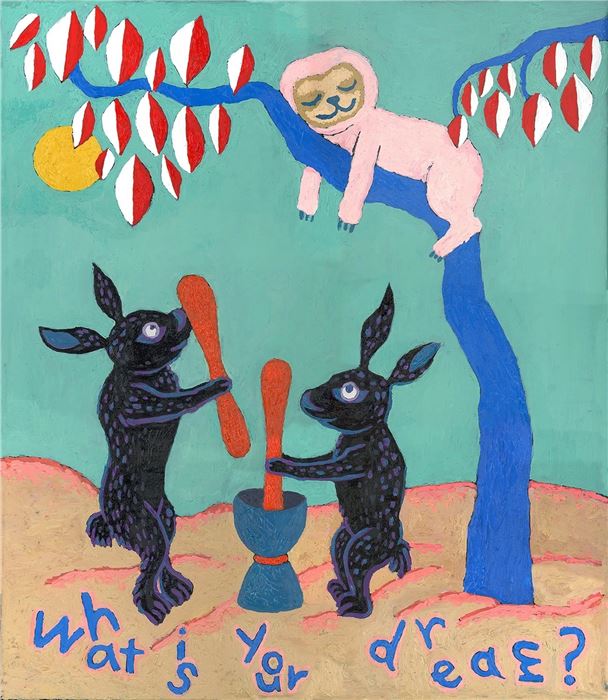
The Seoul-based painter Anna Song offers a vastly different, though equally compelling, take on the portrait. Born in 1984, Song is not only a painter but also an accomplished picture-book author, having received Korea’s prestigious Andersen Award for excellence in published art in 2007. Her literary background is evident in the narrative quality of her canvases, which often cast animals as the primary sitters in dreamlike, storybook-inspired environments.
Her 2024 work, What’s Your Dream?, is a prime example of this sensibility. The painting features two black rabbits and a monkey positioned together in a tree. While on the surface it appears to be a whimsical scene, it functions as a group portrait in which these animals serve as proxies for the inner lives of the human viewers. It is a quiet, allegorical look at the anxieties and aspirations of the self, rendered with the soft, story-driven touch of an artist who understands how to build a world in a single frame.
Song’s reputation in Korea has been bolstered by a string of recent distinctions, including an Excellence Award in the Wepple Gallery Gyomyo Year Competition in early 2023. The work is represented by Galerie Bruno Massa, a gallery that has maintained an international trajectory since its founding in Paris in 2013, followed by a Seoul branch in 2018 and a subsequent move of its main space to Tbilisi in 2019. Listed at approximately USD$910, the work is one of the most approachable in this selection. With other available works by Song ranging from USD$770 to USD$2,100, the gallery offers a fantastic opportunity to acquire an artist whose narrative-driven practice is gaining significant critical traction.
The Portrait as an Act of Pairing
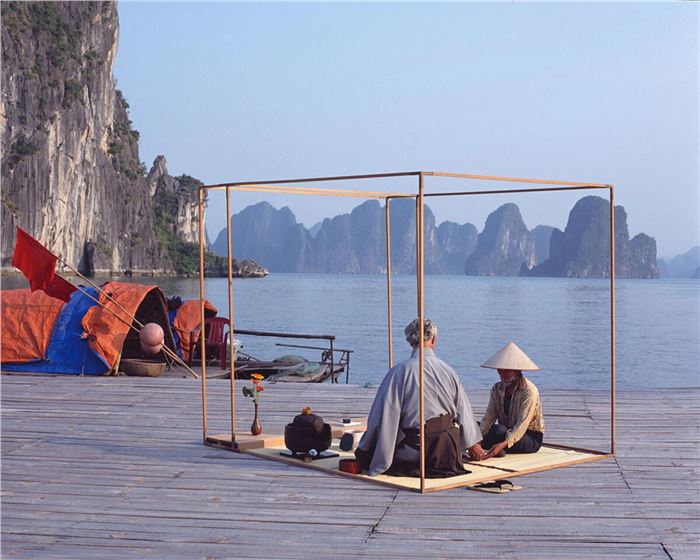
In New York, Arco Gallery represents the work of Pierre Sernet, whose One series fundamentally alters the viewer’s expectation of the portrait. For Sernet, the act of portraiture is an act of pairing. Each image in the series places two figures side by side within their own specific, native landscape. In the piece One — Dinh, Halong Bay, Vietnam, the figures are captured on a wooden dock overlooking the iconic bay.
The composition is as much about the environment as it is about the individuals; the framing turns the sitter’s natural or urban setting into an essential component of their identity. The series is global in scope, traversing Hawaii, India, and China, and it poses profound questions about kinship across cultures. By documenting the relationship between the subject and their home, Sernet creates a portrait that feels anchored in both the physical world and the shared human experience. Listed at USD$8,500, the work reflects the established value of this series, which remains a cornerstone of Sernet’s artistic output.
Quietude and Human Scale
Finally, the work of Kelly James, represented by the Stefani Art Gallery in Salem, Oregon, provides a necessary counterpoint to the more symbolic and narrative works in this group. James, who works primarily in photography, approaches the camera with the patience and intentionality of a classical portrait painter. Her 2025 work, Wifrida, is a direct, unhurried portrait of an older woman seated before a flat blue wall.
The simplicity of the image is its strength; there are no distractions, no complex metaphors, and no busy backgrounds. The emotional weight of the photograph is carried entirely by the sitter’s posture and the minimalist field of color. The print measures approximately 16.5 by 16 inches, or roughly 27 by 26 inches when framed, making it a quiet, human-scaled addition to any collection. Stefani Art Gallery, which was recently profiled as a key partner for our readers, offers Wifrida as a testament to the power of the unadorned image.
Taken together, these five artists demonstrate the remarkable range of the modern portrait. Whether through the bold, masked intensity of a Cuban canvas, the mythological richness of Nigerian-influenced acrylics, the storybook dreams of a Korean painter, the cultural pairing of a photographic series, or the quiet, patient documentation of an American photographer, these works share a common conviction: that the figure on the canvas or in the print carries significantly more than a simple likeness. They are, in essence, repositories of memory and identity. Each gallery involved is currently prepared to discuss the condition, provenance, and logistical details for these works, inviting collectors to inquire directly through MutualArt to secure these pieces for their own collections.