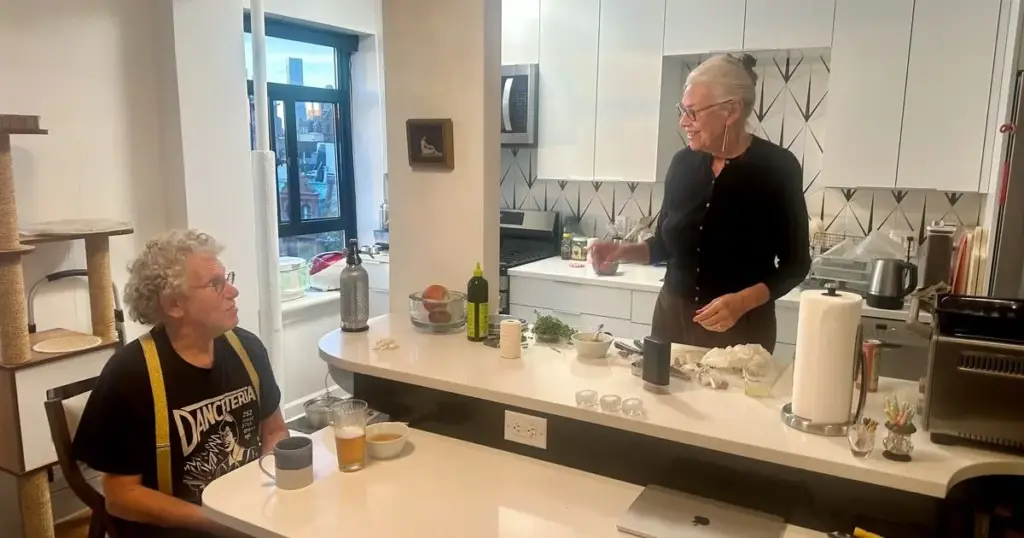
On a typical morning, Sarah Crichton wakes up at 6:30 and heads out for a long walk, leaving her husband, Len Berman, snoozing in bed. When she returns from her stroll, she checks on Len in the bedroom before heading downstairs to her own apartment, where she makes coffee for two. A bit later, Len wanders down to her place for coffee and their morning round of cards.
The couple, both divorcees in their 70s who met on OkCupid in January 2020, maintain separate apartments in the same Brooklyn Heights co-op building. Len owns unit 8J, while Sarah’s place, unit 7G, sits exactly one flight down.
When they first met six years ago, Sarah was living alone in her Boerum Hill brownstone, and Len was subletting a place on the Upper West Side while his new Brooklyn Heights apartment underwent renovations. As the city entered a full lockdown and their relationship deepened, Len moved in with Sarah so they could continue seeing each other.
"But he clearly didn’t feel at home," Sarah recalls. "Also, my ex-husband had lived there, and that was uncomfortable."
It took two years to renovate Len’s apartment, which he purchased following the conclusion of his 35-year marriage. When he finally moved into his new home in the spring of 2022, he was thoroughly energized by the space. Len, a retired IBM research scientist, began spending his days at his own place and staying there overnight. However, missing each other’s company, Sarah began staying over at Len’s more frequently. That fall, they married, and she began living at Len’s nearly full-time.
While his one-bedroom co-op was perhaps a quarter the size of Sarah’s former brownstone, it felt intimate. "We were in love and happy, and it was like having a cute little aerie," Sarah says.
Soon, however, it was Sarah’s turn to feel out of place. "This apartment reflects Len so powerfully," she says. "It’s the apartment of somebody who intensely loves the things he loves and also never had an apartment of his own to express himself. But it doesn’t reflect me."
The first time she saw Len’s home, she recalls, it resembled the quarters of a mathematician. It featured geometric shapes and an aesthetic that mirrored the inner workings of his mind—a quality she initially found charming.
"It’s got a lot of geometric stuff in it," Len agrees. "It’s kind of an orderly sort of apartment. Except it’s totally unorderly. And the more intensely mine it is, the messier it gets!"
On a recent evening, the couple offered a tour of Len’s eighth-floor unit. Featuring stark white walls, endless expanses of tile, industrial shelving, and storage units ordered straight from the Uline catalogue, the space resembles a cross between an art gallery and a warehouse. The rooms are lined with wire grid-wall panels typically reserved for retail displays.
"It lets you move things around, in theory. Not that I’ve ever moved anything," Len admits.
Among the items on display are a Mad Hatter top hat, a series of small cartoonish paintings, Christmas lights, a fly swatter, bungee cords, retractable tape measures, exercise bands, sunglasses, and a sack of dog biscuits. "Sometimes a dog will visit," Len explains. "And I like to be prepared."
His furniture is decidedly ad hoc. His desk consists of a used slab of countertop laid across a pair of ancient filing cabinets, while an adjacent restaurant cart displays a dust buster, an industrial mixer, and a bucket of vintage Altoids containers.
Sarah’s aesthetic, by contrast, leans traditional. A book editor by profession, she is drawn to warm colors, Central Asian patterned rugs, sleek cherrywood cabinets, and mid-century modern furniture—a combination she describes as "classic New York." Her space is also significantly less cluttered.
To establish comfortable boundaries and personal territory, the couple initially considered buying a larger two-bedroom apartment together or renting a studio that Sarah could use as an office. But approximately six months after their wedding, Sarah spotted an open house listing on StreetEasy for an apartment directly downstairs from Len’s.
"We hadn’t really figured out what we wanted to do," Sarah recalls. "And then we walked in, and I whispered to Len, ‘I want this!’ So we bought it that afternoon, basically."
Because their co-op building is tied to an unpredictable land-lease situation, the units sell for roughly half the cost of typical Brooklyn Heights real estate. According to the couple, buying and maintaining two separate units actually costs less than what they would pay for a standard two-bedroom in the neighborhood.
For a married couple living in separate units, Sarah and Len spend a remarkable amount of time together. After their morning coffee and cards at Sarah’s apartment, Len heads back upstairs to work on a science-fiction novel he has been writing, while Sarah works in her bedroom downstairs, which she has converted into a home office. Her office features a fold-out sofa instead of a bed, ensuring that any overnight guests always stay in Sarah’s apartment.
Around noon, Sarah heads upstairs to Len’s apartment, frequently remaining there for the rest of the day. She works on her laptop at the dining table while he operates from his desk.
"We get lonely," Sarah says simply.
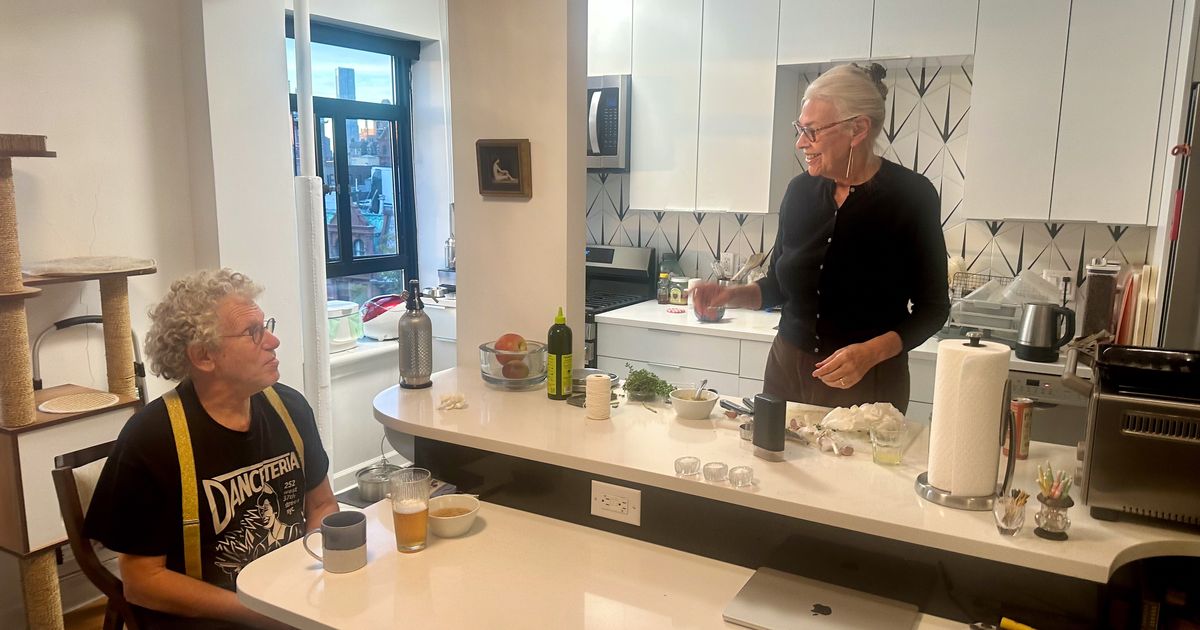
"I like her to be here," Len adds. "I mean, I’m glad she can go, but I’m glad when she’s here. If she was downstairs and didn’t come up here to make lunch, I’d probably come down."
Since they typically eat lunch and dinner together at Len’s, that unit serves as the primary storage location for everyday food items, with overflow items stashed in Sarah’s kitchen. Meanwhile, because Sarah’s more formal apartment features a long dining room table and large cookware, her unit is utilized for larger gatherings, including a Thanksgiving dinner for 16 held last fall.
Logistics occasionally require some indoor commuting. "We do wander up and down with pots of food and stuff like that because we have different equipment," Sarah says. "I finally got a Cuisinart in Len’s apartment because I just can’t live without a food processor."
Following dinner and another round of cards, Sarah typically reads and watches television in Len’s bedroom before turning in early. The couple always sleeps in Len’s bedroom. Len, however, stays up late working at his desk.
"I don’t like to watch TV, period," Len says. "And in bed? I’m just not going to do it."
When they watch a movie together, they do so downstairs in Sarah’s office.
Moving between floors is simple and routine. They usually take the stairs rather than the elevator, unless they are carrying heavy items, and they do not knock before entering each other’s homes. In fact, they installed identical locks on both front doors so that a single key opens both units.
"I didn’t want to have to carry two keys, and Sarah can never find her keys, so having one key was bad enough," Len notes.
Financially, they maintain separate bank accounts and pay the respective mortgages and maintenance fees for their own properties. They split the cost of groceries and a weekly housekeeper—who cleans both apartments—using a joint account. Laundry duties are shared as well: Sarah sorts and starts the loads in the building’s basement laundry room, while Len, who considers himself better at folding, handles the rest.
This routine has governed their daily lives for two years. When acquaintances learn about their upstairs-downstairs living arrangement, the reaction is uniformly positive.
"Everyone goes, ‘Oh my God, that’s just the most ideal situation,’" Sarah says. "And it is!"
"We both get to express ourselves without oppressing the other," Len adds.
To prevent the separate spaces from creating entirely separate lives, the couple established a firm rule early in their marriage: They never sleep apart. The rule was tested only once during a squabble while staying at a vacation rental in Cape Cod.
"I put my foot down and said, ‘We don’t do that,’" Len recalls.
"Sleeping separately would be a crime against the marriage, against the relationship," Sarah agrees. "But certainly, there are times when you get on each other’s nerves, and it’s fantastic to be able to go downstairs. When one is upset, one wants to be comforted by objects or things you look at. There’s not a lot of my stuff in Len’s apartment that feeds me that way, except for Len and the cat."
Gradually, however, that dynamic is shifting. Despite their commitment to preserving separate identities, Sarah’s personal sensibilities continue to make inroads into Len’s space. She arranged for a television to be installed in the bedroom, the hallway is now lined with her favorite books, and the entryway features a poster of Che Guevara that belonged to her late mother.
When Len expressed a desire to install more industrial wire grid panels over his living room sofa, Sarah intervened. "Enough with the grid!" she says.
Instead, she hopes they will find a large painting to hang above the couch. Len, meanwhile, has alternative plans.
"I want to get a tripod and a projector and use that wall to watch movies," he counters. "That would be perfect."
With apartment 8G currently listed for sale in the building, the possibility of a third unit remains open.