I walked past my alma mater with only one intention: getting an order of fries at J&J’s Fish and Chicken. It was a routine errand in a familiar neighborhood, a simple craving on a standard day. But without warning, a stunning rainbow of light caught my eye from within the SITE Galleries at the School of the Art Institute of Chicago’s (SAIC) Sharp building. What I expected to be a quick trip for comfort food transformed into an immersive encounter with a medium often relegated to the background of our daily lives.
In all of my years attending SAIC, I cannot recall a student show that focused so intently on glass as a primary, singular medium. Rarer still was an exhibition that demanded an acknowledgment of its meticulous timing, precise nature, and the sheer physical intensity required to bring it into existence. Glasswork is an exercise in extreme labor, a craft where the physical feeling in the hand is a luxury most people—even those who own glass sculptures—rarely get to experience. Most glass art sits behind velvet ropes or within protective glass cases, creating a distance that contradicts the material’s molten, fluid origins. The curator of the exhibition, Kenny Kay, set out to dismantle this distance, offering the works as a way to fundamentally shift the viewer’s relationship to the medium. Drawing from forgotten pieces stored in the archives of Ignite Glass Studios, Handle With Care brings together works by Arvin Makhsous, Ben Tullman, and the dedicated Ignite Studios team, challenging the viewer to stop looking and start feeling.
Interactive Play and the Collective Process
Kenny Kay, a student at SAIC, views the show as an intimate, long-overdue exploration of how glass can be both tangible and engaging, yet frequently underappreciated. "Handle With Care is a collaborative exhibition with works of my own as well as works retrieved from the basement of Ignite Glass Studios, where I work," Kay explains. "Every piece was either made by me or kept in storage for months, years, or an undetermined length of time. I was really interested in getting people to touch glass and experience the tactile qualities of the medium—feeling the texture and listening to the sounds they make."
This focus on the tactile is a radical departure from the "do not touch" ethos of traditional gallery spaces. For Kay, the vulnerability of the material is not a reason to hide it away, but rather a reason to embrace it. "When working with glass, you learn not to be overly sentimental with your creations because they can break or shatter at any moment," he notes. "I want audiences to feel comfortable experiencing this medium up close and seeing how beautiful even simple objects can become." By bringing these lightly discarded works—pieces that were once relegated to storage—into the gallery, Kay makes a point to invite viewers to physically engage with pieces throughout the space, bringing a genuine sense of play to the student gallery.
As Kay highlights in the exhibition’s curatorial statement, glass is an integral part of our daily existence, yet we seldom stop to appreciate the immense effort it takes for it to exist. It is a material shaped not only by fire and heat, but by deep collaboration—a process where even the simplest object requires multiple hands, precise timing, and a profound level of shared trust. Emerging from that collective process, the exhibition highlights the labor and interdependence often hidden behind the material’s everyday functionality. Rather than reinforcing distance and fragility, Kay invites touch, play, and curiosity to challenge the assumption that glass must remain distant and untouchable.
Framed as resilient, dynamic, and open to transformation, the exhibition features works that fall outside conventional standards of perfection. These pieces, created by team members at Ignite Glass Studios in Chicago’s West Loop, were not necessarily designed for a pristine museum pedestal. Rather than viewing these works as failures, Kay approached them as "unresolved monuments" with ongoing potential. It is a philosophy that proves imperfection does not diminish value; instead, it opens new pathways for interpretation, interaction, and appreciation.
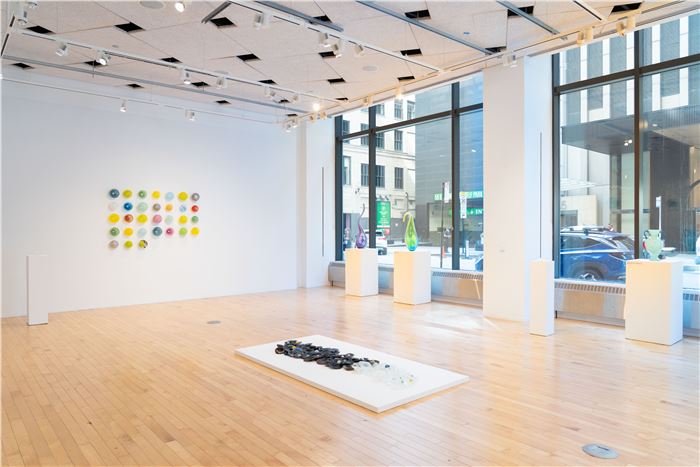
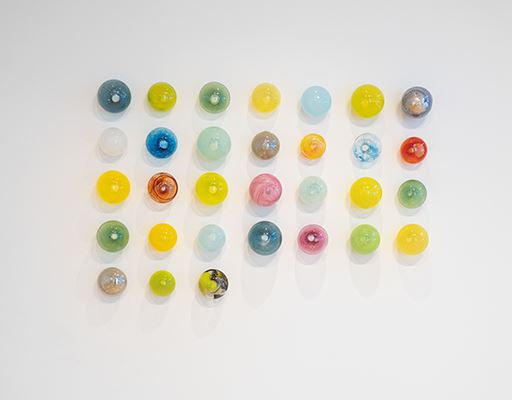
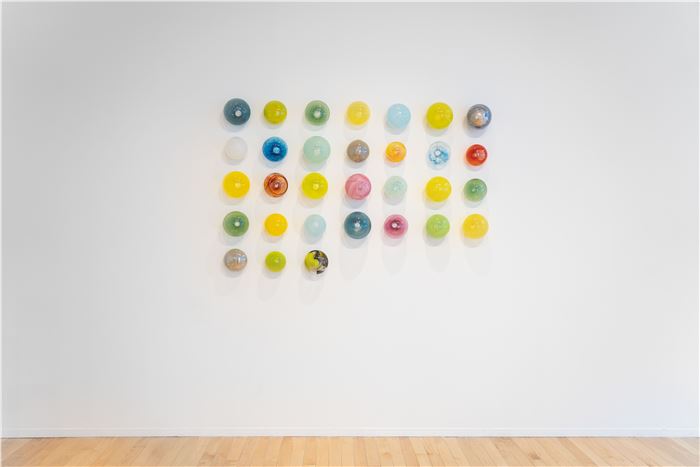
Inside the gallery, the white walls feature glass collections arranged in a classic ROYGBIV spectrum, a bold aesthetic choice that draws the eye immediately. To the left, a wave ranging from red to violet spans the longest wall in the space. Here, the Ignite Team’s Untitled: Wall Plates are showcased. The collection is diverse in its execution: some plates remain flat, honoring the surface of the material, while others have indented corners or are blown into decorative, bowl-like forms, their edges shaped like rolling hills and valleys.
Following the flow of the show, the back wall features Kay’s own Day By Day, a 31-piece series of blown, hollow glass spheres mounted in sequential order. The series appears to mimic the atmospheric view of the sky over the course of a month. Next to the more rigidly kaleidoscopic assemblage, the integration of more common, natural colors makes for a visual odyssey, grounding the exhibition in the cycles of time and light.
Vessels, Puddles, and the Freedom to Touch
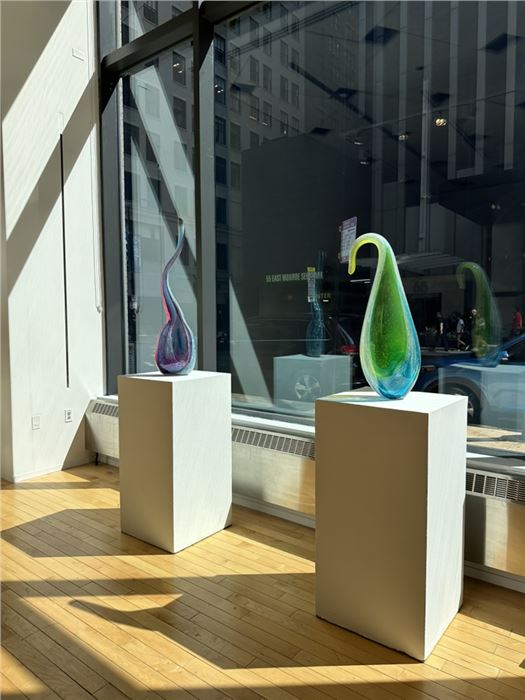
Moving toward the windows, a collection of water drops, flames, vases, and glass puddles gather, seemingly in conversation with one another as the autumn sunlight bids them goodbye earlier each day. The installation feels organic, as if the objects are reacting to the changing seasons outside the Sharp building.
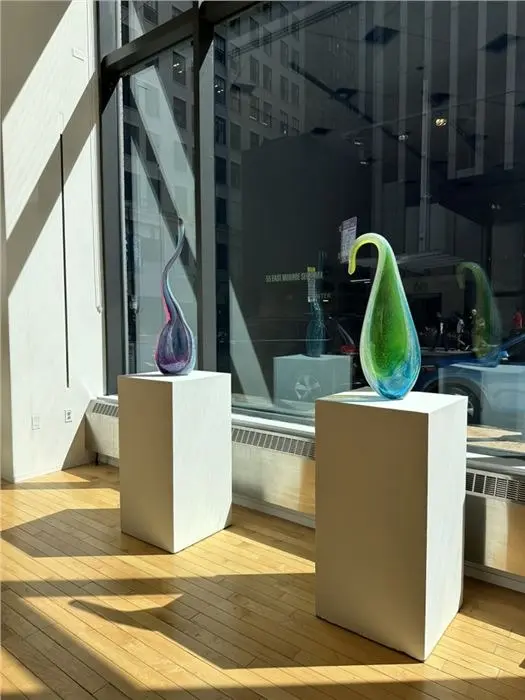
Starting off the section are two of Ben Tullman’s works. Untitled: Pink & Blue Vase sports an ombré mix of blue and violet that recalls the deepest, most intense color of a fire. On the adjacent pedestal, Tullman’s Untitled: Blue & Green Vase offers a stark, yet complementary contrast; it is a "droopy" vessel crafted with deep blue and grass-green glass, suggesting a fluidity that defies the solid, cold nature of the material.
Next is the third in a series of clear glass ponds and touchable pebbles. Kay’s Low Bowls & Marbles acts as an interactive playpen, demonstrating how water might feel if it were solid, and how inherently fun it is to hold, arrange, and juggle these objects. On the far end, Kay’s Untitled: Pale Aqua Green Vase stands as a classic two-handed vessel. Blending white, green, and lime glass, the piece seems to emit the glint of sunlight through leaves or the shimmering quality of underwater sunshine. A contradicting method lives here; while the body of the vase moves as water does, its arms carry a solid blue, reminiscent of the deep, cold currents of Lake Michigan.
The center of the gallery holds the largest and most whimsical portion of the exhibition. Arvin Makhsous’ Untitled: Caviar Dishes & Orbs is explicitly meant to be rearranged, touched, and heard. Small glass beads clink inside different glass dishes, and the iridescence of the tiny glass spheres changes color depending on how the light hits them. The dishes are propped on a low white pedestal, only about four inches off the hardwood floor. By placing the work so low, Kay allows enough space for viewers to kneel and swap glass pieces around. The true beauty of the work is found in these participatory actions and the joy derived from finally being allowed to touch a material that is, by social contract, most often reserved for visual observation.
Three visually "globby" dishes sit in separate corners of the gallery to round out the experience. Clear as water, their glossy finish slips through the hands like non-stick hard candies. Slippery like water and hard like rubber, Kay’s Low Bowls & Marbles is playfully varied in size, inviting moments of pure joy through physical interaction. It is a rare experience to be encouraged to handle art in such an uninhibited way, and the effect on the viewer is immediate—a release of the tension usually associated with navigating a gallery.
I left Handle With Care pleasantly surprised—and, true to my original goal, I still got my fries. Equipped with a fresh perspective on the difference between functional objects and tactile art, an appreciation for the curator’s premise took hold immediately. We are often surrounded by things we are told not to touch: display cases, vases, precious artworks, construction tape, or even delicate living things. We are conditioned to believe that distance is the only way to ensure preservation. But Handle With Care asks a simple, profound question: Why can’t I touch it? And above all, it suggests that if some things are made to break, we might as well enjoy them while they last. In a world that demands we treat everything with caution, this exhibition asks us to get a little funky with it, to engage with the material, and to find the beauty in the messy, human, and collaborative process of creation.
Handle With Care was on view from August 27 to September 25 at SITE Galleries, School of the Art Institute of Chicago.