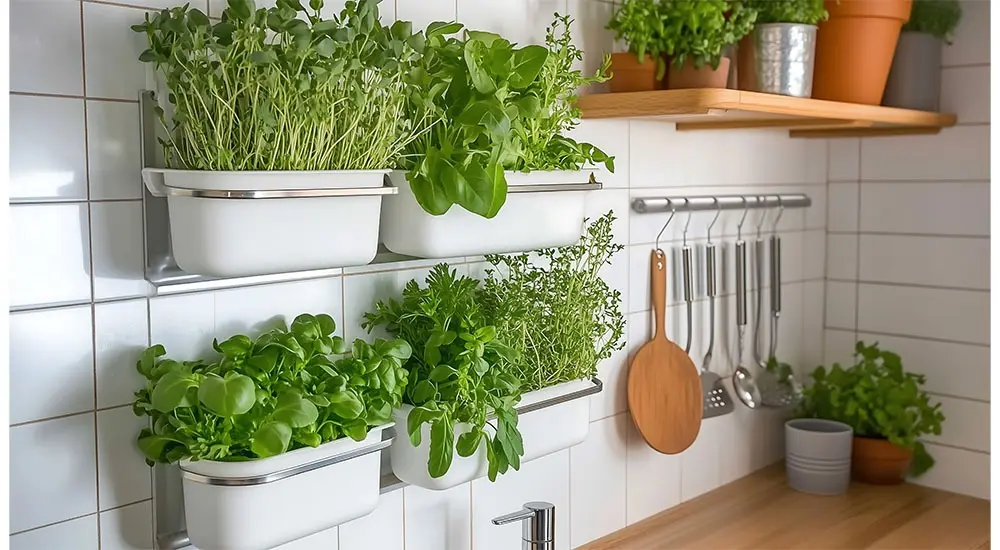
The contemporary design space is witnessing a profound shift toward bringing the outdoors directly into the heart of the home, a movement increasingly defined by interior designers and horticulturists as houseplant maximalism. While this botanical enthusiasm has steadily permeated living rooms and master suites over recent years, its latest and most ambitious frontier is the kitchen and the bath. Among the high-end residential sector, the absolute pinnacle of this trend is the integration of a living herb wall-garden, positioned conveniently near the main culinary prep area and meticulously tailored to the unique micro-climate of the cooking space.
Authored by Andrew Lemieux, a content strategist for the Brooklyn-based plant shop and garden design studio Tula House, recent industry insights emphasize that executing these living installations successfully requires far more than aesthetic ambition. To keep delicate plants healthy and visually vibrant over the long term, a kitchen herb wall demands rigorous early-stage planning regarding light exposure, drainage integration, service access, heat separation from appliances, and a definitive long-term maintenance strategy long before the first plant is ever selected or purchased.
Proximity to the Range Hood and Environmental Realities
One of the most critical challenges interior designers and kitchen architects face when positioning a living wall is the immediate environment surrounding the range hood. The wall space directly above and beside a cooking range is routinely subjected to extreme environmental stressors, including elevated heat, airborne grease, dry moving air currents, and lingering chemical residues from routine cleaning. Furthermore, environmental conditions within this zone can shift dramatically within a matter of inches, heavily influenced by nearby windows, undercabinet lighting configurations, ventilation ducting, and make-up air systems.
Experts strongly caution against installing edible plants directly within the exhaust path or the heavy grease plume of a kitchen hood. Delicate culinary herbs like parsley and chives feature soft, porous leaves that easily bruise and discolor when they accumulate airborne oil droplets and heavy cooking vapors. While more robust, woody varieties such as rosemary, thyme, and oregano are generally more tolerant of drier air conditions, they still require steady, reliable light and clear physical separation from intense, hot airflow columns.
Consequently, design professionals find that a dedicated side wall, an open shelf bay, or a narrow vertical framing system positioned safely near the food preparation zone represents a far superior architectural choice. This thoughtful placement allows the homeowner to effortlessly snip fresh herbs while actively cooking and plating, while successfully keeping the botanical installation safely out of the dirtiest and most volatile air currents in the kitchen.
Millwork, Water Management, and Herb Wall Access
Integrating living foliage into high-end architectural millwork requires seamless coordination between cabinetmakers and interior designers. Before any fabrication or installation work begins in the workshop, cabinetry and millwork teams must confirm several vital technical details with the design lead. These include ensuring unobstructed service access to irrigation water lines, hidden reservoirs, or removable planter trays; engineering reliable drainage paths that completely avoid sensitive wood surfaces, natural stone seams, and electrical outlets; mapping out precise grow light placement before ceiling and cabinet lighting plans are finalized; providing adequate physical access for routine leaf-cleaning near high-splatter cooking zones; and guaranteeing sufficient clearance so that individual plants can be easily removed or swapped without disturbing surrounding custom finishes or architectural hardware.
Industry professionals note that tight, built-in planter pockets carry significant risks when they cannot be easily accessed and serviced. As a result, a removable planter cassette, a waterproofed and lined architectural niche, or a specialized rail system is frequently much easier for homeowners and maintenance teams to manage over time than a permanent, built-in pocket wall concealed deep behind finished custom millwork.
Plant Selection Grounded in Light and Culinary Utility
Choosing the right flora for a kitchen installation depends entirely on the natural light available and how the homeowner intends to use the harvest. Traditional culinary favorites like parsley, mint, chives, oregano, and thyme serve as dependable starting points when the kitchen benefits from strong, abundant natural light or a well-integrated system of dedicated horticultural grow lights. Conversely, varieties such as rosemary, sage, lemon balm, marjoram, chervil, and bay laurel demand much closer management and precise control over both light duration and watering schedules.
Plant placement should always mirror how the greens will actually be harvested and utilized in day-to-day cooking. Delicate varieties like parsley, chives, and mint naturally belong in the most accessible pockets where they can be reached without strain. Meanwhile, hardier woody herbs can be safely situated higher up or slightly farther away from the primary food prep surface, provided they receive sufficient illumination and are allowed adequate time to dry out completely between watering cycles.
Designers also emphasize the importance of managing client expectations from the outset. An edible herb wall should never be sold to a client under the false pretense that it will remain permanently full of lush, static greenery. Because an edible wall is designed to be actively harvested, bare stems, uneven growth patterns, and the occasional need for plant swaps are entirely natural and should be fully anticipated as part of the lifecycle of a living kitchen installation.
Pre-Installation Garden Review Before Final Drawings
To avoid costly construction errors, a specialized plant design team should thoroughly review the kitchen layout long before elevations and architectural drawings are locked in. Professional interior plant design services—such as those provided by Tula House, which encompass comprehensive design, physical installation, and ongoing maintenance planning—play an indispensable role when living botany transitions from a casual decorating idea into a permanent component of the overall construction package.
This vital pre-installation review evaluates the proposed wall against the reality of the room rather than relying solely on an idealized concept rendering. An experienced horticultural team can quickly flag critical oversights, such as late grow-light placement that fails to illuminate the canopy properly, drainage infrastructure lacking a safe and accessible endpoint, or a plant species list chosen arbitrarily before anyone has accurately verified the actual levels of natural light penetrating the space.
Establishing Clear Care Assignments at Project Handoff
The transition of the completed kitchen to the homeowner must include a detailed handoff document that explicitly assigns every recurring operational task to a specific individual or professional service team. Essential ongoing duties such as routine watering, pruning, leaf cleaning, pest monitoring, and periodic plant replacement should never be left ambiguous or relegated to a vague, generalized owner-responsibility bucket.
Establishing this clarity is critical to ensuring that the sophisticated herb wall design remains healthy, vibrant, and structurally intact long after the first growing season concludes. A living architectural wall that has been engineered to be easily reached, thoroughly cleaned, and conveniently replanted possesses a dramatically higher probability of maintaining its original visual impact and architectural form long after installation day.
Addressing common inquiries surrounding these installations, industry specialists note that herb walls are not universally appropriate for every residential kitchen. Spaces defined by poor natural lighting, severely limited service access, or homeowners with little appetite for recurring horticultural care are typically much better served by traditional removable herb pots or a simple, sunlit shelf positioned near a window.
When considering growing mediums, both traditional soil-based planters and advanced hydroponic pockets can yield excellent results, though the underlying maintenance model shifts significantly. Soil-based setups generally prove much easier for the average homeowner to manage and replant independently, whereas sophisticated hydroponic systems demand much closer attention to water quality parameters, pump access, and precise nutrient dosing.
For designers specifying horticultural grow lights, key technical considerations include confirming the exact fixture location, light output levels, operating heat dispersion, color temperature, dimmer controls, and easy access for eventual bulb or unit replacement. Ultimately, the chosen fixture must successfully support vigorous plant growth without making the kitchen counter feel like an overt commercial greenhouse display.