Who was the first person to domesticate dogs, to dare to bring a wolf into a cave and tame it? “They could grow up to eat your children,” reminds a mustachioed man posing these and other canine questions in Erin Johnson’s striking two-channel film Heavy Water (2018).
Then, the film cuts to show the protagonist’s hand hovering in front of a slide projector displaying a plot of cheap land in South Carolina where nuclear weapons were developed during the Cold War. Viewers might initially wonder where the film is heading, but it soon comes full circle, seamlessly mingling an apocalyptic future with an ancient past.
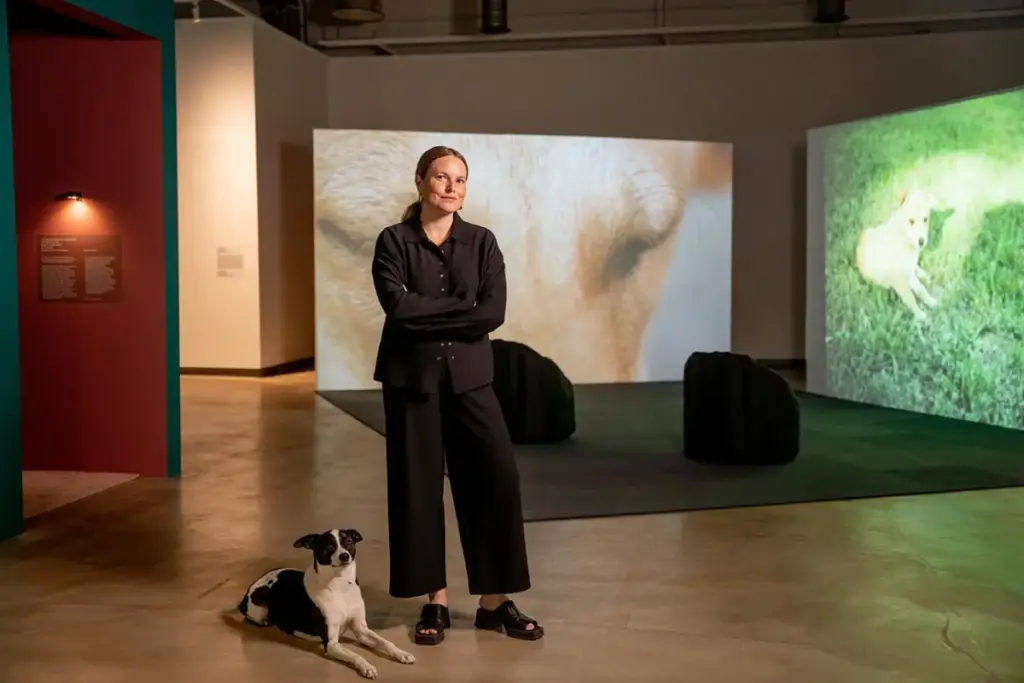
This thought-provoking work is currently on view as part of a major survey of Erin Johnson’s art at the University of Georgia’s Athenaeum in Athens, Georgia. Titled "The Measure Is Something Else," the exhibition offers a comprehensive look at an artist whose practice bridges the gap between empirical science and deeply human, sensorial storytelling. Like many of the other works featured in the survey, Heavy Water functions something like an essay film—yet one that avoids didactically demystifying the world, choosing instead to render it sensorial and strange.
Throughout her career, Johnson has frequently focused her lens on our interactions with other species. She has filmed scientists, such as an oceanographer in her 2022 film To Be Sound Is To Be Solid and a botanist in her upcoming 2026 project The Ferns, as well as animals, including monkeys in the 2024 work Cayo Santiago. She has also examined the humans who interact with these creatures, such as Georgia’s local legend, “the goat man,” in her 2014 film If it Won’t Hold Water, It Surely Won’t Hold a Goat. Yet, the cold, analytical qualities typically associated with both science and traditional documentary filmmaking consistently give way to something tender and embodied in Johnson’s hands.
Unearthing History in the Carolinas
The narrative of Heavy Water draws directly upon real-world historical and ecological investigations. In the 1970s, ecologists like L. Lehr Brisbin—the mustachioed man appearing onscreen—noticed “unusual dogs with strange behavior” inhabiting the South Carolina lot where nuclear manufacturing had taken place. These canines were gingerish, Dingo-like, feral, and rare. Because human species domesticated dogs long ago and have coevolved with them for ages, Brisbin began to investigate their origins.

Brisbin noted that these Carolina Dogs, a rare breed, possess no European DNA. Furthermore, he started noticing their distinct likeness in ancient cave paintings, suggesting they may have inhabited the Carolinas for thousands of years. After environmentalists advocated for the protection of these unique creatures, nuclear-weapons manufacturing on the site was halted. Subsequently, scientists discovered several federally endangered species of birds and plants thriving in the area that humans had cordoned off, turning a site of potential nuclear devastation into an unexpected sanctuary for biodiversity.
The overarching theme of the exhibition is encapsulated by its title, "The Measure Is Something Else," which is drawn from a letter written by Rachel Carson to her lover, Dorothy Freeman, while Carson was dying of cancer. The subject of their correspondence was the migration of monarch butterflies. Carson observed that the butterflies’ lifespan seemed short, but she understood that the measure is something else entirely from their perspective.
The Poetry of Naming and Ecosystemic Thinking
This poetic engagement with the natural world continues in There Are Things in This World that Are Yet to Be Named (2020), where a voice-over reads more of Carson’s letters. The film unfolds through sonic textures of the kind that so much heady research-based art frequently misses. Lines from Carson’s letters are chanted almost musically, repeating the refrain “there are so many things yet to be named” until an enthusiastic sense of wonder radiates from the screen.
Meanwhile, botanists in a greenhouse reflect on the ways binary and unscientific thinking about gender has brought unhelpful biases into plant classifications, occluding humanity’s ability to understand the more marvelous ways plants reproduce. Their laboratory’s research on a certain bush tomato has helped explode conventional understandings of sexual normativity, demonstrating how nature continually defies rigid human categorization.
The exhibition embodies ecosystemic thinking just as much as it is ostensibly "about" it. Such a philosophical framework posits that everything depends on and is connected to everything else. Unsurprisingly, there is perhaps no art form that relies more heavily on interdependence than film. When Johnson’s credits roll, they reveal a veritable list of art stars, featuring contributions from creative peers like Nikita Gale, Farah Al Qasimi, and Sondra Perry. Filmmaking, much like an ecological system, takes a village, and Johnson consistently relies on her community of friends.

Community, Collaboration, and Intimacy
Johnson’s collaborative spirit is rooted in her background. She trained at the alternative Warren Wilson College in Asheville, North Carolina, an institution where students farm their own food and manage the land. In addition to her art practice, Johnson directs an artist-run space in New York named Winnie—after her dog—and actively participates in dog-rescue work, organizing and collaborating both in art and in daily life.
This ethos is made most visible in works like Tomatoes (2020) and Oranges (2023), where friends from her creative credits and broader circles appear onscreen. In one video, the camera scans her Skowhegan cohort seated in a circle as they eat tomatoes in a field; in another, they consume oranges on a rooftop. Watching people—including fellow artists like Tomashi Jackson, Annika Todd, and Chase Hall—simply eat together feels surprisingly intimate, balancing the sensual and the silly as they slurp juices and handle the rounded fruits.
Thematically, interconnectedness abounds throughout the exhibition. Unexpected juxtapositions of seemingly unrelated topics—such as plants and gender, or feral dogs and nuclear weapons—form conceptual Venn diagrams, with Johnson dwelling comfortably in their overlapping middles.
This approach is evident in To Be Sound Is To Be Solid (2022), which features footage of the artist talking on the phone with a scientist whose work involves mapping the ocean floor. Concurrently, Johnson imagines the lives of the two women who built the Sea Ranch house she is renting, a midcentury architectural marvel complete with fresh flowers, crisp bedding, and sleek bistro chairs. Finding subtle hints that these women were a couple, she notes how they drafted one version of the floor plan with just a single shared bedroom. Queer history, Johnson suggests, can be much like the ocean floor: as the scientist relays, because hard data is often too difficult to come by, the best researchers can do is average the depth of an area across a grid.
Ultimately, Erin Johnson offers a rare, rich breed of research-based art. Her work invites viewers to marvel at how big and strange the world truly is, enlisting the rigor of science not to close down mystery, but to open it wider.