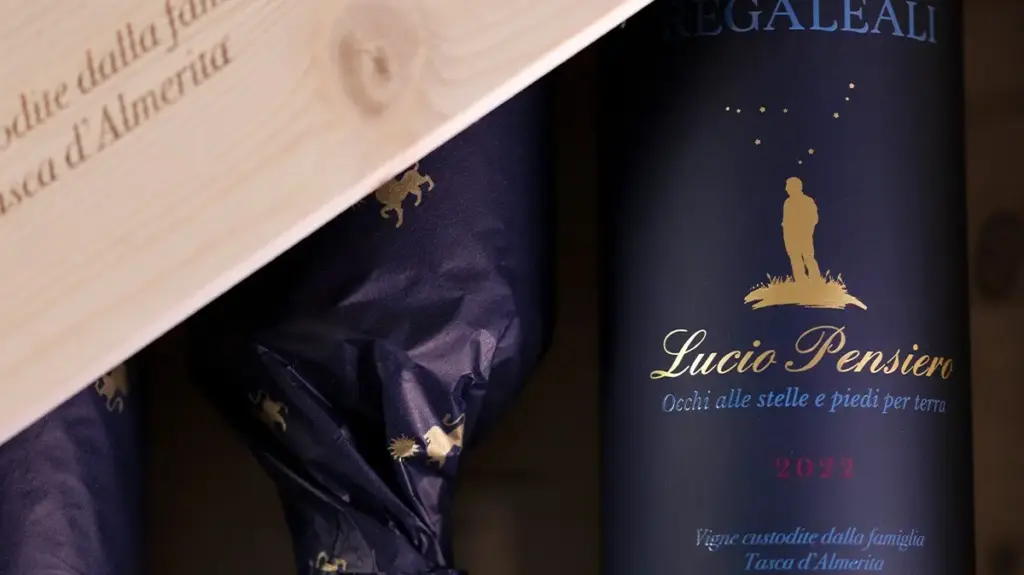
At a time when the vast majority of Sicilian winemakers are firmly doubling down on the island’s celebrated native grape varieties—such as the robust Nero d’Avola, the elegant Nerello Mascalese, the aromatic Lucido, and the crisp Grillo—one prominent winemaking dynasty is charting a fascinating and unexpected course. The Tasca family, custodians of winemaking history in Sicily for nearly two centuries, is releasing a rare, limited-edition Bordeaux-style red blend that serves as a profound testament to their family heritage and a bold act of retrospective innovation.
Entitled Lucio Pensiero—which translates from Italian as "Lucio’s Thoughts"—this special bottling pays direct homage to Lucio Tasca, the visionary family member who first introduced French grape varieties to the sun-drenched island of Sicily in the late 1970s. Crafted as an enticing and meticulously balanced blend of Cabernet Franc, Cabernet Sauvignon, and Merlot, the inaugural 2022 vintage is extraordinarily scarce. Total production is capped at fewer than 5,500 bottles worldwide, with a mere 300 bottles allocated for distribution in the United States, positioning it as an immediate collector’s item for enthusiasts of fine and rare wine.
Alberto Tasca, representing the eighth generation of the Tasca d’Almerita family and the current owner of Tenuta Regaleali alongside four other esteemed Sicilian estates, reflects deeply on the roots of his family’s winemaking philosophy. He points out that his grandfather, Giuseppe, was deeply and passionately invested in exploring and championing Sicily’s indigenous varieties. Back in 1959, Giuseppe planted Nero d’Avola and Perricone on the rugged San Lucio hill, thereby laying the foundational stones for Rosso del Conte, one of the family’s most prestigious and high-end red blends.
However, Lucio Tasca, Alberto’s father, possessed a restless intellectual curiosity about the broader potential of the Tenuta Regaleali terroir. Explaining the origins of the family’s pivot toward international varieties, Alberto notes that in 1979, his father planted a small, covert experimental trial at the estate. This initial planting consisted of just four rows each of Cabernet Sauvignon, Chardonnay, Pinot Noir, and Sauvignon Blanc—undertaken initially without the knowledge of his own father, Giuseppe. At the time, these international French varieties held no official recognition or status under Sicily’s regional wine regulations, making the endeavor a genuinely clandestine agricultural experiment.
While the prevailing lore surrounding these vines often characterizes them as having been planted in absolute secrecy, the reality was slightly more nuanced. It was less a matter of hiding from regional regulatory authorities and more about a son initiating a project behind his father’s back. Alberto Tasca explains that the original experimental vines were acquired through a nursery that supplied them strictly for trial and observation purposes. Over time, what began as a quiet personal curiosity evolved into a much larger, purposeful viticultural initiative.

Lucio soon recognized the immense marketing hurdles involved in selling unfamiliar wines made from obscure, local varieties from a region that had not yet earned a prominent place on the global fine wine map. He reasoned that one of the most effective ways to demonstrate the true agricultural and climatic potential of Sicily to an international audience was to utilize globally recognized grape varieties. The goal was to prove what the land could achieve through a familiar lens. After several years of careful observation and micro-vinification, the results of the experiment unequivocally validated his bold hypothesis.
The grapes that now comprise the Lucio Pensiero blend—specifically the Cabernet Franc, Merlot, and Cabernet Sauvignon—are cultivated at Tenuta Regaleali, a sprawling 1,500-acre estate situated approximately two hours southeast of Palermo. Owned and operated by the Tasca d’Almerita family since 1830, this historic agricultural haven is far from a viticultural monoculture. In addition to a diverse mix of native and international grape vines, the rolling landscape is thoughtfully planted with fields of wheat and grain, alongside ancient groves of olive and almond trees.
The estate’s Ninth-generation representative, Alessandro Tasca, emphasizes that one of the defining characteristics of Tenuta Regaleali is its extraordinary topography and range of growing conditions. The estate extends across six distinct hills, spanning elevations from approximately 450 to 850 meters, which translates to roughly 1,475 to 2,790 feet above sea level. This dramatic verticality introduces a wide array of soil compositions, sun exposures, and distinct microclimates across the property. According to Alessandro, this geological and climatic diversity grants the winemaking team remarkable flexibility, allowing them to pinpoint the exact parcels best suited to each individual grape variety and, ultimately, to capture the precise character they desire for every single vintage.
Some of the Cabernet Sauvignon vines currently thriving on the estate date all the way back to Lucio’s original 1979 experimental plantings, while newer blocks have been integrated over the decades. Meanwhile, Cabernet Franc has established a robust history at Regaleali spanning roughly two decades, anchored by a specific selection cultivated in one of the estate’s higher-elevation plots. Although Merlot plays a role in this inaugural vintage, Alessandro notes that the exact composition of the blend may shift and evolve over time. Cultivating Merlot has increasingly presented agricultural challenges as global growing conditions have shifted alongside climate change. The family expects the wine to adapt organically with each vintage, leveraging Regaleali’s diverse altitudes and microclimates to express the estate’s unique traits.
Because the wine has not yet made its formal debut in the United States market, an opportunity was seized during a recent visit to Sicily to taste the Tenuta Regaleali 2022 Lucio Pensiero alongside estate manager and sommelier Valerio D’Angelo. In the glass, the wine presents a deep, saturated purple hue. On the nose, it offers an alluring aromatic profile characterized by ripe blackberry, cassis, crushed leather, and fresh sage, underscored by a delicate, fragrant hint of violet. On the palate, plush, well-integrated tannins support luscious flavors of purple plum, eucalyptus, and lavender, finishing with a soft, pleasing touch of earthiness layered over bright orange peel. While it possesses the structural integrity and balance to age gracefully for many years, it proves remarkably approachable and harmonious right now, completely devoid of the heavy, overpowering oak notes that one might occasionally anticipate after spending 18 months aging in new French oak barrels.

The wine has already begun drawing high praise from some of Italy’s most respected culinary figures. Marco Reitano, chief sommelier at La Pergola—Rome’s first and only restaurant to be awarded three Michelin stars—describes the tasting experience as an intellectual journey. He notes that the structural depth and aromatic complexity immediately transport the taster to the Right Bank of Bordeaux, yet the vibrant acidity and underlying mineral salinity evoke qualities that only the high-altitude vineyards of Regaleali could produce with such remarkable precision. Reitano hails the bottling as a masterpiece that evokes The Leopard, the renowned Sicilian historical novel adapted into a Netflix miniseries, describing it as a Bordeaux-style blend of world-class stature that remains profoundly and proudly Sicilian at its core.
Similarly, Maurizio Cerio, sommelier at the two-Michelin-starred Don Alfonso 1890 in Sorrento, observes that Lucio Tasca was a pioneer who always went above and beyond convention. He characterizes the wine dedicated to Lucio as modern and approachable on the palate, yet exceptionally persistent in its finish. Sharing the assessment that the wine drinks beautifully in its youth while holding immense potential for future evolution, Cerio suggests that patient collectors who wait will find an even deeper reward.
Reflecting on the philosophy that guided his grandfather and continues to steer the family enterprise, Alessandro Tasca emphasizes that tradition has never meant preserving things in amber. Instead, it is about understanding the aspirations of previous generations and discovering an authentic path forward. Lucio Tasca followed his palate, his heart, and his convictions rather than fleeting market trends, believing that authenticity always prevails.