In the vast mythology of New York City real estate, few addresses carry the romantic, chaotic, and artistic weight of the Hotel Chelsea. For decades, its iconic wrought-iron balconies have whispered secrets of a bygone bohemian era, serving as a creative sanctuary—and occasional battleground—for writers, musicians, actors, and visionaries. Among the building’s current custodians is filmmaker and producer Steve Willis, who has made the historic West 23rd Street landmark his home for over thirty years. Today, Willis occupies two facing studio apartments on the property, living in a meticulously curated time capsule that honors the legendary divas and artists of the past while reflecting his own distinct, maximalist aesthetic.
Willis first moved into the building in 1994, taking over a one-bedroom apartment equipped with a balcony and a fireplace. Crucially, this was the very room where rock icon Janis Joplin had once lived. Decades later, the physical traces of Joplin’s residency remain part of the apartment’s DNA. Willis still owns her original soap dish and toothbrush holder, humble everyday objects that anchor the space to its storied rock-and-roll history.
The weight of that history is palpable in the anecdotes Willis shares about his early days in the building. He recounts a piece of musical lore passed down directly from another Chelsea resident, Patti Smith. According to Willis, Smith told him she was standing right inside the room when Kris Kristofferson sang "Me and Bobby McGee" to Janis for the very first time. Such encounters with living legends are woven into the very fabric of daily life at the Chelsea.
Before settling into his life as a fixture of the hotel, Willis built a multifaceted career in the entertainment industry. He has directed music videos for celebrated artists such as Patti LaBelle and Mary J. Blige. In a fascinating pivot from his work in the music industry, Willis later carved out a unique niche choreographing elaborate fountain shows for major hospitality destinations, including the iconic Bellagio in Las Vegas. He even documented this unusual artistic endeavor in a film titled Wet Dreams, created in collaboration with actress Rebecca Romijn.
When Willis first arrived at the Hotel Chelsea in 1994, the surrounding neighborhood bore little resemblance to the upscale, highly gentrified Chelsea of today. Back then, the area was a vastly different landscape.
"Chelsea was sort of a no-man’s-land. It wasn’t the gay neighborhood yet. There was almost nothing. It had Rawhide," Willis recalls, referring to the neighborhood’s long-since-shuttered dive bar. The building itself operated under a different reality as well. "When I moved in, there was bulletproof glass at the front desk and you had to get buzzed in."
Willis’s arrival in New York was initially prompted by his work in Los Angeles, where he had been serving as a producer for Mariah Carey’s music video "Anytime You Need a Friend." While working in the city, he found his way to the Hotel Chelsea. Stanley Bard, the legendary owner and manager of the property at the time, suggested that Willis take a room on-site rather than continuing to pay for traditional hotels.
"He was sort of the casting director for the building," Willis says of Bard. "We were all invited to live here."
At the time, the physical condition of the apartment left much to be desired. The space was severely run down, featuring worn-out carpeting and multiple layers of heavy white paint caked over the building’s original dark woodwork. Rather than calling in a team of modern contractors, Willis took matters into his own hands. He stripped the layers of paint down to expose the original woodwork and began assembling an interior that would grow into an eclectic, highly personal museum of street finds, antiques sourced from the Chelsea Flea Market, and discarded set pieces from his professional projects.
The building itself proved to be an endless resource for his restoration efforts. "The basement here also had furniture, and I could pilfer that," Willis notes, adding that Stanley Bard was remarkably relaxed and easygoing about residents sourcing decor from the hotel’s subterranean storage.
The evolution of Willis’s living arrangement took a significant turn in 1996, when the studio apartment directly across the hall became vacant. He promptly rented that space as well, effectively doubling his footprint in the building.
His approach to interior design in the second studio was just as theatrical as the first. He initially covered the walls with a metallic patterned wallpaper that appeared to hail from the 1960s. He later replaced it with a 19th-century French wallpaper discovered on eBay. True to form, he filled the second studio with a dense collection of foraged goods, antiques, and personal mementos, creating a symbiotic pair of spaces that function as an extension of his creative mind.
"I keep everything. I’m a pack rat. I have become my family’s archivist," Willis says, acknowledging his compulsion to preserve the physical remnants of the past.
Aside from a single painting of Dolly Parton, there is not a single new piece of furniture or modern decor to be found across either of Willis’s apartments. Every chair, table, and decorative object carries a provenance, a story, or a past life. "Well, the mattress, the sheets, and the towels," he clarifies with a laugh.
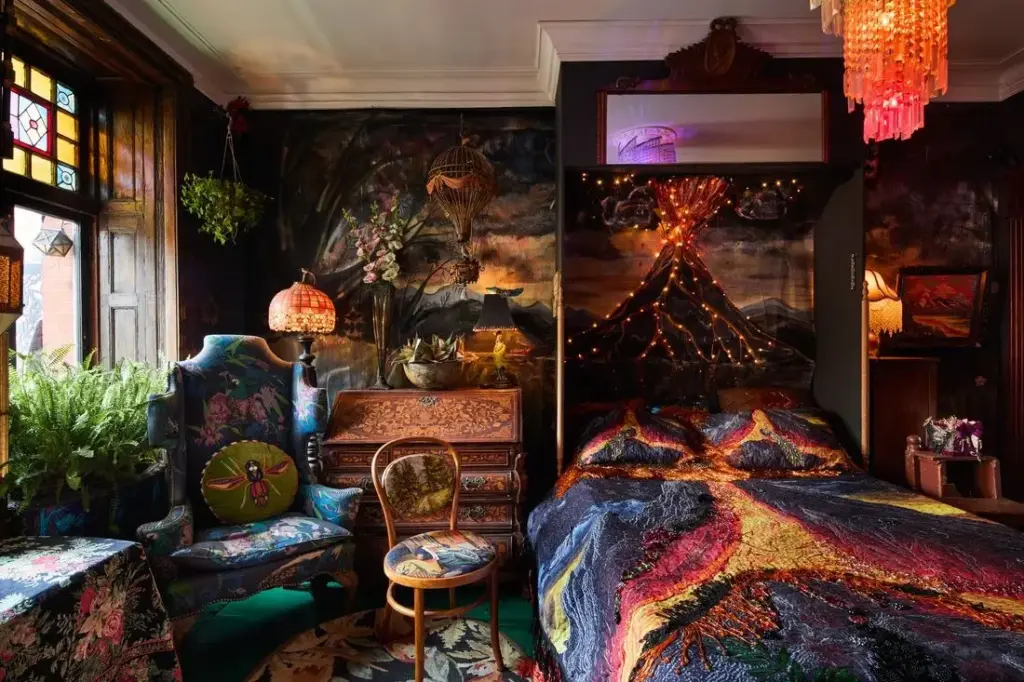
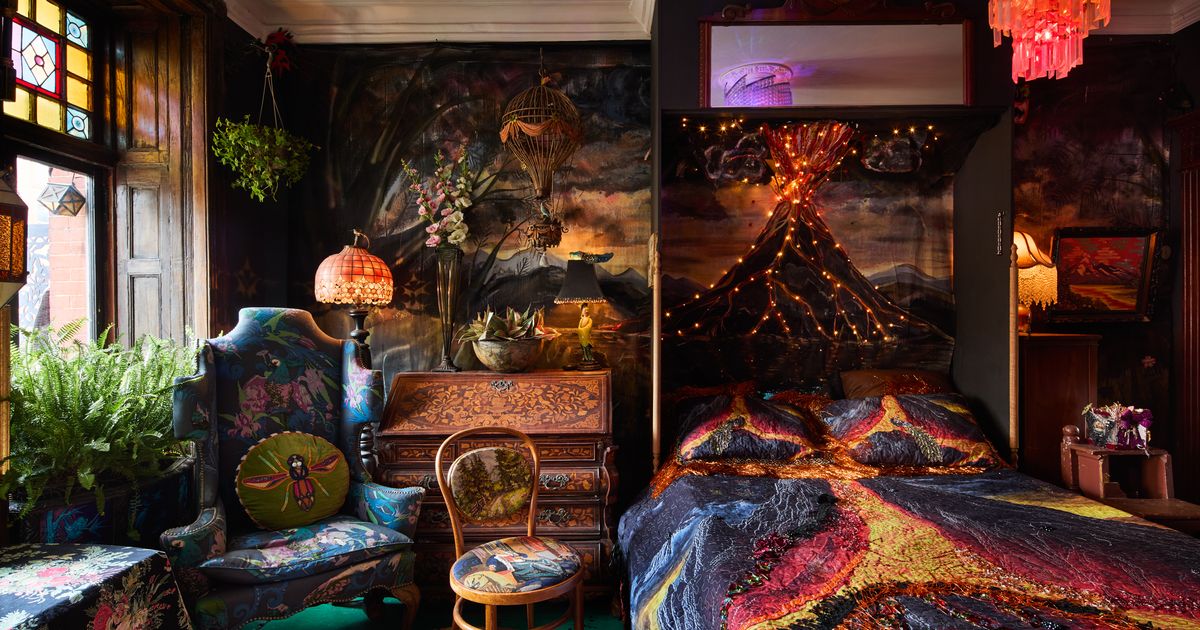
Every corner of Willis’s dual-studio domain tells a distinct story. In the space he calls the Volcano Room, the wall behind his Murphy bed features a striking mural that Willis painted himself for an Off-Broadway show about the Peruvian singer Yma Sumac. He also designed the custom bedspread that anchors the room. A café chair positioned nearby was gifted to him by actress Rebecca Romijn, who pursues a unique hobby of finding vintage embroideries on eBay and applying them to furniture. The room’s inlaid desk, meanwhile, was salvaged from the City Opera Thrift Shop.

Nearby, a traditional fireplace serves as the focal point for another curated vignette. The lacquer chest positioned by the hearth hails from Japan, where Willis’s family lived for several years during the 1970s. The surrounding portraits, originally sourced from flea markets and antique shops, received a custom drag makeover directly from Willis’s hands. He customized a vintage chandelier by outfitting it with colored lightbulbs, while a 1960s elephant statue that once belonged to his mother sits comfortably alongside the building’s original mirror.
The apartment’s bathroom is similarly theatrical, featuring a door frame constructed from a repurposed Victorian wall unit. Artwork sourced from the Chelsea Flea hangs above, while the bedspread trim and oversized tassels were procured from Hai Trim & Feathers in Manhattan’s Garment District. "It’s a fantasyland inside," Willis says of the immersive environment he has built.
In the primary lounging area, a vintage sofa tells a tale of preservation. "This sofa was covered in plastic," Willis recalls. "When I took it off, I knew some old lady in heaven was having a fit. It felt almost sacrilegious to remove it." A marble-top coffee table pulled from Goodwill sits beside lamps and a chaise lounge acquired through eBay. The eclectic arrangement has prompted more than one visitor to remark on the space’s intellectual atmosphere. "Someone said, ‘You know your apartment looks like Freud’s study?’ And I thought, Is that bad?"
Another area of the home functions as a private shrine. Willis points to a recent portrait, finished just months prior, as his newest artistic creation, noting that he has been actively pitching Dollywood on a future fountain design project. The trompe-l’oeil-painted mantelpiece was rescued from a thrift store, while the porcelain faces embedded in the surround came from the Chelsea Flea. A decorative screen purchased on eBay and a side chair found on Facebook Marketplace complete the vignette.
In the bedroom, the walls and lampshade are wrapped in fabric discovered in the Garment District. Demonstrating the resourceful, adaptive reuse that defines his entire design philosophy, Willis has repurposed an original building radiator to serve double duty as a bedside table, accompanied by a nude thrift-store painting gifted by a friend.
Ultimately, whether looking out from the historic balcony outside the former Janis Joplin apartment or moving between his two densely packed studios, Steve Willis remains a dedicated steward of a vanishing New York. Surrounded by the rescued relics of decades past, he continues to live inside the living history of the Hotel Chelsea, preserving the spirit of the artists and divas who walked its halls long before him.