For more than three decades, filmmaker and fountain-show producer Steve Willis has called the legendary Hotel Chelsea his home. Moving into the landmark building in 1994, Willis initially secured a one-bedroom apartment complete with a balcony and a working fireplace—a historic space famously once inhabited by rock icon Janis Joplin. Decades later, the filmmaker still retains physical fragments of Joplin’s tenure there, including her personal soap dish and toothbrush holder.
The echoes of the building’s musical past run deep within these walls. "Patti Smith told me she was in this room when Kris Kristofferson sang ‘Me and Bobby McGee’ to Janis for the first time," Willis recalls. As a creative who has directed music videos for celebrated artists such as Patti LaBelle and Mary J. Blige, and who now designs elaborate, large-scale water features for destinations like the Bellagio in Las Vegas—a project he documented in the film Wet Dreams, co-created with actress Rebecca Romijn—Willis feels a profound connection to the artistic lineage of the property.
A Neighborhood in Transition
When Willis first arrived at the Hotel Chelsea over thirty years ago, the surrounding neighborhood bore little resemblance to the bustling, highly sought-after arts and nightlife district it is today. Back in the mid-1990s, the property and its immediate environs were rough around the edges.
"Chelsea was sort of a no-man’s-land. It wasn’t the gay neighborhood yet. There was almost nothing. It had Rawhide," Willis says, referencing the long-shuttered local dive bar. "When I moved in, there was bulletproof glass at the front desk and you had to get buzzed in."
Willis’s relocation to New York from Los Angeles was originally tied to his work producing the music video for Mariah Carey’s "Anytime You Need a Friend." During that production, Stanley Bard, the legendary longtime owner and manager of the property, suggested that Willis take a room in the building rather than paying standard hotel rates.
"He was sort of the casting director for the building," Willis remembers of Bard. "We were all invited to live here."
Renovating and Reclaiming History
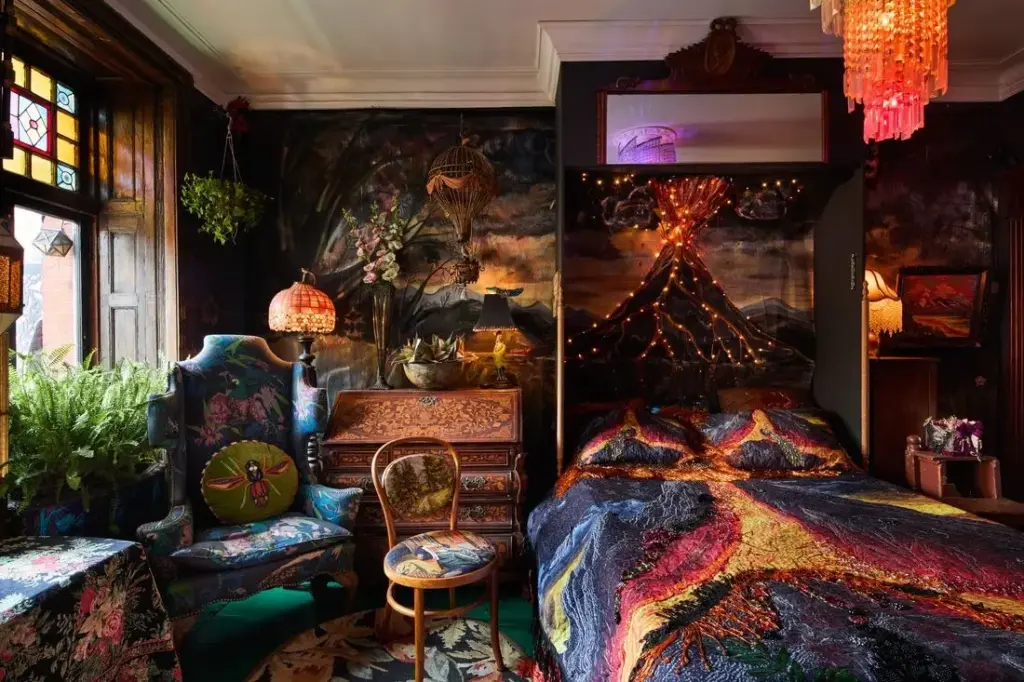
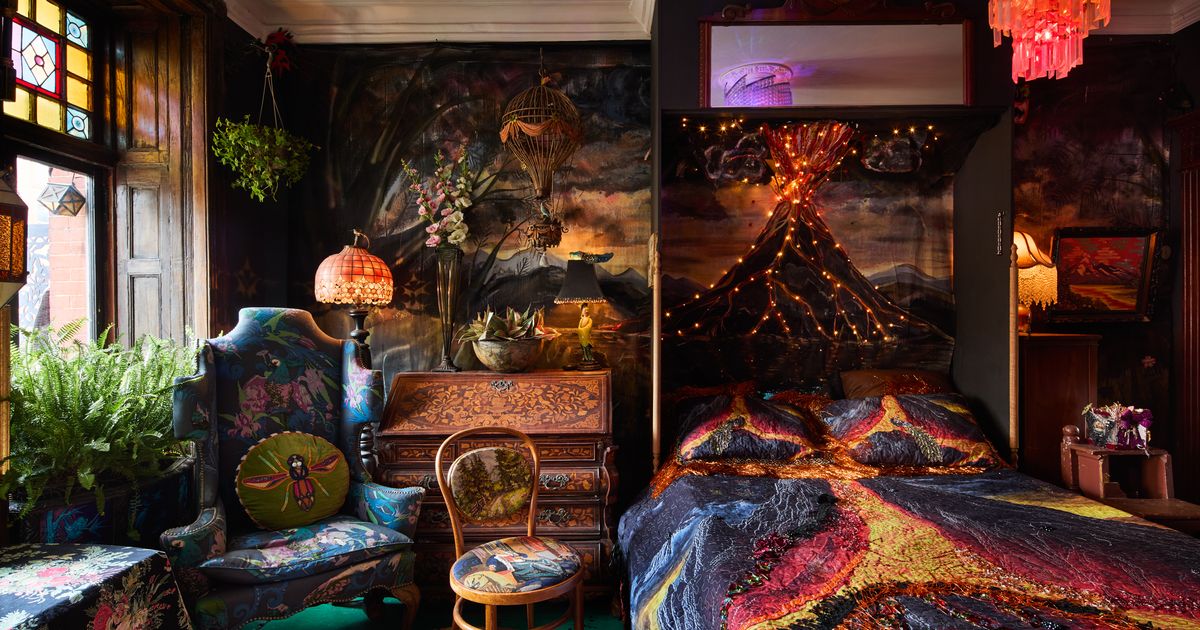
The initial apartment was far from glamorous upon arrival. It featured worn-down carpeting and layers of thick white paint masking the building’s original dark woodwork. Rather than gutting the historic character or modernizing it into a sterile contemporary space, Willis carefully stripped down the architectural elements by hand. He then began packing the residence with a dense accumulation of street finds, antique treasures sourced from the Chelsea Flea Market, and set pieces salvaged from his professional design work.
"The basement here also had furniture, and I could pilfer that," Willis notes, praising Bard’s notoriously relaxed approach to building management. "Stanley was really easygoing about stuff."
The footprint of his home expanded in 1996 when the studio apartment directly across the hall became vacant, prompting him to rent that space as well. Initially, he lined the walls with a patterned metallic wallpaper reminiscent of the 1960s, which he later replaced with authentic 19th-century French wallpaper discovered on eBay. True to form, he filled the secondary studio with an eclectic array of foraged goods, treating the interconnected rooms as a sprawling canvas for his collector’s eye.
A Pack Rat’s Archive
Describing himself as a dedicated pack rat and his family’s unofficial archivist, Willis admits that he holds onto nearly everything. Aside from a striking personal painting of Dolly Parton, virtually every piece of furniture, decor, and artwork in both apartments has a provenance rooted in history, thrift, or personal gifting.
"Well, the mattress, the sheets, and the towels," he clarifies regarding the few modern elements in his home.
The spaces are layered with personal and historical mementos. In the primary living area, centered around the original fireplace, sits a Japanese lacquer chest brought back from Japan, where Willis’s family lived during the 1970s. The room’s portraits, gathered from various flea markets and antique shops, received custom drag makeovers by Willis himself, illuminated by vintage chandeliers outfitted with colored lightbulbs. A 1960s elephant statue that once belonged to his mother sits comfortably among the curated clutter, alongside the apartment’s original architectural mirror.

Step into the bathroom, and the historical details continue: the door frame is constructed from a salvaged Victorian wall unit, while the overhead artwork hails from the Chelsea Flea. The bedspread features custom trim and oversized tassels sourced from Hai Trim & Feathers in the Garment District. "It’s a fantasyland inside," Willis says of the immersive aesthetic.
Even the foundational furniture carries a narrative. A prominent sofa, discovered covered tightly in its original protective plastic, was uncovered by Willis with a mixture of reverence and amusement. "When I took it off, I knew some old lady in heaven was having a fit. It felt almost sacrilegious to remove it," he says. Paired with a marble-top coffee table from Goodwill and lamps and a chaise from eBay, the room has drawn amusing comparisons from visitors. "Someone said, ‘You know your apartment looks like Freud’s study?’ And I thought, Is that bad?"
Ongoing Creative Pursuits
Willis continues to channel his artistic vision both inside his dual studios and in his professional endeavors. In September, he completed a new portrait, displayed as part of a home altar space featuring a trompe-l’œil-painted mantelpiece from a thrift store, porcelain faces sourced from the Chelsea Flea, and a screen found online. He is currently pitching Dollywood on a new fountain design project, bridging his theatrical background with large-scale public art.
Whether he is repurposing an original radiator as a makeshift bedside table, displaying nude thrift-store paintings gifted by friends, or stepping out onto the wrought-iron balcony where Janis Joplin once took in the New York air, Steve Willis remains a dedicated custodian of the Hotel Chelsea’s bohemian spirit, living entirely surrounded by the memories of the cultural icons who walked its halls before him.